Instruments by Science Group
 Macromolecular
 Soft Condensed
  Imaging and
 Biological
 Magnetic
 Structures and
 Crystallography
  Spectroscopy
 I14 Contact
I14 Control room:
Tel: +44 (0) 1235 778570
Principal Beamline Scientist:
Majid Kazemian
Email: [email protected]
Tel: +44 (0) 1235 778222
Science Group Leader
Julia Parker
Email: [email protected]
Tel: +44 (0)1235 778924
I14 Hard X-ray Nanoprobe
Status: Operational
Beamsize: 50nm x 50nm
Energy: 5 - 20 keV
Energy: 5 - 20 keV
What it tells you: how your sample changes over time
All of the techniques we offer can apply to our in situ cells, which can do gas/liquid under flow or static, with optional heating and biasing. For more information visit our ‘in-situ’ page, which describes the holders the beamline offers. In addition, we can accommodate bespoke holders.
In addition, we have experience assisting previous users in developing and manufacturing custom electrochemistry in operando cells. Currently, there are a few models available at the beamline (see image below), but we are flexible enough to adapt to your sample and instrumental needs. Furthermore, I14 owns two different pieces of equipment for providing different potentials: Ivium OctoStat (https://www.ivium.com/product/octostat200/) and a Bio-potentiostat (https://www.stinstruments.com/electrochemistry/potentiostat-galvanostat-eis/sp-200-potentiostat/). Please approach a member of the I14 team to discuss the operational details. Miguel Gomez Gonzalez will be pleased to hear from you to discuss electrochmistry experiments.
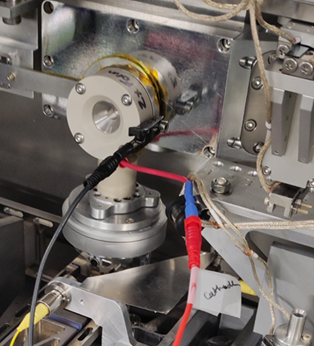
Based on the original design published in Borkiewicz et al. (2012) Jornal of Applied Crystallography 45, 6, 1261–1269
(https://journals.iucr.org/paper?S0021889812042720).
Things to consider:
Sample preparation – You will need to apply your sample to a specific chip depending on which holder you choose. The size is limited to the space between the chips (approx. 2-8 microns).
Timescale – The timescale of change needs to correspond with our mapping times (e.g. too quick and you will miss it, too slow and you may run out of beamtime).
Testing – A certain amount of offline testing is usually beneficial to make an experiment successful.
Beam related effects – Some reactions can be induced by the X-ray beam
More info: https://doi.org/10.1080/09603409.2023.2213579.

Diamond Light Source is the UK's national synchrotron science facility, located at the Harwell Science and Innovation Campus in Oxfordshire.
Diamond Light Source Ltd
Diamond House
Harwell Science & Innovation Campus
Didcot
Oxfordshire
OX11 0DE
Copyright © Diamond Light Source. Diamond Light Source® and the Diamond logo are registered trademarks of Diamond Light Source Ltd
Registered in England and Wales at Diamond House, Harwell Science and Innovation Campus, Didcot, Oxfordshire, OX11 0DE, United Kingdom. Company number: 4375679. VAT number: 287 461 957. Economic Operators Registration and Identification (EORI) number: GB287461957003.