Instruments by Science Group
 Macromolecular
 Soft Condensed
  Imaging and
 Biological
 Magnetic
 Structures and
 Crystallography
  Spectroscopy
 I14 Contact
I14 Control room:
Tel: +44 (0) 1235 778570
Principal Beamline Scientist:
Majid Kazemian
Email: [email protected]
Tel: +44 (0) 1235 778222
Science Group Leader
Julia Parker
Email: [email protected]
Tel: +44 (0)1235 778924
I14 Hard X-ray Nanoprobe
Status: Operational
Beamsize: 50nm x 50nm
Energy: 5 - 20 keV
Energy: 5 - 20 keV
Performs Spectromicroscopy (XANES and EXAFS) experiments in a fraction of the standard time with significantly reduced x-ray dose. This page provides information on the sparse sampling patterns and completion of the sparse data. For details on the physics and analysis of XANES and EXAFS experiments, see Beamline techniques – XANES and Beamline techniques - EXAFS.
Spectromicroscopy experiments are often restricted by long acquisition times and high X-ray doses, especially for in-situ experiments and biological samples. Fortunately, the datasets formed by XANES and EXAFS experiments are inherently structured, and by exploiting this structure we can obtain near identical results from only a fraction of the total measurements.
Following experiments, the collection of XRF images are stacked into 3D datasets, with axes representing the incident X-ray energy and the two spatial dimensions. The signal obtained for each pixel is simply a linear combination of the signals corresponding to each material present in that pixel. Since the number of distinct materials (in the set range of energies) is typically small relative to the total number of pixels measured across, the matrix formed by flattening the 3D data set (by vectorising each image) is low rank, or approximately low rank when considering signal noise. Essentially, this means that every column in the matrix is some combination of only a small number of components.
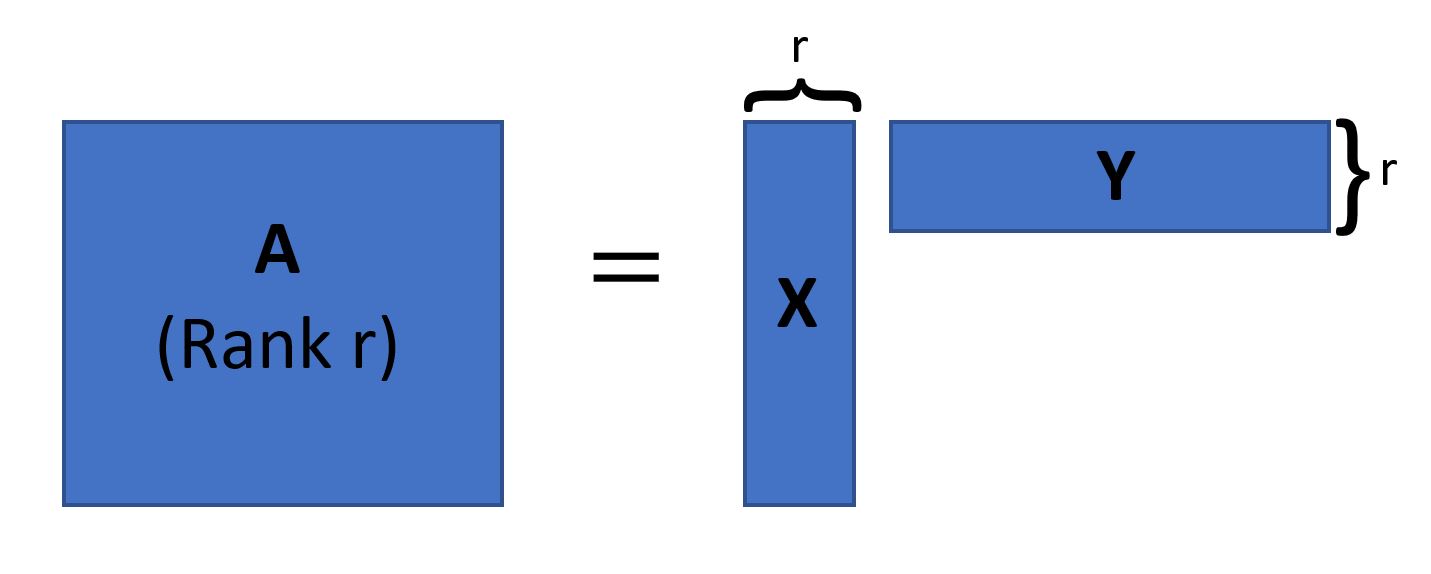
- Illustration of the (low) rank-r decomposition of a matrix.
The field of Low Rank Matrix Completion has demonstrated that low rank matrices can be accurately recovered from only a small number of entries. At I14 we use the LoopedASD algorithm, part of the ASD family of completion algorithms to recover full XANES and EXAFS datasets from only a small number of measurements.
ASD is an iterative algorithm that imposes a rank-r structure by factoring the iterates into two matrices. As seen in Figure 1, the first matrix has r columns and the second has r rows, which ensures the product also has a maximum rank r. ASD then fixes one factor and fits the other to the sparse data using gradient descent, with the factors alternating each iteration. LoopedASD repeatedly implements ASD with an increasing rank r, so that the complexity of the completion increases with each rank incremement. The key benefits of LoopedASD are an improvement in completion accuracy and the ability to automatically estimate the optimal rank. Using these algorithms, we can successfully produce near identical spectromicroscopy results from as little as 15% of the measurements (see Figure 2).
I14 typically measures samples using a raster scanning path: for each row in the region of interest, the sample is moved continuously through the beam while recording data. The beam resets its x-position after each row, and once all rows have been measured, the energy level is increased. To maximise efficiency, sparse scanning experiments still take measurements by rastering, however we now measure only a small number of randomly chosen rows at each energy level, passing over the rest.
When performing Sparse Scanning experiments at I14, users can set the undersampling parameter (percentage of measurements take) and the model used to produce the sampling pattern. At this point, a sparse scan pattern will be automatically generated and implemented on the machine. However, the scan path is fully customisable, and a specific path can be input if required.
Once the experiment has finished, the data will be completed automatically using our suite of completion algorithms. This will result in completed XANES datasets saved in both NeXus and Exchange file formats. Further analysis can then be performed as usual.
In the case of Sparse EXAFS experiments, there is a greater need for signal accuracy in the region of interest, especially for higher energies with the magnitude decreases significantly. To ensure the quality of the completion is sufficient in this region, there are several potential procedures currently in development for sparse EXAFS experiments. Examples involve a two-stage completion approach, in which the standard normalisation and scaling of the EXAFS signal is performed using the first completion, after which a second round of completion is applied to the restricted scaled data to improve accuracy.
Things to consider:
Size of Dataset – completion methods become more efficient for larger numbers of entries. If we are measuring at more pixels and energy levels, it is possible to set smaller undersampling ratios and still produce accurate results. Conversely, low rank completion is generally less efficient for smaller datasets, in which case higher undersampling ratio may be required. The default value is set to 20%, which tends to work well for datasets with 100 x 100 pixels and 150 energy levels.
Complexity/Number of materials – the more materials present within sample, the higher the completion rank r will need to be to capture the variation in the data, and the more known measurements are required to accurately recover the missing entries. On the other hand, if the sample is known to be relatively simple, it may be possible to reduce the undersampling ratio further.
Post processing – Our in-house python scripts will automatically stack, normalise, align and complete the data, and provide the results in standard file formats. Further analysis and interrogation can be performed as usual using MANTiS, DAWN, Athena etc. For more info, have a look at: I14 beamtime and access > After your beamtime > Data analysis and interpretation.
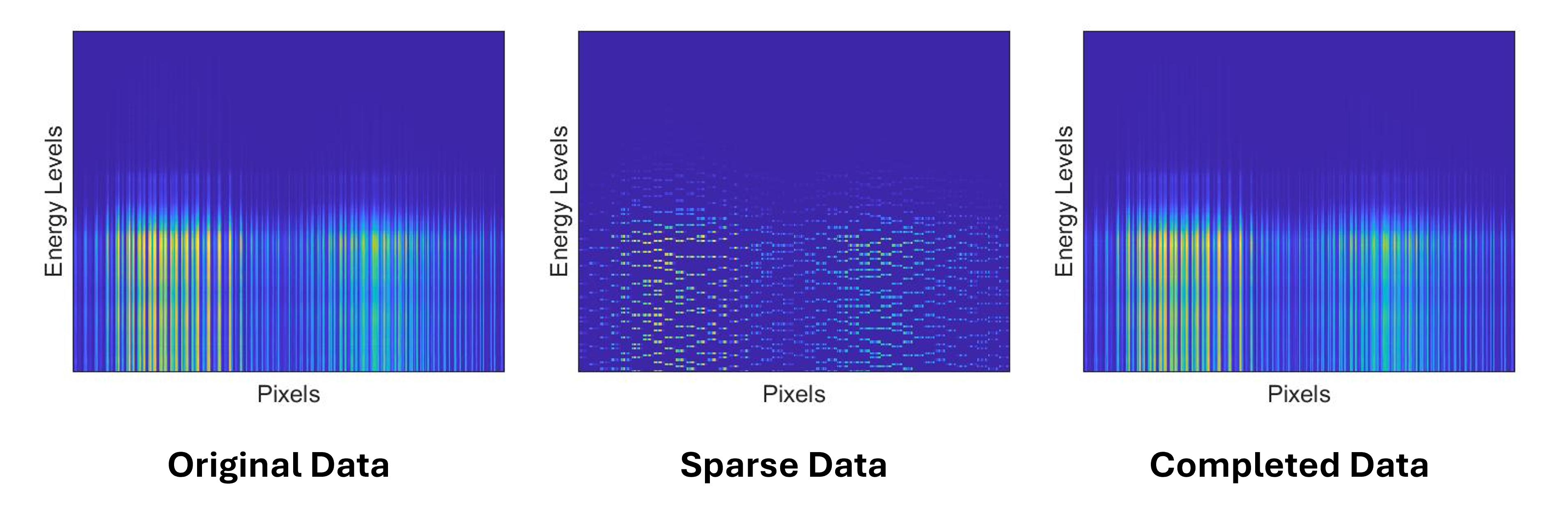
- Illustration of data completion on XANES data. A mixture of Fe oxides were drop cast onto a membrane, and measured across the Fe edge at 150 energies, and over 80 x 80 pixels. Left: the data set has been flattened into a matrix and presented as a scaled colour image (larger values are coloured yellow). Middle: the data was sampled so that only 20% of the measurements were kept. Right: the sparse data was completed using LoopedASD, with mean error of 3%.
To acknowledge the use of this technique, please copy:
This experiment was performed using I14’s Sparse XANES experimental procedure, in which measurements were taken using a robust raster sampling pattern to reduce the experimental times and X-ray dose. In this setting, measurements were taken at a few rows for each X-ray energy; the rows were selected pseudo-randomly so that measurements are spread evenly across all pixels. Sparse data sets were completed using the LoopedASD completion algorithm, with automatic rank detection.
And cite: https://opg.optica.org/oe/fulltext.cfm?uri=oe-30-24-43237&id=518958

Diamond Light Source is the UK's national synchrotron science facility, located at the Harwell Science and Innovation Campus in Oxfordshire.
Diamond Light Source Ltd
Diamond House
Harwell Science & Innovation Campus
Didcot
Oxfordshire
OX11 0DE
Copyright © Diamond Light Source. Diamond Light Source® and the Diamond logo are registered trademarks of Diamond Light Source Ltd
Registered in England and Wales at Diamond House, Harwell Science and Innovation Campus, Didcot, Oxfordshire, OX11 0DE, United Kingdom. Company number: 4375679. VAT number: 287 461 957. Economic Operators Registration and Identification (EORI) number: GB287461957003.