Instruments by Science Group
 Macromolecular
 Soft Condensed
  Imaging and
 Biological
 Magnetic
 Structures and
 Crystallography
  Spectroscopy
 I22 Contact
Beamline phone numbers:
+44 (0) 1235 77 8617
+44 (0) 1235 77 8713
Principal Beamline Scientist:
Nick Terrill
Tel: +44 (0) 1235 778047
E-mail: [email protected]
Science Group Leader
Robert Rambo
Email: [email protected]
Tel: +44 (0)1235 56 7675
USAXS
This project has developed a dedicated Bonse-Hart USAXS instrument for use on I22 and labSAXS. This drop-in instrument allows current users who require lower q than the extreme 9.7 m camera can provide an option to collect neccessary low q data. This project originated between Brian Pauw, Wim Bras and Nick Terrill to investigate the possibility of producing a cost effective, portable USAXS end station for use on lab sources and synchrotron beamlines, including DUBBLE at the ESRF and I22 at Diamond. Its design is an evolution of two preceding proof-of-principle laboratory variants of the instrument.
The instrument consists of two towers with Si 220 channel-cut crystals on top. In between the two towers there is a platform for mounting a sample or sample stages. The two crystals can be rotated very carefully in the incoming X-ray beam, and undergo an alignment routine. As the instrument is designed to be in the synchrotron hutch, extensive motorisation is in place for remote control.
The downstream tower is designed to move between two positions: the normal SAXS/WAXS measurement position (i.e. with the downstream crystal tower out of the way) and the USAXS position. This configuration allows for the consistent illumination of the sample for both SAXS/WAXS and USAXS measurements.
The USAXS position spans a Q range from 0.002 to 0.1 nm-1, whereas the normal SAXS instrument will provide a bit of overlap and cover the remaining range to higher Q. The central stage is ~150 mm wide to allow a range of sample stages to be mounted, with a total vertical travel of 100 mm and a total horizontal travel of 100 mm.

Tensor Tomography SAXS/WAXS setup
The project has constructed a motion tower specifically designed for tomographic measurements at I22. The setup includes two orthogonal motorised rotational stages and, in phase one, a manual goniometer assembled and aligned into the system allowing two-axes rotation of a sample and its positional adjustment into the beam. In phase two we want to replace the manual goniometer with a motorised version to allow automated sample changing utilizing the Automation Robot. Motorising the goniometer will ultimately allow us to perform SAXS Tomography experiments in an automated mode as part of Phase II of the Automated Sample Delivery System project for I22.
BCO upgrade
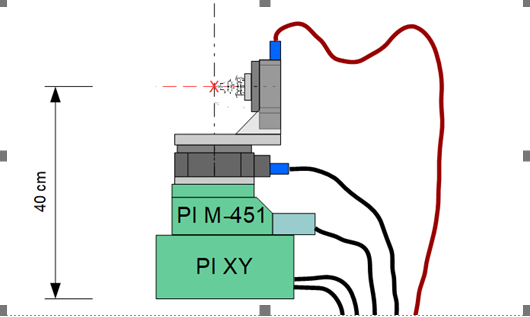
The beam conditioning section for I22, just upstream of the sample, had grown organically since first designed. The I22 BCO upgrade Project, planned to improve the performance and usability of the experimental hutch beamline components, to deliver quality, versatile beam to the sample area is now complete. The upgrade moved I22's microfocus capability from a drop-in endstation to a permanently installed solution that can be driven in and out of the beam dramatically reducing swap-over time between these two modes of operation (days to minutes) and improving data quality.
We have included a number of additional or improved components that will enhance the capability of this section of the beamline.
These include:
- A quad beam position monitor, which in combination with feedback to piezo positioners on the primary KB mirrors will ensure that the photon beam always enters the BCO section at the same position. This will alleviate a long standing problem on I22, namely that almost any motion of the beam caused by the machine or upstream optics has a definite detrimental effect on the instrument background, since collimation and guard slits must be so close to the primary beam to deliver good background for SAXS.
- Upgrade of the final gate valve on the beamline to include an X-ray transparent insert will allow some use of the beamline even if the vacuum in the final section is not good enough to be exposed to the machine vacuum (I22 has only the final beamline window separating machine vacuum from atmosphere during data collection). A beryllium window in this gate valve would allow alignments to proceed even if data collection could not.
- Creation of a secondary source point in the transfer tube in CIA2 should allow greater flexibility in selection of beam sizes. A combination of a variable number of CRLs in the beam, variable focus from the primary KB mirrors and tuning of the secondary source point size should allow us to offer beam sizes from millimetres down to microns, although not necessarily continuously variable. An optical concept design will form the first stage of this project.
- An in-vacuum sample shutter to protect samples from overexposure to the x-ray beam.
- A laser alignment system that is collinear with the X-ray beam for aligning samples and sample environments without exposure to X-rays.
- One of the major reasons for this upgrade is to provide a permanent installation for our microfocussing optics in the beamline which will reduce changeover time between modes from 2 days to, potentially, minutes. The exact solution will be identified during the concept design phase.
- Upgrading our collimation and guard slits (S4 and S5 in current designation) to a scatterless design has improved instrument background.
- An inline viewer, in concert with laser alignment, will improve sample alignment. This also allows optical images to be collected synchronously with X-ray data.
- A larger beamline window to accommodate the inline viewer.
- A protective shutter for the SiN beamline window, interlocked to the hutch door, will ameliorate most risk of accidental breakage.
Bimorph mirror upgrade
This project, to sequentially repolish the two bimorph mirrors of I22 while keeping the beamline operational with Diamond’s spare bimorph mirror, is now complete.
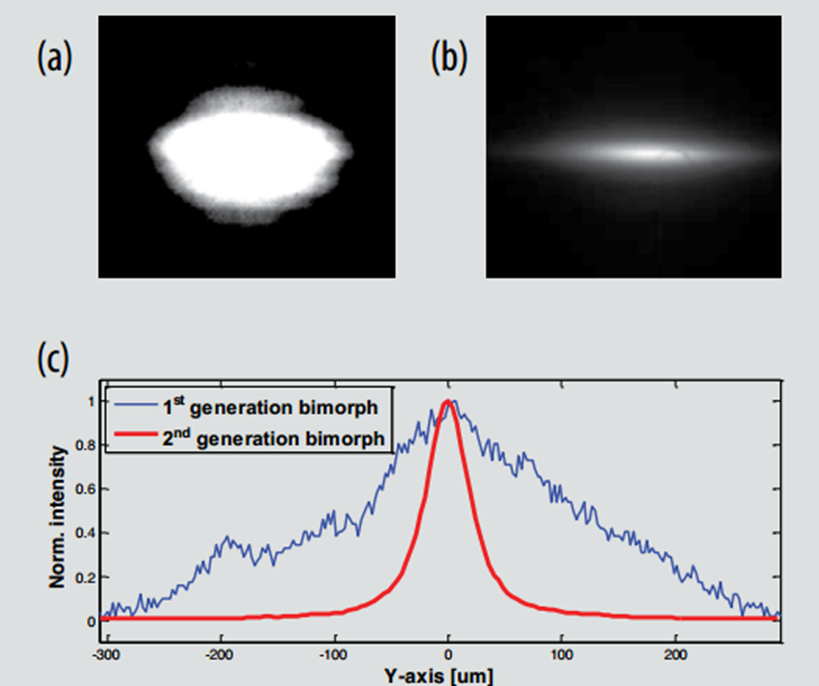
I22’s bimorph mirrors were in the first batch of bimorph mirrors received by Diamond. They appear to have suffered from surface damage at the piezo ceramic junctions during their early life cycle. As such it was initially impossible to fully optimise the performance of the I22 beamline to deliver the variable focus expected. It also prevented full exploitation of the Micro Focus end station on I22. Repolishing of the two I22 mirrors has seen significant improvements for I22 with this modest upgrade.
Both mirrors have now been repolished and have lead to significantly improved focusing capability. The results for the VFM are shown below
Development Lab
We have established a new Sample Environment Development lab in Lab 38. Supported by a Sample Environment Support Scientist the lab will be the first port of call for all users who wish to incorporate their sample environment into the data acquisition system on I22. This infrastructure capability includes a cut down mock-up of the essential beamline equipment including breadboards, motorised stages, geobricks and some of the data acquisition infrastructure as well as a dedicated, fully featured, GDA and EPICS environment.
We are finalising the infrastructure for the lab and would welcome ideas for potential consortia for collaboration on sample environment development. Please contact [email protected] or your local contact to discuss further.
GI-SAXS upgrade
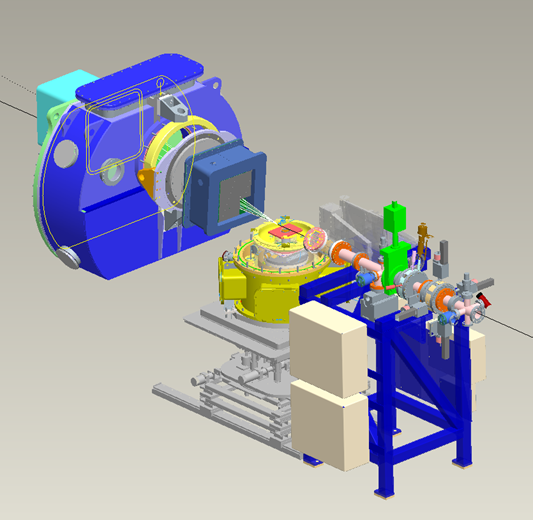
This upgrade enables I22 to work in grazing incidence mode for thin film materials and includes a hexapod sample platform and environmental chamber together with a remodelled SAXS detector platform with multiple beamstops for direct, reflected and specular beams.
Upgrade to WAXS detector
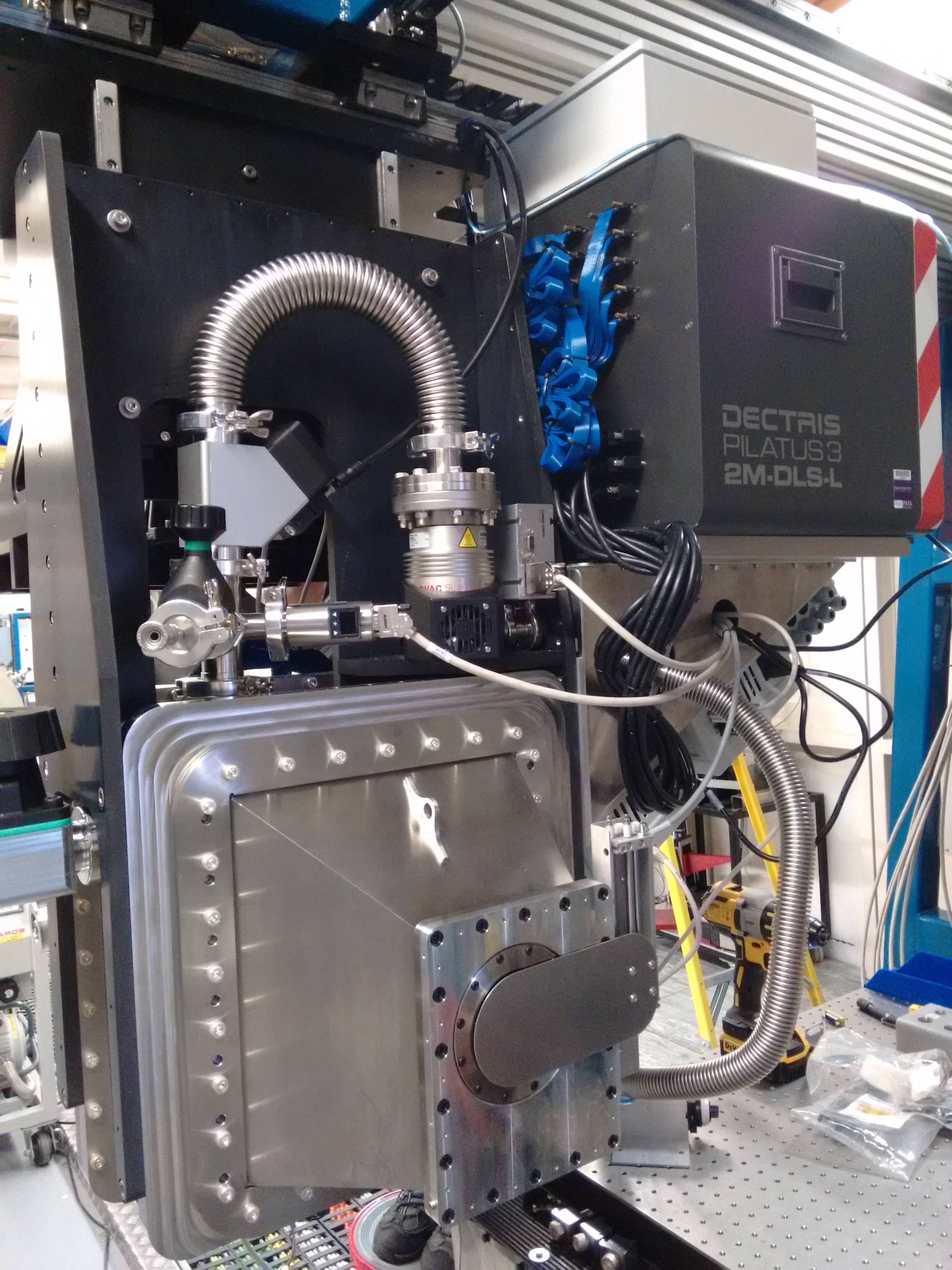
This project has now delivered a replacment Silicon pixel based system for the final gas based detector on I22, HOTWAXS. I22 has purchased a 21 module device in L shaped geometry with P3 technology from Dectris. This gives I22 some 2D capability in simultaneous 2D SAXS/WAXS measurements.
The project has included the purchase of the detector and infrastructural changes to I22 to accommodate the new in vacuum detector shape.

Diamond Light Source is the UK's national synchrotron science facility, located at the Harwell Science and Innovation Campus in Oxfordshire.
Diamond Light Source Ltd
Diamond House
Harwell Science & Innovation Campus
Didcot
Oxfordshire
OX11 0DE
Copyright © Diamond Light Source. Diamond Light Source® and the Diamond logo are registered trademarks of Diamond Light Source Ltd
Registered in England and Wales at Diamond House, Harwell Science and Innovation Campus, Didcot, Oxfordshire, OX11 0DE, United Kingdom. Company number: 4375679. VAT number: 287 461 957. Economic Operators Registration and Identification (EORI) number: GB287461957003.