 Macromolecular
 Soft Condensed
  Imaging and
 Biological
 Magnetic
 Structures and
 Crystallography
  Spectroscopy
 Multi-xia2 runs a xia2 processing job on the raw images from multiple data collections. Consistent with the auto processing on a single dataset, multi-xia2 runs in both 'dials' and '3dii' mode, meaning there will be separate jobs using the DIALS and XDS algorithms. A key consideration for Multi-Crystal Rotation data processing is ensuring the symmetry of all datasets are consistent. Multi-xia2 does this using the first dataset as a reference. Therefore, this pipeline is best suited to data collections performed on the same crystal, or large wedges from multiple crystals with high reflection overlap. It should not be used for many small wedges merged together as the lack of common reflections in such experiments complicates symmetry determination. For such cases, use xia2.multiplex.
Triggering multi-xia2
When several data collections are queued on the same sample using GDA, multi-xia2 is triggered. Examples of experiments that make use of multi-xia2 include multiple starting orientations, multi-wedged MAD, etc. However, if the sample is returned to after other data collections, it will not be automatically grouped. In this case, multi-crystal reprocessing can be triggered manually in ISPyB to group the new data with the previous group.
Finding multi-xia2 Processing
In ISPyB, datasets within collection groups are now combined within blue boxes. All the different pipelines that ran over all crystals are summarised here. To view individual crystals, click on the 'Group' box.
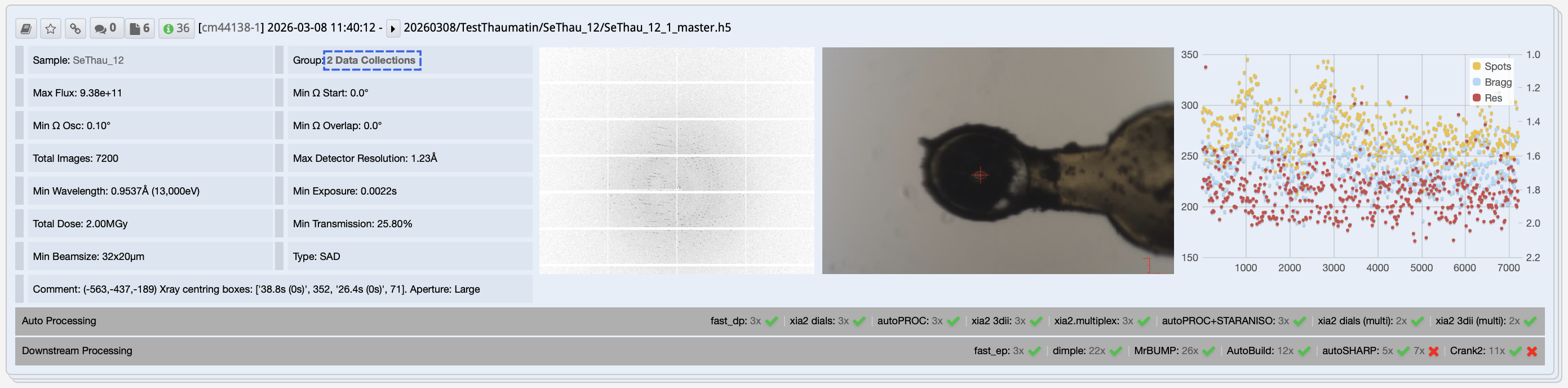
This will open the subset of data collections in this group. There is xia2 dials (multi) and xia2 3dii (multi) - these denote the multi-xia2 jobs run with DIALS and XDS respectively. The first data collection chronologically (bottom of the list) will not contain multi-xia2 jobs. Each dataset collected afterwards will contain multi-xia2 processing corresponding to the number of datasets available at the time. For example, the last dataset collected (first displayed on ISPyB) will have all datasets in the group included in the multi-xia2 job, the second last dataset (second displayed on ISPyB) collected will have all but one included, etc.
Citations and Documentation
If your publication uses data processed with the multi-xia2 pipeline, please cite the following references:
- Winter, Graeme. "xia2: an expert system for macromolecular crystallography data reduction." Applied Crystallography 43.1 (2010): 186-190.
- For multi-xia2 DIALS: Winter, Graeme, et al. "DIALS: implementation and evaluation of a new integration package." Biological Crystallography 74.2 (2018): 85-97.
- For multi-xia2 3dii: Kabsch, Wolfgang. "xds." Biological crystallography 66.2 (2010): 125-132.
If you deposit a structure in the PDB which is determined from data processed with the multi-xia2 pipeline, please make sure both xia2 and DIALS (for multi-xia2 DIALS) or XDS (multi-xia2 3dii) are included in the software category.
The documentation for xia2 can be found here: https://xia2.github.io
The documentation for DIALS can be found here: https://dials.github.io
The documentation for xds can be found here: https://xds.mr.mpg.de

Diamond Light Source is the UK's national synchrotron science facility, located at the Harwell Science and Innovation Campus in Oxfordshire.
Diamond Light Source Ltd
Diamond House
Harwell Science & Innovation Campus
Didcot
Oxfordshire
OX11 0DE
Copyright © Diamond Light Source. Diamond Light Source® and the Diamond logo are registered trademarks of Diamond Light Source Ltd
Registered in England and Wales at Diamond House, Harwell Science and Innovation Campus, Didcot, Oxfordshire, OX11 0DE, United Kingdom. Company number: 4375679. VAT number: 287 461 957. Economic Operators Registration and Identification (EORI) number: GB287461957003.