 Macromolecular
 Soft Condensed
  Imaging and
 Biological
 Magnetic
 Structures and
 Crystallography
  Spectroscopy
 -
Copy direct link to clipboard

If radiation damage is only present for part of the data (see Per-Image Analysis and Radiation Damage pages for identifying image ranges with radiation damage), then you can use ISPyB to reprocess the data sets. When doing so, you should only select the image ranges that are relatively damage free. This will remove the highly damaged frames from the data processing. Note that this may reduce completeness of your data and may need multiple crystals merged together.
-
Copy direct link to clipboard
This is done using the Multi Crystal button available in the reprocessing window in ISPyB. Instructions for doing so can be found on the ISPyB reprocessing page.
-
Copy direct link to clipboard
In most cases, this is because the necessary structural information has not been uploaded to ISPyB. This can be done while Registering a protein . If this is done after data collection, you can then retrigger downstream processing on ISPyB to obtain your results.
-
Copy direct link to clipboard
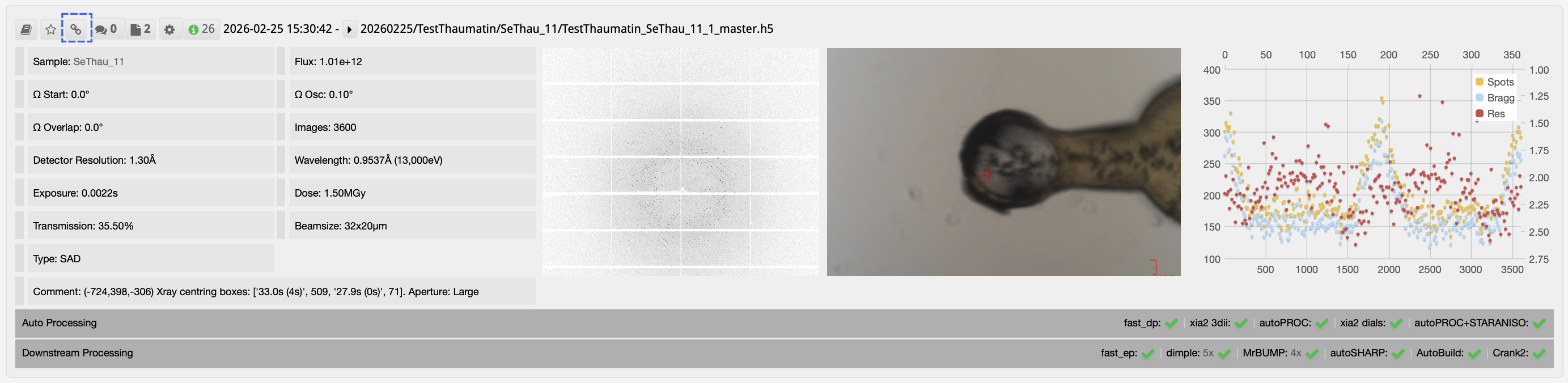
Users can send data processing support requests to [email protected]. However, it is requested that 'permalinks' are provided with all support requests so that the data in question can be quickly identified. To obtain the permalink for a given dataset, click the icon of a chain in the top left of your dataset. This will take you to a new page in ISPyB with only the dataset of interest. The URL of this page is unique to this dataset and providing this will be the fastest way to get specific help.

Diamond Light Source is the UK's national synchrotron science facility, located at the Harwell Science and Innovation Campus in Oxfordshire.
Diamond Light Source Ltd
Diamond House
Harwell Science & Innovation Campus
Didcot
Oxfordshire
OX11 0DE
Copyright © Diamond Light Source. Diamond Light Source® and the Diamond logo are registered trademarks of Diamond Light Source Ltd
Registered in England and Wales at Diamond House, Harwell Science and Innovation Campus, Didcot, Oxfordshire, OX11 0DE, United Kingdom. Company number: 4375679. VAT number: 287 461 957. Economic Operators Registration and Identification (EORI) number: GB287461957003.