 Macromolecular
 Soft Condensed
  Imaging and
 Biological
 Magnetic
 Structures and
 Crystallography
  Spectroscopy
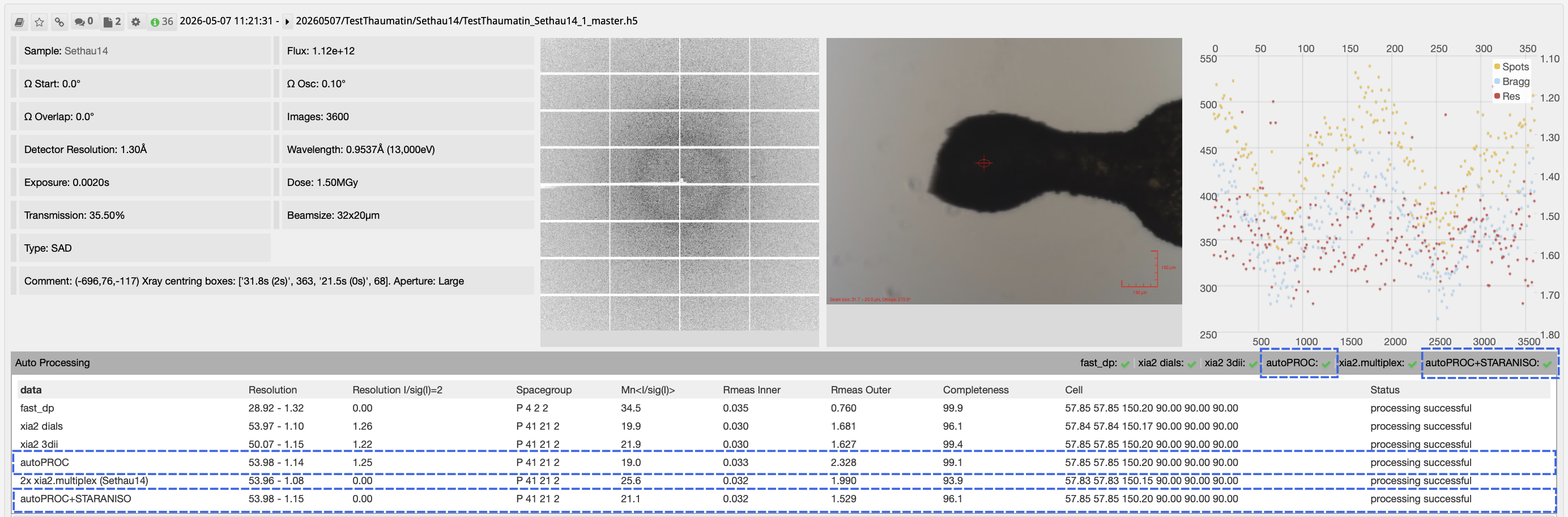
 autoPROC is an autoprocessing pipeline from Global Phasing. It combines several 3rd party programs (XDS, AIMLESS, XSCALE, POINTLESS, MOSFLM) with original tools to provide a complete data processing workflow.
Some datasets exhibit anisotropic diffraction, meaning that diffraction strength and resolution limit vary with direction in reciprocal space. In practice, this appears as higher-resolution and/or stronger diffraction along certain directions, and weaker, lower-resolution data along others.
Strong anisotropy can negatively affect merging statistics and map quality if treated as isotropic data (see here).
To address this, the program STARANISO, is run after autoPROC. STARANISO estimates the directional dependence of diffraction and applies anisotropic scaling and truncation. This can improve the overall quality of the processed data. Both the autoPROC processing results and the subsequent STARANISO processing are available as distinct tabs in ISPyB.
Citations and Documentation
Documentation for autoPROC can be found here: https://www.globalphasing.com/autoproc/
If your publication uses data processed with the autoPROC and STARANISO pipeline, please cite the following references:
- Vonrhein, C. "Data processing and analysis with the autoPROC toolbox" Acta Cryst. D67 (2011): 293-302.
- Vonrhein, C. "Advances in automated data analysis and processing within autoPROC, combined with improved characterisation, mitigation and visualisation of the anisotropy of diffraction limits using STARANISO" Acta Cryst. A74 (2018).
If you deposit a structure in the PDB which is determined from data processed with the autoPROC pipeline and the STARANISO analysis, please make sure both autoPROC and STARANISO are included in the software category.

Diamond Light Source is the UK's national synchrotron science facility, located at the Harwell Science and Innovation Campus in Oxfordshire.
Diamond Light Source Ltd
Diamond House
Harwell Science & Innovation Campus
Didcot
Oxfordshire
OX11 0DE
Copyright © Diamond Light Source. Diamond Light Source® and the Diamond logo are registered trademarks of Diamond Light Source Ltd
Registered in England and Wales at Diamond House, Harwell Science and Innovation Campus, Didcot, Oxfordshire, OX11 0DE, United Kingdom. Company number: 4375679. VAT number: 287 461 957. Economic Operators Registration and Identification (EORI) number: GB287461957003.