Instruments by Science Group
 Macromolecular
 Soft Condensed
  Imaging and
 Biological
 Magnetic
 Structures and
 Crystallography
  Spectroscopy
 I04 Contact
Beamline Phone Number:
+44 (0) 1235 778679
Principal Beamline Scientist:
Ralf Flaig
Tel: +44 (0) 1235 778412
E-mail: [email protected]
Science Group Leader
Dave Hall
Email: [email protected]
Tel: +44 (0) 1235 778926
I04 Microfocus MX
Status: Operational
Beamsize: 10 µm x 5 µm - 110 µm x 100 µm
Detector: Eiger2 XE 16M
Wavelength: 0.69 - 2.07 Å
Detector: Eiger2 XE 16M
Wavelength: 0.69 - 2.07 Å
Understanding Radiation Damage and Dose Limits at I04
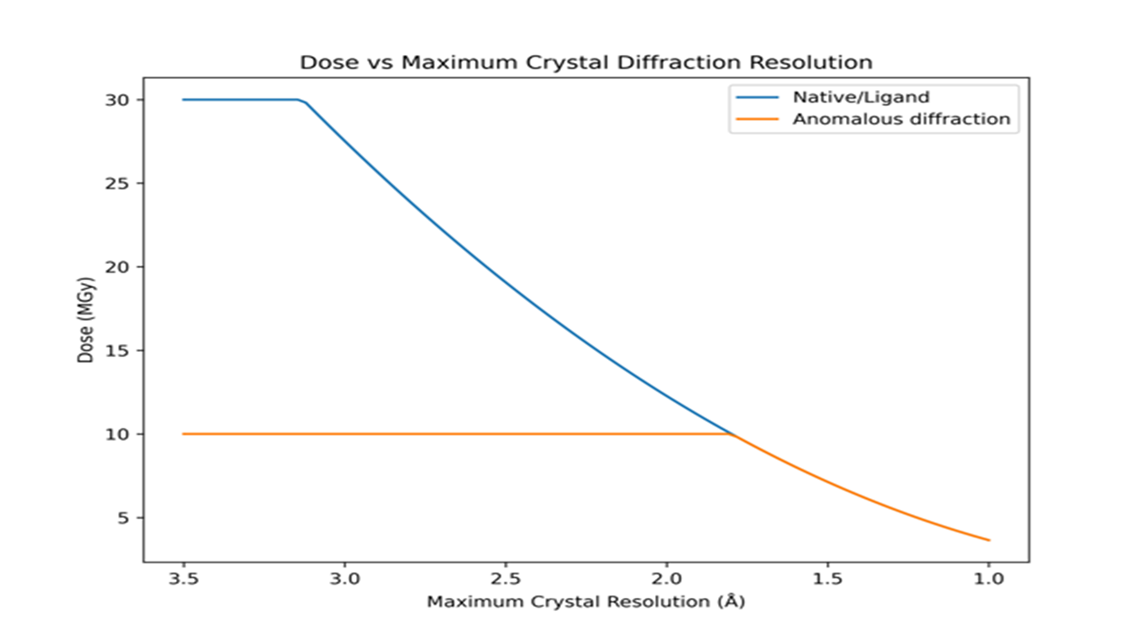
- Figure 1: Relationship between Dose & Diffraction Resolution
With advancements in technologies, such as brighter synchrotron sources and more sensitive detectors, the limitation in data collection has shifted from the capabilities of the instruments to the radiation damage of the sample. Radiation damage, caused by the absorption of X-ray photons by the crystal, is a major concern in macromolecular crystallography. The absorbed energy can lead to various deleterious effects, and such effects can manifest themselves in the diffraction data as reduced resolution, decreased intensity, and increased noise.
The amount of absorbed dose depends on several factors, including the composition and size of the crystal, as well as the properties of the incident X-ray beam, such as energy, flux, size, and shape.
The graph (Figure 1) provides a guide on the maximum dose to use for data collection as a function of the maximum diffraction resolution of the crystal. The maximum dose is lower for higher-resolution crystals and higher for lower-resolution crystals, as higher-resolution crystals are more susceptible to radiation damage. For native experiments (blue line), two sweeps of 360 degrees at different crystal orientations are recommended, with a maximum dose of 15 MGy per sweep. For ligands, a single 360-degree sweep with a maximum dose of 30 MGy is recommended. For anomalous diffraction experiments (orange line), three sweeps are recommended, with a maximum dose of 3.33 MGy per sweep. It is important to note that this graph provides a guide only, and the values do not need to be followed exactly. The actual dose used may vary depending on the specific experiment and the properties of the crystal.
Dose Awareness at I04
The Physical Basis for Dose-Aware Data Collection
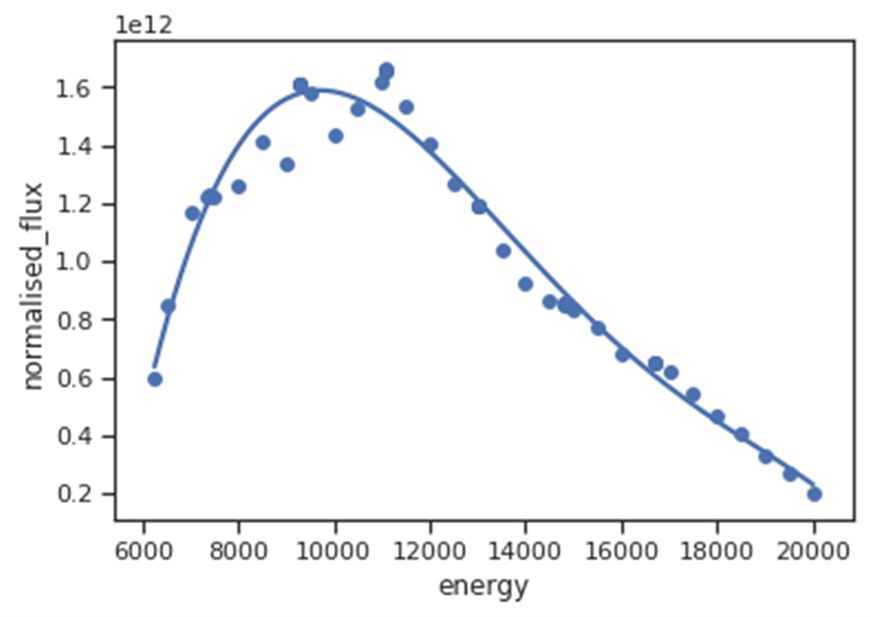
- Figure 3. Flux as a Function of Energy at Beamline i04
The "set target dose" mode is particularly useful when changing beam size or energy, as it ensures that the beamline operates at a fixed dose, regardless of the changes in beam parameters. This is important because the flux profile across the energy range is not linear or constant (Figure 3).
Figure 3 shows the variation of the flux (number of photons per second) as a function of energy (eV) at Diamond Light Source beamline I04. The data were collected for a fixed beam size of 20 microns vertical and normalised to a 300 mA synchrotron ring current. The dots represent the real measured flux, while the smooth line is to illustrate the difficulty of fitting the data with a simple algorithm. The non-linear and non-constant nature of the flux profile is evident, highlighting the importance of using dose-aware data collection strategies.
Maintaining Experimental Consistency Amidst Ring Current Fluctuations.
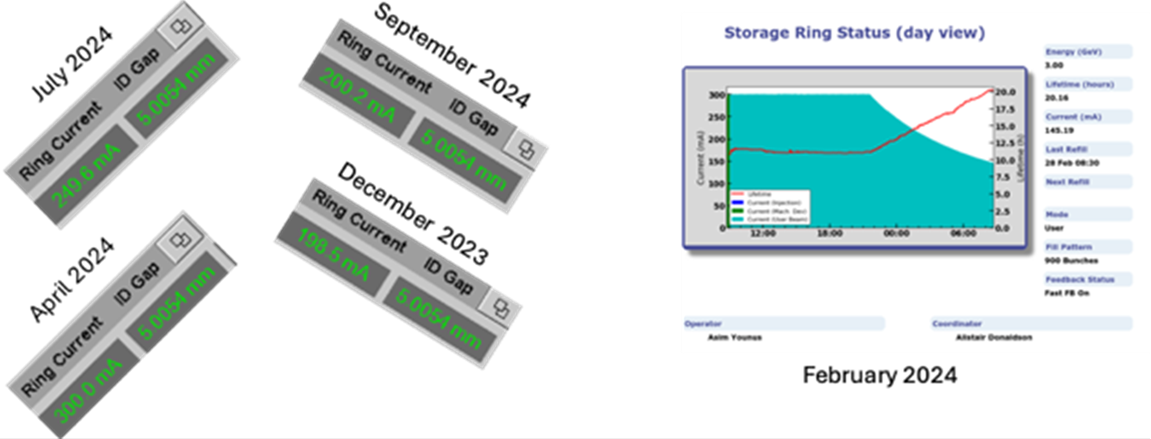
- Figure 4. Variation of Diamond Light Source Ring Current
Even for a particular energy, the flux can vary on different days due to variations in beamline commissioning and machine ring current (Figure 4). Working at a fixed dose and using the live flux at the time of the experiment allows for more rigorous comparisons between experiments on the same sample conducted months apart. This ensures that the diffraction power of the crystals remains consistent, which is not the case when working at fixed exposure.
The figure 4 shows the variation in the Diamond Light Source ring current over time. The left panels illustrate examples from December (2023), April, July, and September 2024, where the ring current varied significantly between and within synchrotron runs, often unnoticed by users. The right panel shows an example of a "decay mode" event, where the ring current steadily decreased over an 11-hour period due to the lack of electron re-injection. In such situations, the "Set Target Dose" mode is crucial for maintaining the consistency of experiments, as the exposure time will be automatically adjusted to compensate for the drop in flux.

Diamond Light Source is the UK's national synchrotron science facility, located at the Harwell Science and Innovation Campus in Oxfordshire.
Diamond Light Source Ltd
Diamond House
Harwell Science & Innovation Campus
Didcot
Oxfordshire
OX11 0DE
Copyright © Diamond Light Source. Diamond Light Source® and the Diamond logo are registered trademarks of Diamond Light Source Ltd
Registered in England and Wales at Diamond House, Harwell Science and Innovation Campus, Didcot, Oxfordshire, OX11 0DE, United Kingdom. Company number: 4375679. VAT number: 287 461 957. Economic Operators Registration and Identification (EORI) number: GB287461957003.