-
highlight
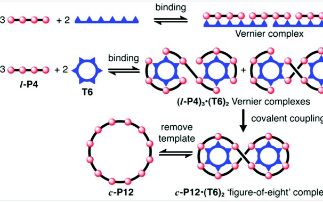
Templates are widely used to arrange molecular components so that they can be covalently linked to generate complex molecules that are not readily accessible by classical synthetic methods. Nature uses sophisticated templates such as the ribosome, whereas chemists use simple ions or small molecules. But as we tackle the synthesis of larger targets, we require larger templates — which themselves become synthetically challenging. Recently, we have shown that Vernier complexes can solve this ...
-
highlight
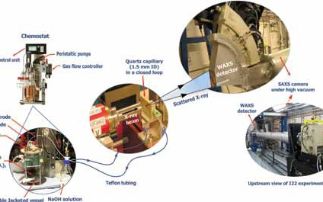
A combined time-resolved synchrotron-based Wide-Angle X-ray Scattering (WAXS) utilising a controlled chemical synthesis apparatus including electrochemical monitoring of the reaction was successfully developed to study the formation and transformation of the redox-reactive ‘green rust’ phases. Iron corrosion in some marine environments and waterlogged soils is known to involve the formation of dark olive-green compounds called green rusts (GR) which transform quickly into the usual brown ...
-
highlight
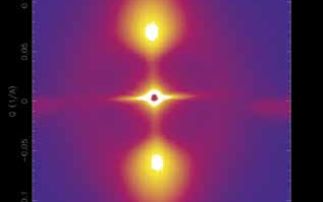
We show that small quantities of 1,3:2,4-di(4- chlorobenzylidene) sorbitol dispersed in poly(ε- caprolactone) provide a very effective self-assembling nanoscale framework which, with a flow field, yields extremely high levels of polymer crystal orientation. We have used the small-angle X-ray scattering beamline I22 at Diamond to follow in a time resolving manner the formation of the particles and the subsequent crystallisation of the polymer. During modest shear flow of the polymer melt, the ...
-
highlight

Why do some fossils preserve soft tissue in very fine detail while others most of the detail is lost? After death there is a race against time between soft tissue destruction and mineralisation of the carcass. In some cases soft tissue becomes mineralised in a state similar to the living animal; in others, only bone survives. One theory is that if the body is allowed to dehydrate, for example during a period of drought, and later rehydrated, for example during a flood, the soft tissue may be ...
-
highlight

Before we are born, each and every one of us is enveloped by membranes and fluid that ensure our safe development and protect us from the external environment at a time when we are at our most vulnerable. Foetal membranes are split into two layers and the protective sac, the amniotic membrane that surrounds the developing baby, is currently the focus
of studies being carried out by researchers from the University of Reading’s School of Pharmacy and the Institute for Women’s Health at ...
-
highlight
Scientists have been using both Diamond Light Source and the ISIS neutron source to get a better understanding of an important group of materials that can help target the delivery of drugs to the right place in the body. The materials, called Pluronics™, form water-based gels which can be customized to control their structure and how they flow, important considerations in controlling how and when the drugs become active.
-
highlight
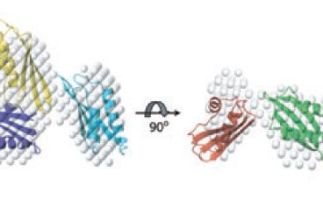
Membrane proteins are essential for many biological processes in organisms ranging from bacteria to humans. In the bacterium Escherichia coli (E. coli), a protein called YaeT selects and folds other proteins before inserting them into the outer membrane of the cell. Tim Knowles and his colleagues at the University of Birmingham have been using Diamond Light Source to study protein solution structures in order to understand the processes by which they are targeted in the cell, and how they ...
-
highlight
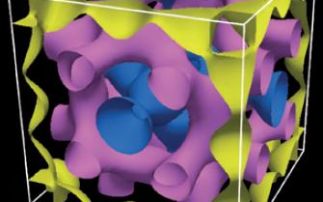
Liquid crystals are a state of matter that possesses some properties of liquids and some of solids. Their use in display screens is familiar, where the optical properties of the substance change in response to applied electric field. However, liquid crystals can form a wide range of very complex phases, and scientists have been using Diamond to study perhaps the most complex liquid crystal structure so far observed. This work has been published in the Journal of Materials Chemistry.
-
highlight

Metal oxyhydroxide nanoparticles form in many natural (e.g. rivers) and contaminated land environments. These mineral particles are an important part of the global iron cycle and, due to their high surface reactivity, adsorb large amounts of dissolved species onto their surfaces and into their structures during formation. These processes significantly influence the distribution, speciation and bioavailability of trace elements in many natural systems. This is particularly relevant in ...
-
highlight
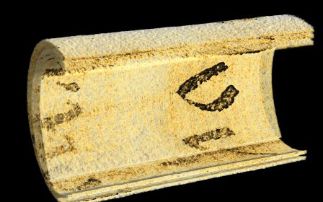
The first users on the I22 Non-Crystalline Diffraction beamline, Professor Tim Wess and his team at the University of Cardiff, have been able to analyse the state of the collagen within parchment and its degenerative change to gelatine. Understanding the deterioration process will allow them how to preserve parchment for future generations. In cases where precious parchments may be too damaged or at risk, they have developed techniques to image written work without unrolling the fragile ...
 Macromolecular
 Soft Condensed
  Imaging and
 Biological
 Magnetic
 Structures and
 Crystallography
  Spectroscopy