Instruments by Science Group
 Macromolecular
 Soft Condensed
  Imaging and
 Biological
 Magnetic
 Structures and
 Crystallography
  Spectroscopy
 I24 Contact
Beamline Phone Number:
+44 (0) 1235 778950
Principal Beamline Scientist:
Robin Owen
Tel: +44 (0) 1235 778522
E-mail: [email protected]
Science Group Leader
Dave Hall
Email: [email protected]
Tel: +44 (0) 1235 778926
I24 Microfocus MX
Status: Operational
Beamsize: 5x5 - 50x40 (variable aspect ratio)
Detector: Pilatus3 6M
Wavelength: 0.62Å - 1.77Å
Detector: Pilatus3 6M
Wavelength: 0.62Å - 1.77Å
New Jungfrau detector
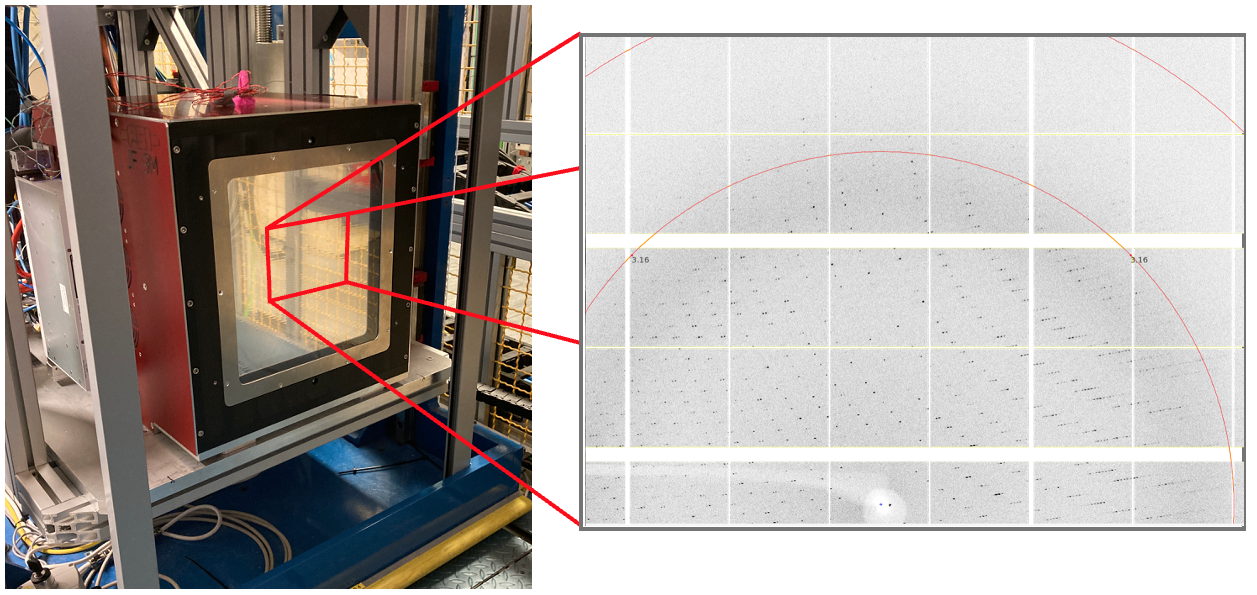
A Jungfrau 9M detector has arrived at I24 and excellent quality data already collected. For further information see the JF9M page. If you are interested in using the JF9M please contact beamline staff.
New Eiger Detector
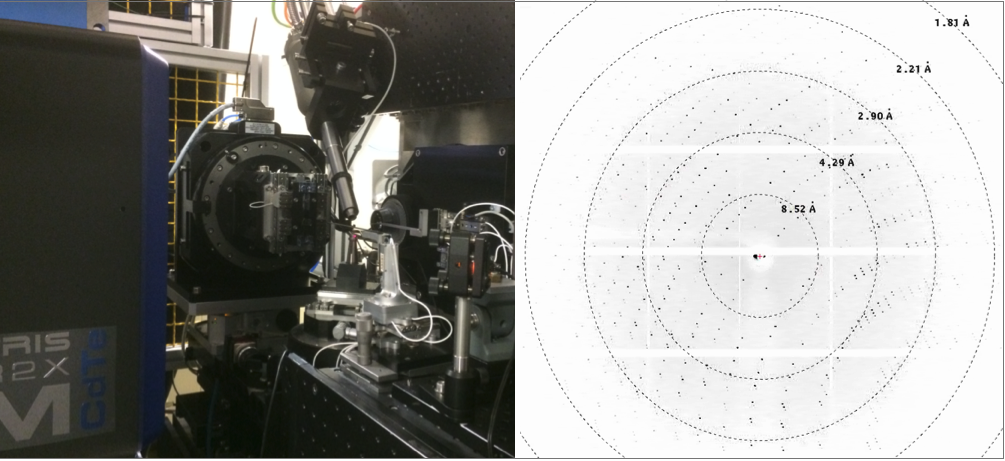
The CdTe Eiger2 9M is the work-horse detector at I24 it is optimised for high energy data collection (>17keV) and has been shown to give better diffraction for a given X ray dose into your sample. Particularly beneficial for small crystals.
For more info on see the eiger page here
Energy Range and beamline flux
The current accessible energy range is 7.9 -24 keV.
The high energy range will be extended as commissoning continues. If lower energies are a priority for you please let us know in advance of your beamtime: the eiger will work well but the resolution you can collect to may be limited due to the area of the detector
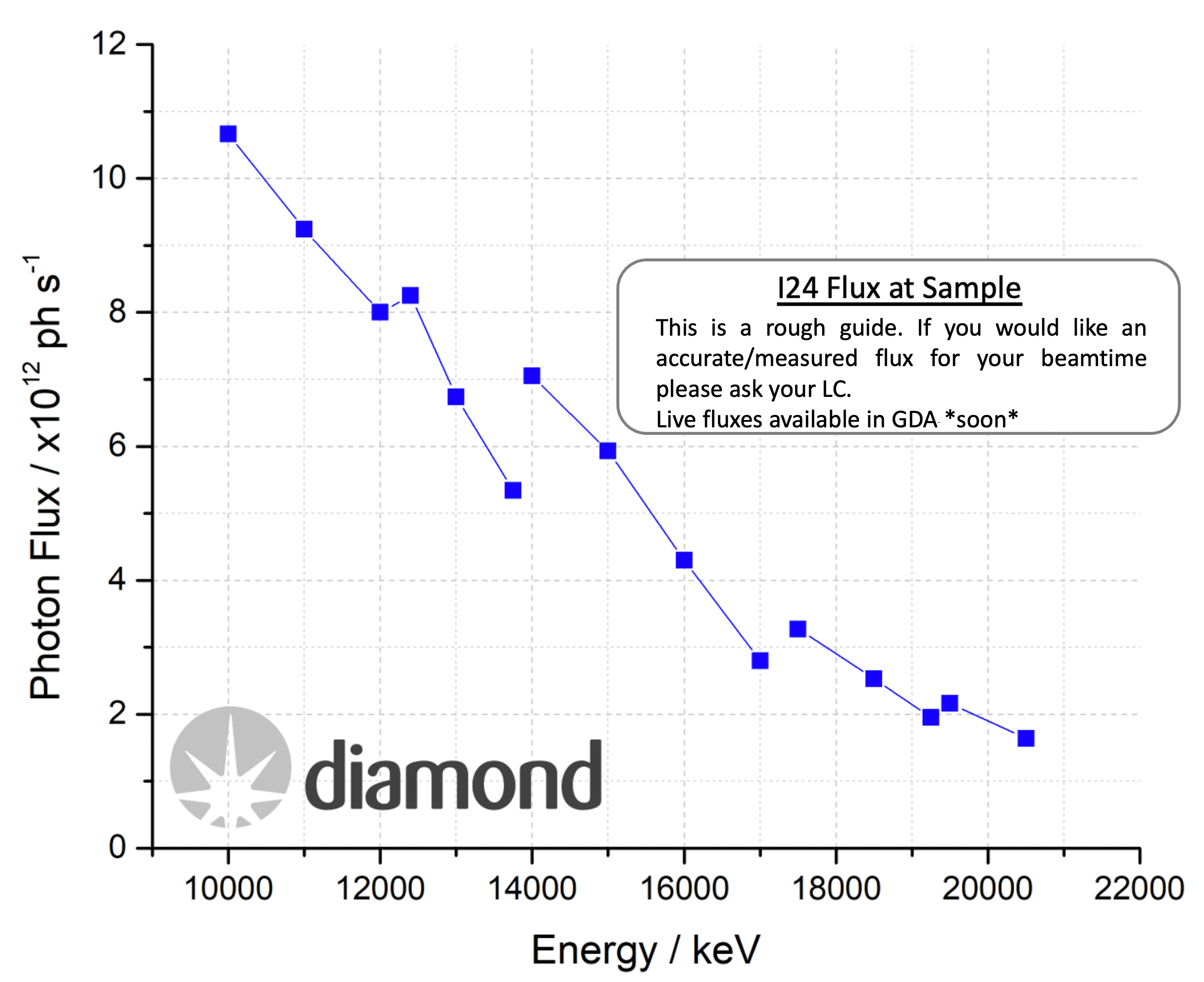
The beamline flux is shown in the image below. If you need a number ask your local contact. If you need an accurate flux please ask your local contact in advance of your beamtime.
Complementary data
UV-Vis data collection is available. While data collection works well, there are some constraints as the setup is currently incompatible with the sample changer. Please contact beamline staff to discuss.
Serial data collection
Serial data collection is routine. Our primary offering is fixed target SSX and we can also offer extruder-based data collection. Though other approaches are possible and we are always happy to discuss new ways of collecting data.
Dynamic SSX is possible using LEDs, the PORTO laser system or drop-on-chip.
For a very brief overview see the I24 serial webpage. Send us an email if you are interested in a serial experiment - we are happy to help with experiments from very first screening of crystals through to more complex time-resolved sessions using a laser or a drop-on-chip approach.
Multiplex data merging
Multiplex is a powerful tool to optimally merge wedges of data together. It can be run automatically or manually.
For a brief overview of how to run in manually see the multiplex news page.
For a brief overview of how it runs automatically see the manual
Fast grid scans
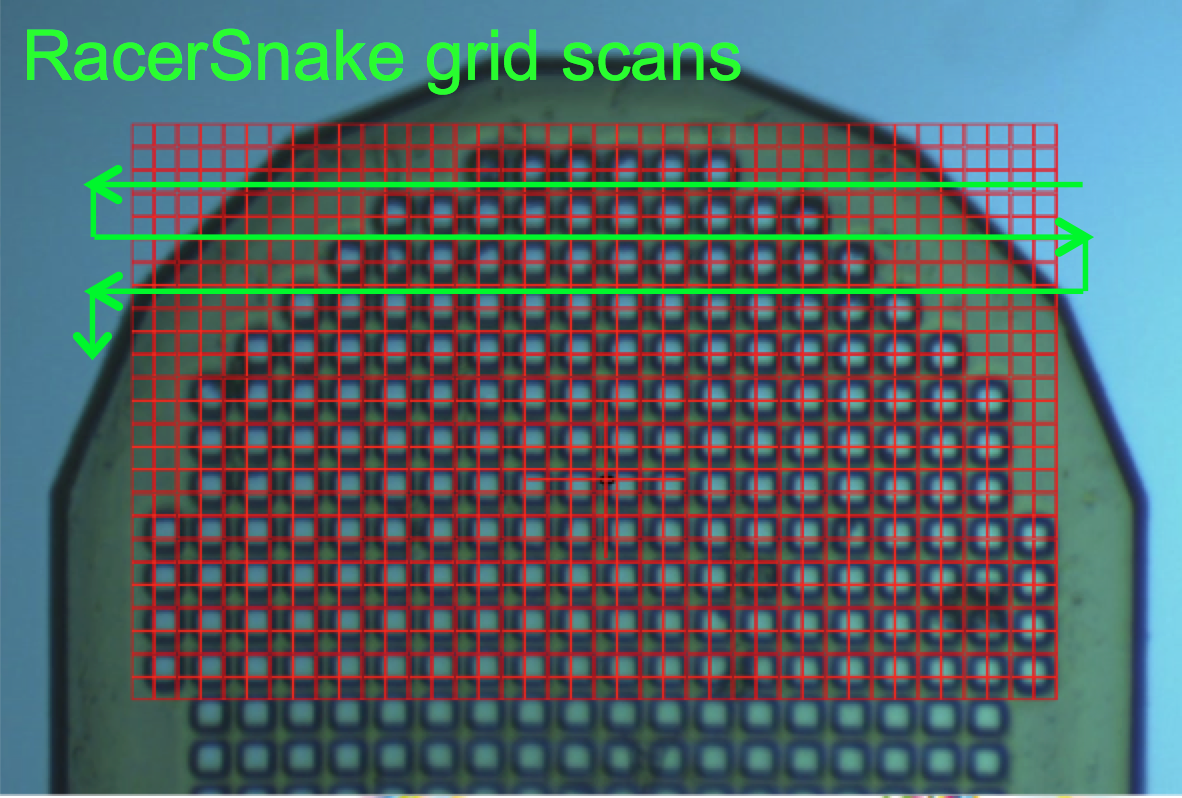
Grid scans have now been sped up by almost an order of magnitude using an approach developed from the one we use for fixed target serial crystallography Sherrell et al. J. Synch Rad (2015), Owen et al. Acta Cryst D (2017).
The grid shown to the right now takes ~40s compared to ~300s previously thanks to an optimised path being taken and a new mode of motion control. We expect further speed ups in the near future as we further develop the approach.
You can now queue hits from grid scans for data collection. For further information on this brief instructions see the grid scan page.
Fast grids are available on both goniometers.
Beamline overview - breakdown by area
| Component | Status | Notes |
|
Vertical Goniometer (RT and cryo) |
Operational |
Multi-axis goniometry is not available - resouces have been committed to other modes: For example, room temperature (RT) data collection is available with multiple mounting methods, and we can make the beamline dark for light-sensitive samples |
| X ray centring | Operational | Standard collections exploiting fast grids are routine but also queued data collections based on multiple hits are available. Further information here. |
| Line (helical) scans | Operational | Works well but if trying for first time, ask staff in advance for advice on optimal set-up |
| Tuneability | Operational | Full energy range accessible |
| Beamsizes available | Operational | Change beamsize via pull down menu as per normal |
| Fluorescence detector | Operational | |
| Sample changer | Operational | BART sample changer. Dewar capacity 37 pucks. |
| Automated data collectiion | Queued rather than UDC |
I24 is not optimised as a high-throughput screening beamline, however it is quite possible to automate a large number of samples to be collected under a set recipe. Contact staff for advice if unsure. But please consider coming to the beamline for data collection, especially for day shifts and/or if you have a challenging project. We're here to advise you on exploiting all available tools for your experiment. |
| Serial data collection | Operational |
Fixed target and LCP extruder experiments available. An overview can be found here. We encourage you to contact beamline staff to discuss potential experiments and give you examples of recent successes. |

Diamond Light Source is the UK's national synchrotron science facility, located at the Harwell Science and Innovation Campus in Oxfordshire.
Diamond Light Source Ltd
Diamond House
Harwell Science & Innovation Campus
Didcot
Oxfordshire
OX11 0DE
Copyright © Diamond Light Source. Diamond Light Source® and the Diamond logo are registered trademarks of Diamond Light Source Ltd
Registered in England and Wales at Diamond House, Harwell Science and Innovation Campus, Didcot, Oxfordshire, OX11 0DE, United Kingdom. Company number: 4375679. VAT number: 287 461 957. Economic Operators Registration and Identification (EORI) number: GB287461957003.