
• Diamond Home page
  • About
  • For Users
  • Public
  • Industry
  • Instruments
  • Careers
  • More Show more menu items
Search

About

  • About Diamond
  • About Synchrotrons
  • News and Features
  • Events
  • Contact Us
  • FAQ

For Users

  • Apply for beamtime
  • User guide
  • Diamond Users Commitee
  • FAQ
  • User Administration System
  • iSpyB

Industry

  • Techniques Available
  • Industry Research
  • Industry Case Studies
  • News
  • Meet the Industry Team

Science

  • Research
  • Computing
  • The Machine
  • Publications
  • Research Expertise
  • Membrane Protein Laboratory
  • Additional Facilities
  • Publications Database

Instruments

  • Biological Cryo-Imaging
  • Crystallography
  • Imaging and Microscopy
  • Macromolecular Crystallography
  • Magnetic Materials
  • Soft Condensed Matter
  • Spectroscopy
  • Structures and Surfaces

Diamond-II

  • Science
  • Machine
  • Beamlines
  • Software, Control and Computing
  • Infrastructure

Public

  • Public open days
  • School visits
  • Partner with Diamond
  • Explore Diamond

Procurement

  • Non-OJEU Tender Notices
  • OJEU PINs
  • OJEU Tender Notices
  • Registration Form

Careers

  • Vacancies
  • Info for applicants
  • Company Benefits
  • Apprenticeships
  • PhD Studentships
  • Work Placement

Main Content

Macromolecular Crystallography
Sub-navigation
  • MX
  • I03
  • I04
  • I04-1
  • I23
  • I24
  • VMXi
  • VMXm
  • HeXI
  • XFEL-HUB
  • XChem
  • MPL
  • Crystallisation Facility
  • MX Data Analysis
  • Staff Research
  • Contacts

In This Section

Sub Navigation
  • MX Responsive Beamtime Guide
  • Manual
    • Preparing for Beamtime
    • ISPyB/SynchWeb
      • Select a Proposal
      • Add Lab Contact
      • Create a shipment
      • Registering a protein
      • Registering Samples
      • Assign Containers
      • Data Management
        • Time in Visit
        • Toolbar in ISPyB
        • Experiment Type Views
        • Sample View
        • Beamline Parameters
        • Viewing Diffraction Images
        • Photos of Crystals
        • Per Image Analysis Plot
        • Auto Processing Results
        • Phenix xtriage Results
        • Logs and Files
        • Downstream Processing Results
        • Data Quality Plots
        • Radiation Damage Plot
        • Reciprocal Space Viewer
        • Permalinks
        • AlphaFold: Downstream Processsing
      • Mobile Access
    • Sample Holders
    • Shipping Samples
    • Remote Access
    • Data Collection Software
    • Data Analysis
    • Data Backup
    • Webcams
    • Acknowledging MX beamlines
    • Introduction to Eiger2 X Detectors for MX at Diamond
    • Redhat user environment
  • Science Highlights
  • Useful Calculators
  • MX beamtime guide for COVID-19 work
  • MX Training
  • Getting Started at Diamond MX

Instruments by Science Group

Macromolecular
Crystallography
Soft Condensed
Matter
Imaging and
Microscopy
Biological
Cryo-Imaging
Magnetic
Materials
Structures and
Surfaces
Crystallography
Spectroscopy
  1. Instruments
  2. MX
  3. Common
  4. Manual
  5. ISPyB/SynchWeb
  6. Data Management
  7. Logs and Files

Logs and Files

For each autoprocessing pipeline the files generated are accessible via synchweb, under the "Logs & Files" button.
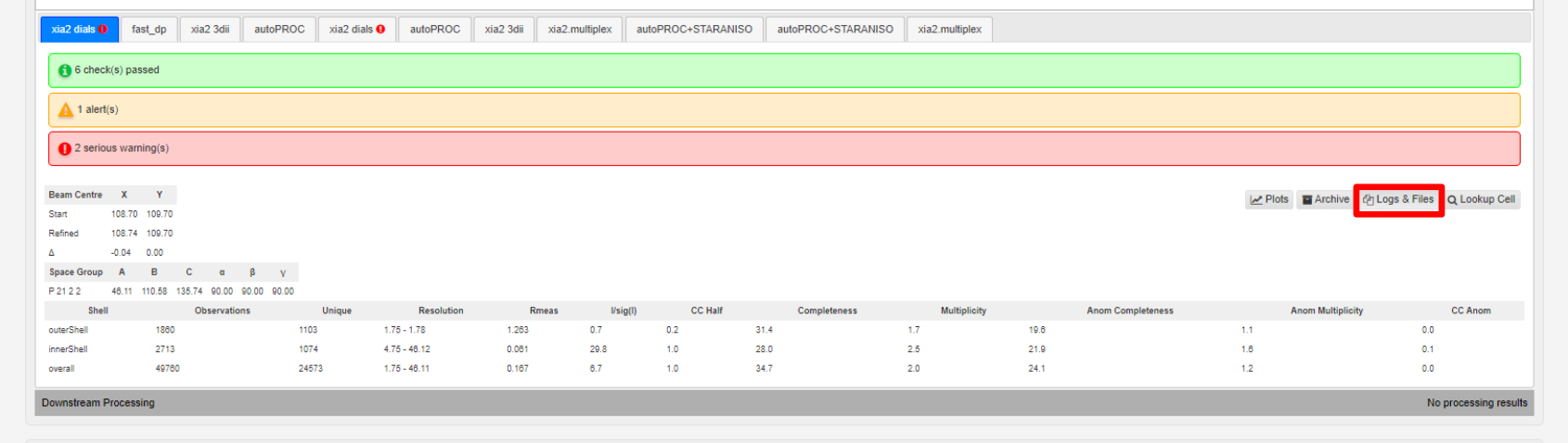
Logs and files button

Which opens a menu showing the possible logs and files that can be downloaded or viewed.
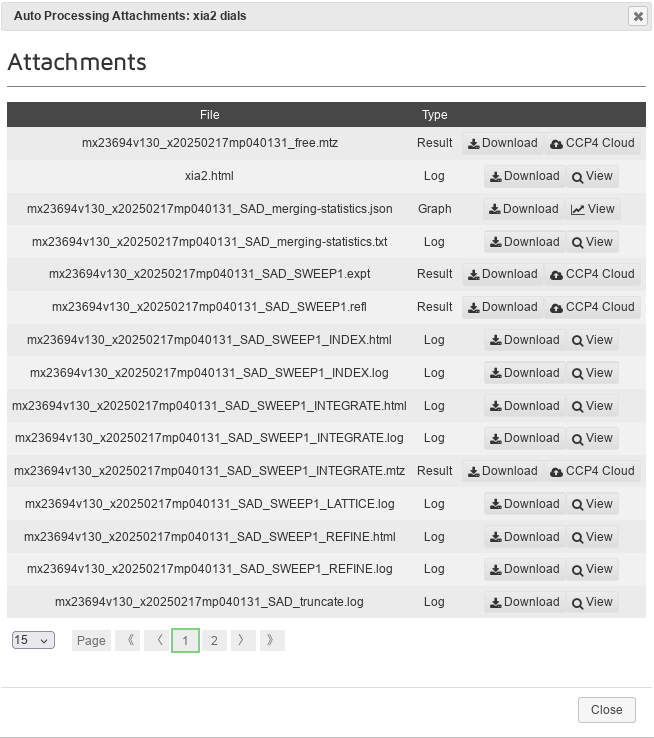
Logs & Files dialog

Items with a view button can be viewed ina modal window on the webpage. HTML files may contain graphs and logs. JSON file are typically graphs, and .txt or .log files are plain text:
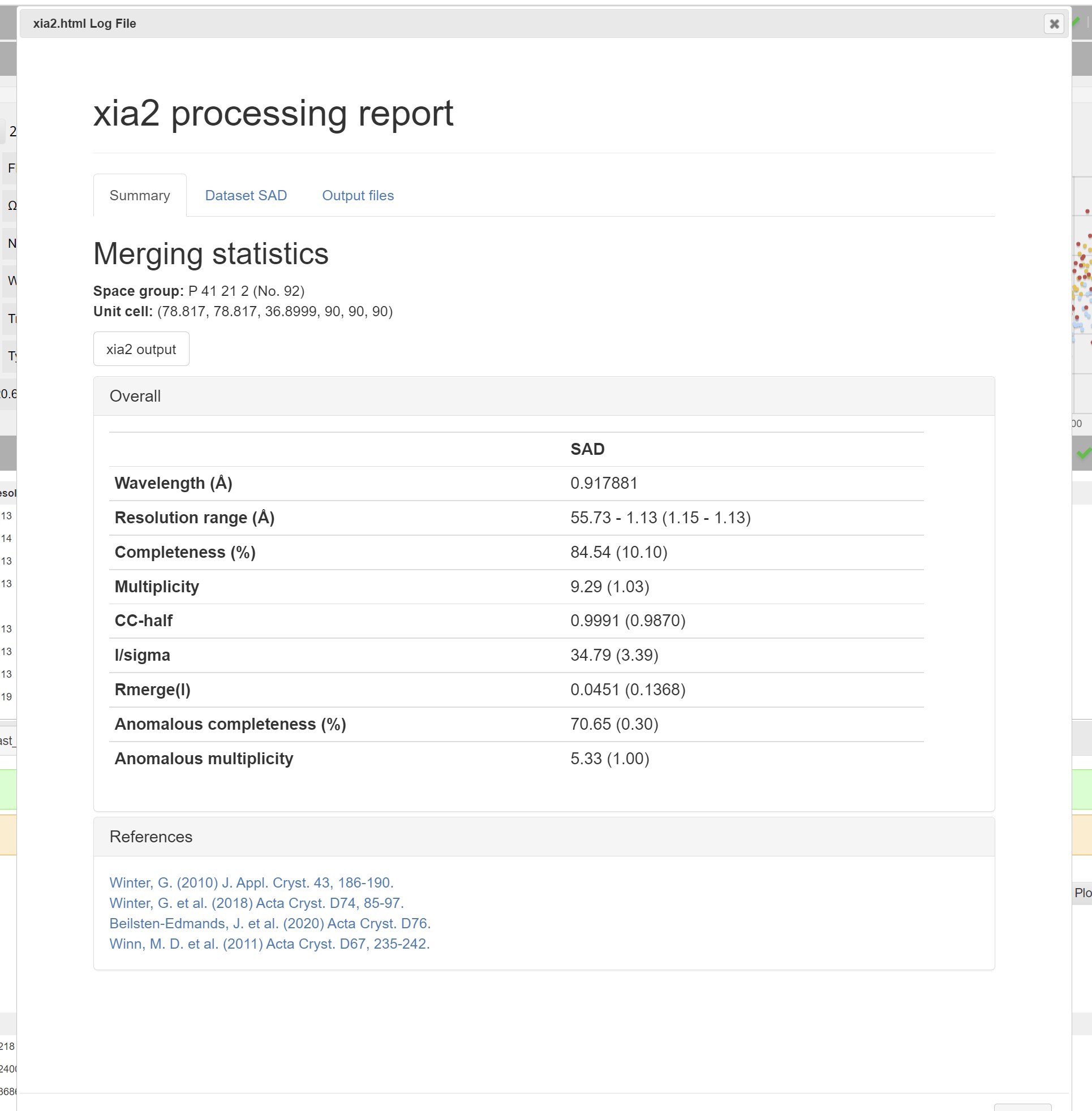
xia2 report
This contains only a subset of the most used files generated from the pipeline. If this is insufficent then you will need to find the path to the data on disk. This will be related to the path found for the raw data which can be seen on ISPyB by clicking the triangle icon on a dataset:

file path triangle

file path

The end of the path would need to changed such that the .../<visit>/processed/<protein>/<sample_name>/<dataset_name>/<processing-pipeline>/

Normally such processing is kept for a long time on disk, unlike the much larger raw images. 

The archive button, dowloads a zipped directory of files related to that processing.
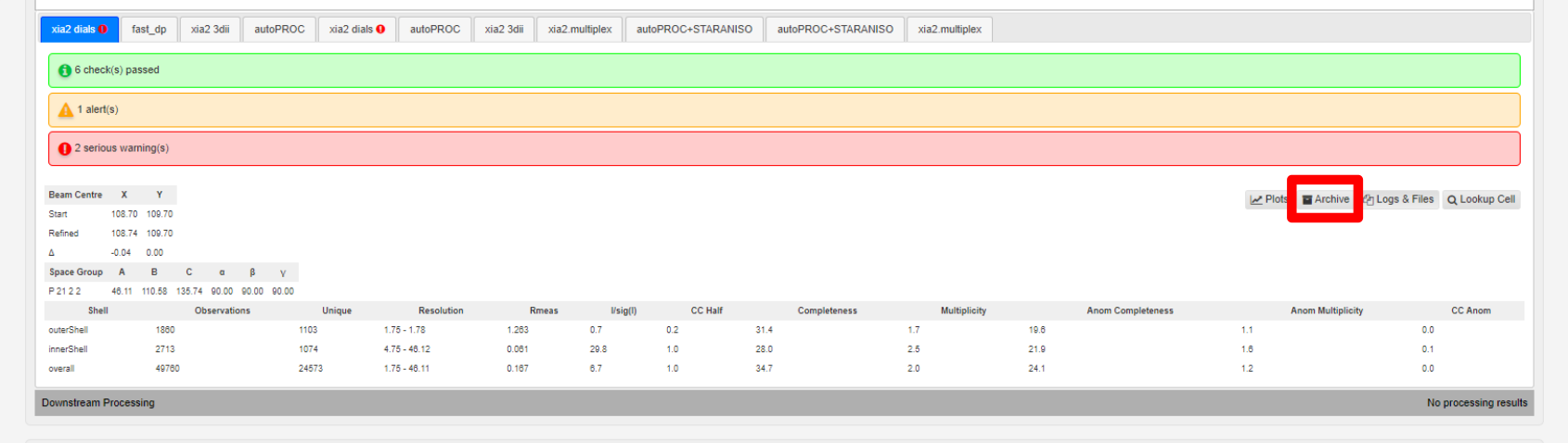
archive button

If you are missing acess to files you expect to find, please contact [email protected] in the first instance who can redirect you appropriately. 

CCP4 Cloud Upload

Any files of the type "Result" will have a button to upload them to CCP4 Cloud. If you do not have a CCP4 Cloud account you can set one up at https://cloud.ccp4.ac.uk.

You will then need your CCP4 Cloud username and your Cloudrun ID as credentials to put into Synchweb. You can find your Cloudrun ID on the "My Account" page of CCP4 Cloud.
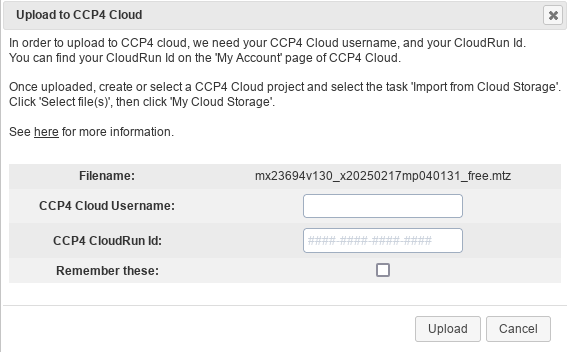
CCP4 Cloud Upload dialog

Uploaded files will be stored in your "My Cloud Storage", and you can then access them using the "Import from cloud storage" task.

There is more help available here.

  • Contact Us
  • About Diamond Light Source
  • Procurement
  • Supply Chain Transparency
  • Cookie Policy
  • Website Terms of Use
  • Privacy Notice

Diamond Light Source

Diamond Light Source is the UK's national synchrotron science facility, located at the Harwell Science and Innovation Campus in Oxfordshire.

Follow us on Facebook Follow us on Linkedin Follow us on Instagram Follow us on Bluesky

Diamond Light Source Ltd
Diamond House
Harwell Science & Innovation Campus
Didcot
Oxfordshire
OX11 0DE

See on Google Maps

Copyright © Diamond Light Source. Diamond Light Source® and the Diamond logo are registered trademarks of Diamond Light Source Ltd

Registered in England and Wales at Diamond House, Harwell Science and Innovation Campus, Didcot, Oxfordshire, OX11 0DE, United Kingdom. Company number: 4375679. VAT number: 287 461 957. Economic Operators Registration and Identification (EORI) number: GB287461957003.

feedback