-
highlight
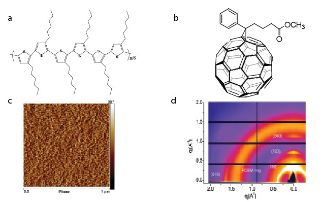
Growing concerns about fuel security and global warming have made the development and use of sustainable (low carbon) sources of energy an increasingly attractive proposition. Harvesting energy from sunlight at low-cost using photovoltaic devices is a rapidly growing research area, with organic based photovoltaics (OPVs) attracting particular interest as they have the potential advantages of low manufacturing-cost (as they are fabricated using solution based techniques) and ...
-
highlight

Spherulites are roughly spherical structures, and their name derives from the Greek for ‘ball’ and ‘stone’. Spherulites occur in various forms in nature. Those that form from polymers self-assemble into arrays of fibres that radiate out from the centre of the structure, and they are typically observed with diameters on the micrometre-scale. The arrangement of the fibres in the spherulite gives rise to birefringence, which may be observed when the spherulite is placed between crossed ...
-
highlight
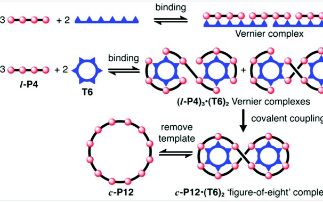
Templates are widely used to arrange molecular components so that they can be covalently linked to generate complex molecules that are not readily accessible by classical synthetic methods. Nature uses sophisticated templates such as the ribosome, whereas chemists use simple ions or small molecules. But as we tackle the synthesis of larger targets, we require larger templates — which themselves become synthetically challenging. Recently, we have shown that Vernier complexes can solve this ...
-
highlight
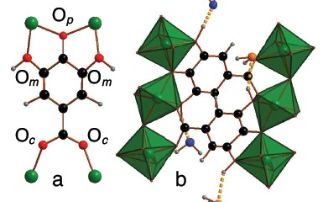
Inorganic-organic frameworks, particularly metal-organic frameworks (MOFs), have attracted considerable attention over the last decade because they exhibit a wide range of interesting physical properties.1 These include the ability to store or separate gases and perform catalytic reactions in nanoporous MOFs; while fascinating magnetic and electronic properties are found in denser frameworks. The transition metal gallate frameworks, M(C7HxO5)·2H2O (M = metal and x = 3 or 4) have ...
-
highlight
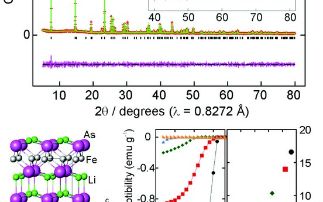
A range of techniques have been used to show that the behaviour of the superconductivity in LiFeAs is quite different from that in the other iron arsenide superconductors, and the system shows some similarities with the FeSe system.
-
highlight
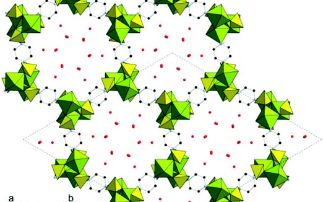
Crystalline porous solids, such as aluminosilicate zeolites have achieved widespread use in commercial processes of adsorption and catalysis. However, they are limited for many fine chemical conversions of complex organic molecules by the size of their pores, which typically do not exceed 1 nm. Mesoporous silicas are known with pore sizes of 3 nm upwards, but these lack long range order, so that crystallography cannot be used to measure, understand and improve their catalytic performance. ...
-
highlight

The alteration shown by silver leaf applied to polychrome carved wood and altarpieces to imitate metal objects (arms, garments, tools and decorative mouldings) is a very generalised phenomenon. The processes involved are not well understood, limiting the development of adequate conservation strategies. The object of the study was to determine and clarify the alteration mechanisms. For this, several silver foils from polychrome carved wood, mouldings as well as flat surfaces of altarpieces ...
-
highlight
Combinatorial high-throughput screening at Diamond may prove useful in discovering novel bulk hydrogen storage materials, according to new research published this month in the Royal Society of Chemistry’s Faraday Discussions journal.
A team of researchers from the ‘HyStorM’ project, a collaboration between Oxford University, Johnson Matthey, Ilika Technologies and the ISIS facility, funded by the Technology Strategy Board, used innovative high-resolution Powder X-Ray Diffraction (XRD) ...
-
highlight
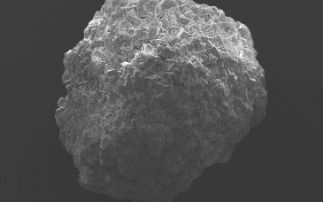
Scientists from Diamond Light Source, the Universities of Reading, Glasgow and the Natural History Museum in London have used the Diamond synchrotron to help determine whether worms can play a part in soil remediation. Their latest findings were published online in the journal Geochimica et Cosmochimica Acta.
-
highlight
%20sm.png)
In general, the antibiotics that are prescribed by your GP work. Complete the prescribed course and your symptoms have gone. But in some cases, the bacteria causing the illness have developed a resistance to the drugs. We need to find a way to improve these drugs so that they can overcome this resistance. But we need to know how our drugs work before we can improve them, and one way to do this is by producing a 3D molecular image of the drug/inhibitor in action. Knowing the 3D structure of ...
-
highlight
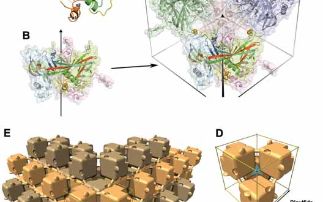
Virus infections in a number of insect families generally culminate in the occlusion of between one and several thousand virus particles within large proteinaceous crystalline occlusion bodies or polyhedra. Polyhedra are generally less than 7 μm in size, serve to protect the viruses from harsh environmental conditions and are made from a protein, polyhedrin, encoded by the viruses. Despite their small size, we solved the structure of polyhedra produced by the dsDNA baculovirus, Autographa ...
-
highlight
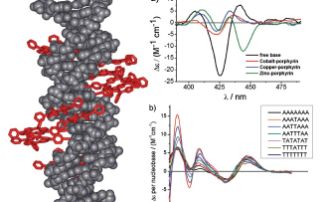
The structure determination of biomolecules, in particular of DNA and of proteins, is of utmost importance to understand their function in chemistry and biology. In recent years, DNA has become attractive as template for the creation of new materials in nano-biotechnology. The availability of synthetic DNA from automated synthesis has allowed using the sequence specific recognition of the complementary strand, together with a clever design of the DNA sequence, to form two and three ...
-
highlight
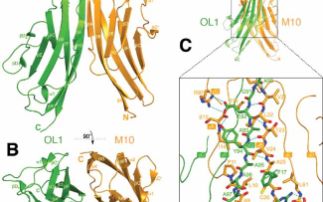
In muscle, assembly of ordered striated myofibrils requires the integration of hundreds of protein subunits in a sequential, regulated way by specific protein-protein interactions. The contractile filaments, composed of actin and myosin subunits, are crosslinked at the Z-disk and M-band, respectively, to give rise to a lateral assembly of molecular machines with nanometre precision. In the sarcomeric M-band, the giant ruler proteins titin and obscurin, its small homologue obscurin-like-1 ...
-
highlight
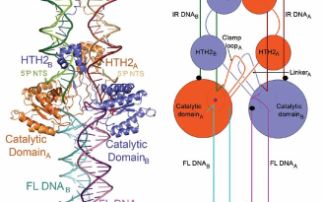
Transposons are pieces of DNA that can jump from one place to another in the genome of a cell and they make up a surprisingly large proportion of many genomes. In creating genetic diversity they have had a strong influence on the evolution of genomes. If they transpose they can directly affect gene expression, by inserting into genes or gene regulatory elements. However, their activity is more often suppressed by silencing mechanisms such as DNA methylation or RNAi. The mutational activity ...
-
highlight
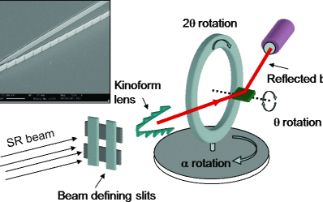
X-ray reflectivity (XRR) is a non-destructive technique widely used for thin layered materials characterization. The brilliance achieved by third generation synchrotron sources, such as Diamond, has opened new opportunities for the study of materials at the micro and nanoscales and has driven the development of new X-ray micro-focussing optical devices, such as kinoform lenses. We have demonstrated the first practical application of kinoform lenses for the X-ray reflectivity characterization ...
-
highlight
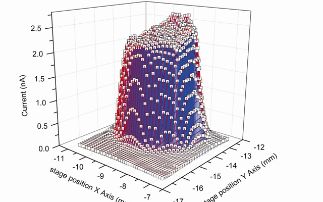
Monocrystalline diamond films with several metal contacts were characterized as radiation detectors in terms of responsivity as a function of X-ray energy, uniformity of response as a function of the position, speed of response, and stability with the time. The responsivity as a function of X-ray energy was found consistent with the physics of the metal to diamond interface and with the characteristic of the crystal in terms of lifetime of charge carriers The uniformity of response as a ...
-
highlight
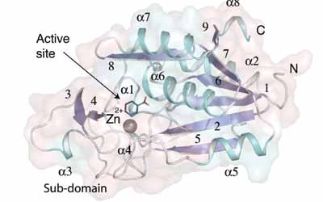
Nicotinamidase catalyzes hydrolysis of nicotinamide to nicotinic acid and ammonia, in the NAD(+) salvage pathway. This enzyme activity has a fortuitous medical benefit since in Mycobacterium tuberculosis it converts the prodrug pyrazinamide nto the bacteriostatic pyrazinoic acid. Pyrazinoic acid is active against semidormant tubercle bacilli and together with rifampicin and isoniazid, forms the front line tuberculosis treatment. Studies of the enzyme have revealed aspects of structure ...
-
highlight
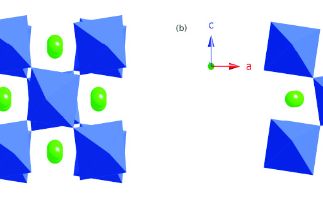
A polar phase of the perovskite NaNbO3 has been successfully synthesised using sol-gel techniques. Detailed characterisation of this phase has been undertaken using high-resolution powder diffraction (X-ray and neutron) and 23Na multiple-quantum (MQ) MAS NMR, supported by second harmonic generation (SHG) measurements and density functional theory (DFT) calculations. Samples of NaNbO3 were also synthesised using conventional solid-state methods and were observed to routinely comprise a ...
-
highlight
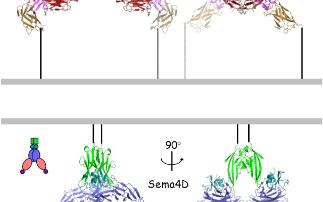
Axons are the communication channels of the body. Up to a metre in length, they connect parts of the body to the brain, carrying signals from muscles, organs and tissues. As the central nervous system develops these axons must follow very precise paths through the body. The route that they take is guided by proteins, which signal paths that the axon should and shouldn’t take. A group of proteins called semaphorins are known to be responsible for directing axons away from inappropriate areas. ...
-
highlight
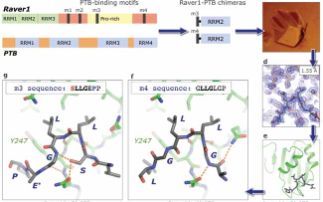
The regulation of the alternative splicing of messenger RNA allows mammals and other eukaryotic organisms to greatly enrich the diversity of the proteins coded by their genomes. Most eukaryotic genes are fragmented into introns that need to be joined up before the encoded protein is synthesised. But by combining the introns in different ways, the cell can make different proteins from the same genetic material.