Metal munching earthworms
Mar 17, 2011
Mar 17, 2011
Scientists from Diamond Light Source, the Universities of Reading, Glasgow and the Natural History Museum in London have used the Diamond synchrotron to help determine whether worms can play a part in soil remediation. Their latest findings were published online in the journal Geochimica et Cosmochimica Acta.
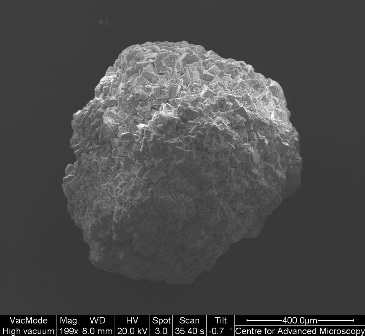 Worm poo could hold the key to cleaning up toxic metals in contaminated soils. Diamond’s intense X-rays were used to probe tiny granules of calcium carbonate (the main component of snail shell) excreted by earthworms that had been living in lead contaminated soil. Although tiny to us, the granules scaled up would be like a human excreting a spikey football!
"We're interested in how earthworms interact with metals at contaminated sites. In this study, we added lead to some of the soils the earthworms inhabited and then looked at the granules they excreted. Using the Microfocus spectroscopy beamline (I18) at Diamond, which can map the elements within a sample to the micron scale, we were able to confirm that the granules picked up a lot of lead. Unfortunately, the granules are so small that they pick up less than 1% of lead in the soil. So although the earthworms can survive in these toxic environments, their granules won't have a big impact on lead in contaminated soils. The next step is to look at different elements such as strontium and zinc within the granules which might be concentrated more heavily."Professor Mark Hodson, University of Reading
Scope for new materials
“Synthesising an amorphous carbonate in the lab is not so easy,” says Professor Hodson. “It’s possible, but the substance is so unstable that it quickly converts to calcite or aragonite – more stable forms of calcium carbonate. The more we can find out about the composition of the earthworm granules and how it affects the mineralogy, the more we can learn about how to create a stable amorphous material.”
Answering Darwin’s questions
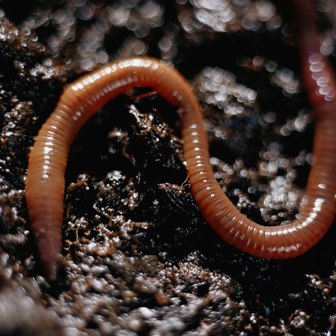 There is also a general interest in increasing our knowledge on how and why the calcium carbonate granules form, which has been a mystery since the humble earthworm caught the attention of Charles Darwin and he described the granules in 1881 when he published his book Formation of Vegetable Mould Through the Action of Worms with Observations on their Habits. It sold 6,000 copies in its first year, selling faster than On the Origin of Species by Means of Natural Selection when it was first published. Spending four decades studying the worm's brain power and senses, after much serenading and tobacco chewing (during his studies, Darwin tested the worms’ reactions to the noise and vibrations of a piano and to his breath whilst chewing tobacco) Darwin concluded, “It may be doubted whether there are many other animals which have played so important a part in the history of the world, as have these lowly organized creatures.” More information about how metals are partitioned within the granules, such as that gathered from Professor Hodson’s group’s data, could lead to a better understanding of how the granules form, filling in the gaps in our knowledge of an animal deemed so important by Darwin.
 Incorporation of lead into calcium carbonate granules secreted by earthworms living in lead contaminated soils
A. Fraser, D.C. Lambkin, M.R. Lee, P.F. Schofield, J.F.W. Mosselmans and M.E. Hodson
Geochimica et Cosmochimica, 18 February 2011
http://dx.doi.org/10.1016/j.gca.2011.02.015

Diamond Light Source is the UK's national synchrotron science facility, located at the Harwell Science and Innovation Campus in Oxfordshire.
Diamond Light Source Ltd
Diamond House
Harwell Science & Innovation Campus
Didcot
Oxfordshire
OX11 0DE
Copyright © Diamond Light Source. Diamond Light Source® and the Diamond logo are registered trademarks of Diamond Light Source Ltd
Registered in England and Wales at Diamond House, Harwell Science and Innovation Campus, Didcot, Oxfordshire, OX11 0DE, United Kingdom. Company number: 4375679. VAT number: 287 461 957. Economic Operators Registration and Identification (EORI) number: GB287461957003.