Instruments by Science Group
 Macromolecular
 Soft Condensed
  Imaging and
 Biological
 Magnetic
 Structures and
 Crystallography
  Spectroscopy
 B21 Contact
Beamline phone numbers:
+44 (0) 1235 77 8627
+44 (0) 1235 77 8640
Principal Beamline Scientist:
Nathan Cowieson
Tel: +44 (0) 1235 567 504
E-mail: [email protected]
Science Group Leader
Robert Rambo
Email: [email protected]
Tel: +44 (0)1235 56 7675
B21 High Throughput SAXS
Status: Operational
Beamsize: <75 μm
Detector: Eiger 4M
Energy: 6 - 23 keV
Detector: Eiger 4M
Energy: 6 - 23 keV
Mail-in request instructions
.png)
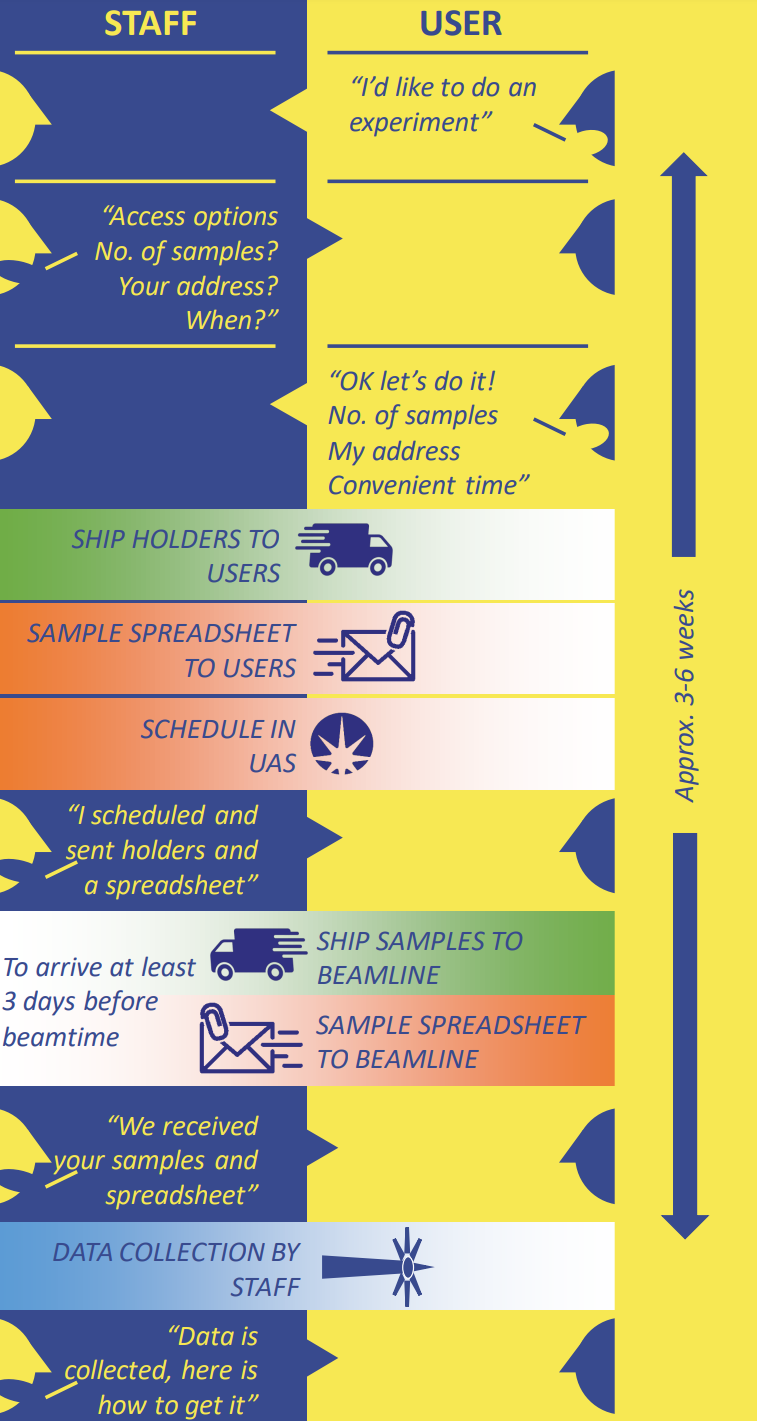
- Mail-in procedure at B21.
Samples must be sent to the beamline in our bar-coded sample holders. To request sample holders please fill out the following form or email [email protected] with the amount of samples you would like to send and a mailing address to send the holders too. Once you have received the holders, fill out all of the information in the sample spreadsheet without editing collumns to avoid delays on the day of your beamtime. Samples are identified by the unique bar code associated with each holder and the position.
Send a copy of your completed spreadsheet to [email protected] and to your local contact. Please include a physical copy of the excel spreadsheet when sending mail-in holders. Please print off the shipping label from the Shipping Label workbook of this document and attach it to your package or copy the information from there to your own label or courier shipping docket.
A member of the b21 team will collect and store your samples at the temperature requested. Please send samples in good time before your allocated beamtime. We have recently been experiencing custom delays, so please check tracking information frequently and contact a member of the team or [email protected] if you notice samples have been held at customs.
Mail-in holder details
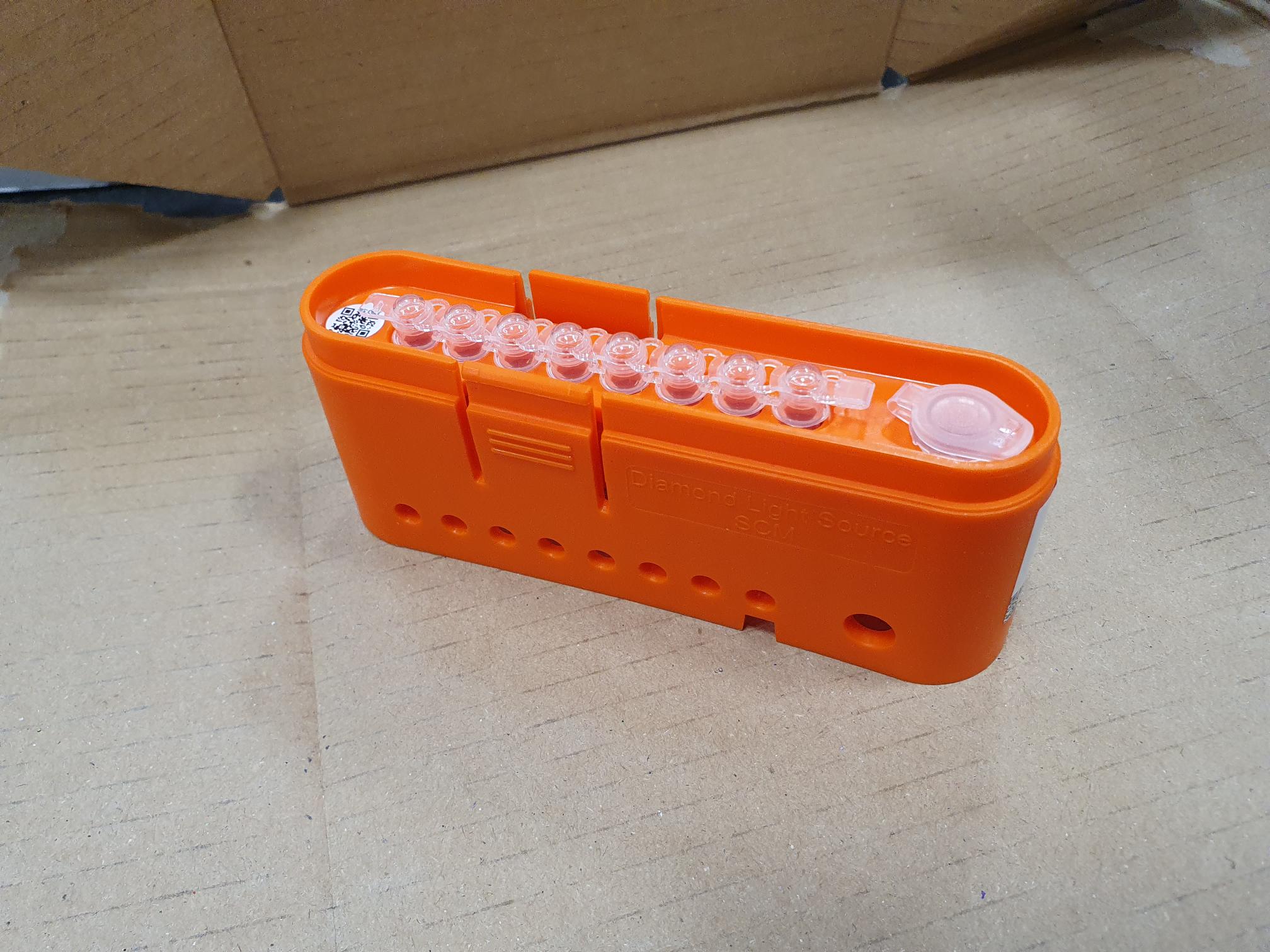
The sample holders have space for 8x 200 μl PCR tubes in a strip plus a 1.5 ml tube that is typically used to contain a matching buffer for batch mode experiments. Tubes can be most easily removed by pushing them up from underneath with a finger. Holes in the side of the holder are for standing the PCR strip up in to make pipetting easier. Make a note of the barcode number to add to your excel spreadsheet.
BATCH mode sample requirements
Batch mode samples are loaded directly from the PCR tubes to the sample cell for measurement. Samples take approximately 2 minutes each to run and this method allows SAXS measurements with well defined sample contents, that is suitable for systematically changing parameters or ligand concentrations and studying the effects. In batch mode, it is relatively hard to assess polydispersity. There is often small amounts of aggregate in the sample and often buffer mismatched. This makes batch mode less suitable for measuring data that will be used for modelling.
Samples should be between 35 and 100 μl each. It is typical to do a serial dilution from 2 -> 0.1 mg/ml. This is a rough guide and will vary from sample to sample. It is critically important that each batch mode sample come with at least 100 μl of a well matched buffer, typically a dialysate, the flow through from a spin concentrator or some eluent from the last sizing column of the purification process.
SEC mode sample requirements
SEC-SAXS mode allows a good assessment of polydispersity across an elution peak, removes aggregate from samples at the time of measurement and come with a built in accurate buffer blank. Data from SEC-SAXS is typically of a higher quality and more suited to model against. In SEC-SAXS mode it is harder to control parameters such as protein or ligand concentration and measurement times are longer, around 35 minutes per sample, making this mode less appropriate for screening parameters.
SEC-SAXS samples are diluted as the elute through the sizing column and so sample concentrations should be higher. We typically use 50 μl samples at somewhere between 2 and 10 mg/ml. You should supply 5x or 10x running buffer stocks in 50 ml tubes. Unless a buffer component is very scarce or expensive, please supply plenty of running buffer for HPLC pump washing and column equilibration as well as running samples. You will typically select from a range of columns that we keep at the beamline rather than supplying your own. The columns we have are:
|
Column |
Dimensions (mm) |
Volume (mL) |
Size Range (Da) |
pH range |
Pressure limit (Bar) |
Flow rate (mL/Min) |
Run time (Mins) |
|
SRT-C SEC-150 (Sepax) |
4.6 x 300 |
4.99 |
500-150,000 |
2-8.5 |
170 |
0.16 |
32 |
|
SRT-C SEC-300 (Sepax) |
7.8 x 300 |
14.34 |
5,000-1,250,000 |
2-8.5 |
170 |
0.3 |
50 |
|
SRT-C SEC-300 (Sepax) Replacing KW-403 (Shodex) |
4.6 x 300 |
4.99 |
5,000-1,250,000 |
2-8.5 |
170 |
0.16 |
32 |
|
SRT-C SEC-500 (Sepax) |
4.6 x 300 |
4.99 |
15,000-5,000,000 |
2-8.5 |
130 |
0.16 |
32 |
|
KW-402.5 (Shodex) |
4.6 x 300 |
4.6 |
5,000-100,000 |
3-7.5 |
80 |
0.16 |
32 |
|
KW-404 (Shodex) |
4.6 x 300 |
4.6 |
30,000-4,000,000 |
3-7.5 |
80 |
0.16 |
32 |
|
KW-405 (Shodex) |
4.6 x 300 |
4.6 |
100,000-20,000,000 |
3-7.5 |
80 |
0.16 |
32 |
|
Superdex 30 (Cytiva) |
3.2 x 300 |
2.4 |
100-7000 |
3-12.0 |
30 |
0.075 |
32 |
|
Superdex 75 (Cytiva) |
3.2 x 300 |
2.4 |
3,000-70,000 |
3-12.0 |
30 |
0.075 |
32 |
|
Superdex 200 (Cytiva) |
3.2 x 300 |
2.4 |
10,000-600,000 |
3-12.0 |
30 |
0.075 |
32 |
|
Superose 6 (Cytiva) |
3.2 x 300 |
2.4 |
20,000-5,000,000 |
3-12.0 |
30 |
0.075 |
32 |

Diamond Light Source is the UK's national synchrotron science facility, located at the Harwell Science and Innovation Campus in Oxfordshire.
Diamond Light Source Ltd
Diamond House
Harwell Science & Innovation Campus
Didcot
Oxfordshire
OX11 0DE
Copyright © Diamond Light Source. Diamond Light Source® and the Diamond logo are registered trademarks of Diamond Light Source Ltd
Registered in England and Wales at Diamond House, Harwell Science and Innovation Campus, Didcot, Oxfordshire, OX11 0DE, United Kingdom. Company number: 4375679. VAT number: 287 461 957. Economic Operators Registration and Identification (EORI) number: GB287461957003.