• Diamond Home page
  • About
  • For Users
  • Public
  • Industry
  • Instruments
  • Careers
  • More Show more menu items
Search

About

  • About Diamond
  • About Synchrotrons
  • News and Features
  • Events
  • Contact Us
  • FAQ

For Users

  • Apply for beamtime
  • User guide
  • Diamond Users Commitee
  • FAQ
  • User Administration System
  • iSpyB

Industry

  • Techniques Available
  • Industry Research
  • Industry Case Studies
  • News
  • Meet the Industry Team

Science

  • Research
  • Computing
  • The Machine
  • Publications
  • Research Expertise
  • Membrane Protein Laboratory
  • Additional Facilities
  • Publications Database

Instruments

  • Biological Cryo-Imaging
  • Crystallography
  • Imaging and Microscopy
  • Macromolecular Crystallography
  • Magnetic Materials
  • Soft Condensed Matter
  • Spectroscopy
  • Structures and Surfaces

Diamond-II

  • Science
  • Machine
  • Beamlines
  • Software, Control and Computing
  • Infrastructure

Public

  • Public open days
  • School visits
  • Partner with Diamond
  • Explore Diamond

Procurement

  • Non-OJEU Tender Notices
  • OJEU PINs
  • OJEU Tender Notices
  • Registration Form

Careers

  • Vacancies
  • Info for applicants
  • Company Benefits
  • Apprenticeships
  • PhD Studentships
  • Work Placement

Main Content

Macromolecular Crystallography
Sub-navigation
  • MX
  • I03
  • I04
  • I04-1
  • I23
  • I24
  • VMXi
  • VMXm
  • HeXI
  • XFEL-HUB
  • XChem
  • MPL
  • Crystallisation Facility
  • MX Data Analysis
  • Staff Research
  • Contacts

MX Data Analysis

Sub Navigation
  • Analysis Pipelines
  • Interpreting Experiment Feedback
    • Per-Image Analysis
    • Reciprocal Space Viewer
    • Viewing Diffraction Images
    • Data Quality Plots
    • Radiation Damage
    • Statistics
    • Xtriage
  • Reprocessing
  • Advanced Experiments
  • Connecting to Diamond
  • Staff
  • FAQ

Instruments by Science Group

Macromolecular
Crystallography
Soft Condensed
Matter
Imaging and
Microscopy
Biological
Cryo-Imaging
Magnetic
Materials
Structures and
Surfaces
Crystallography
Spectroscopy
  1. Instruments
  2. MX
  3. MX Data Analysis
  4. Interpreting Experiment Feedback
  5. Radiation Damage

Radiation Damage

Alongside fastdp results, a radiation damage plot is generated. To access this, select fastdp from the autoprocessing results, then select radiation damage on the right hand side.
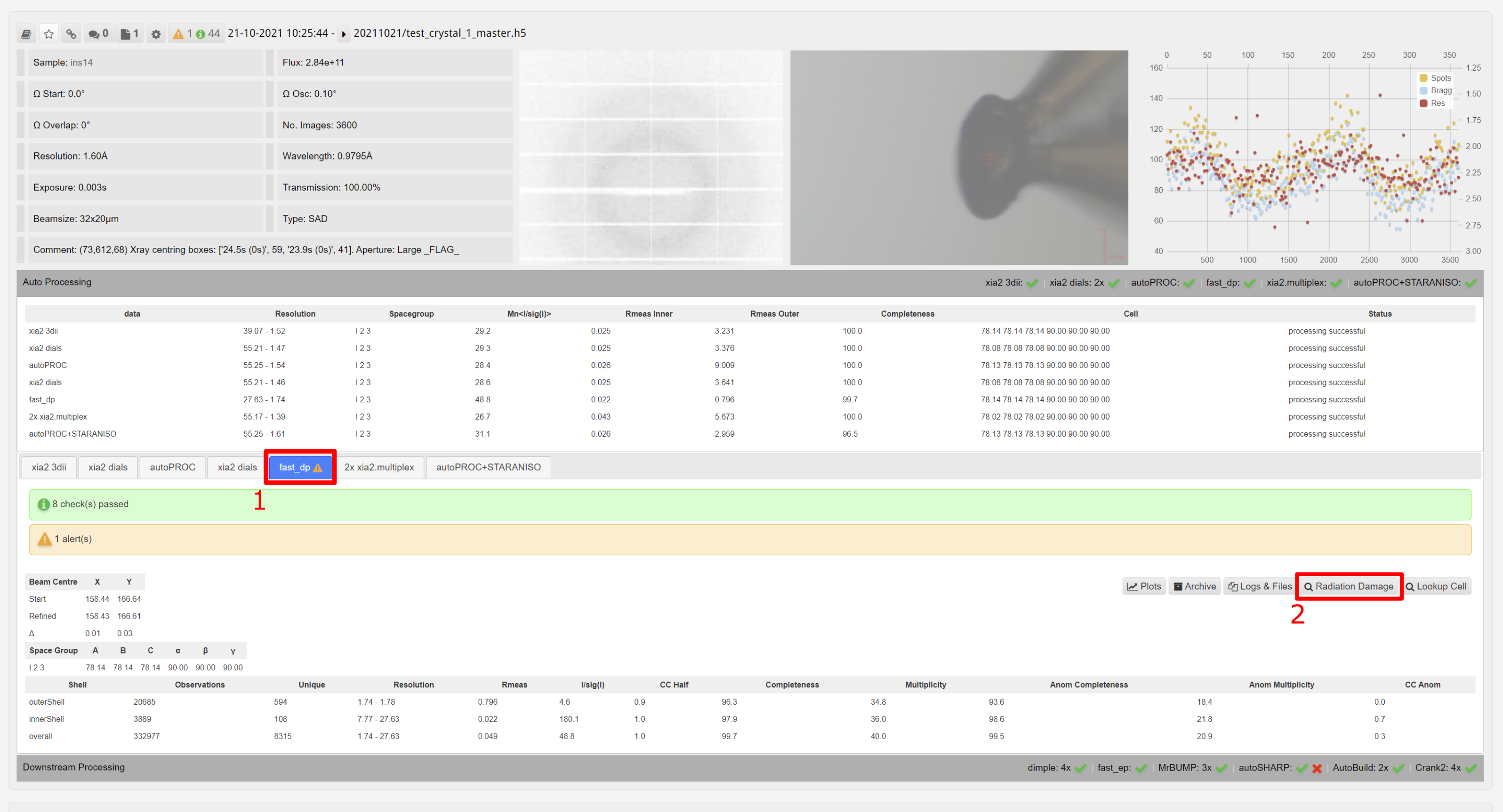
radiation damage plot button in fastdp processing

The plot produced is that discussed in Diederichs, Acta Cryst. (2006). D62, 96-101. Here is an example showing low radiation damage:
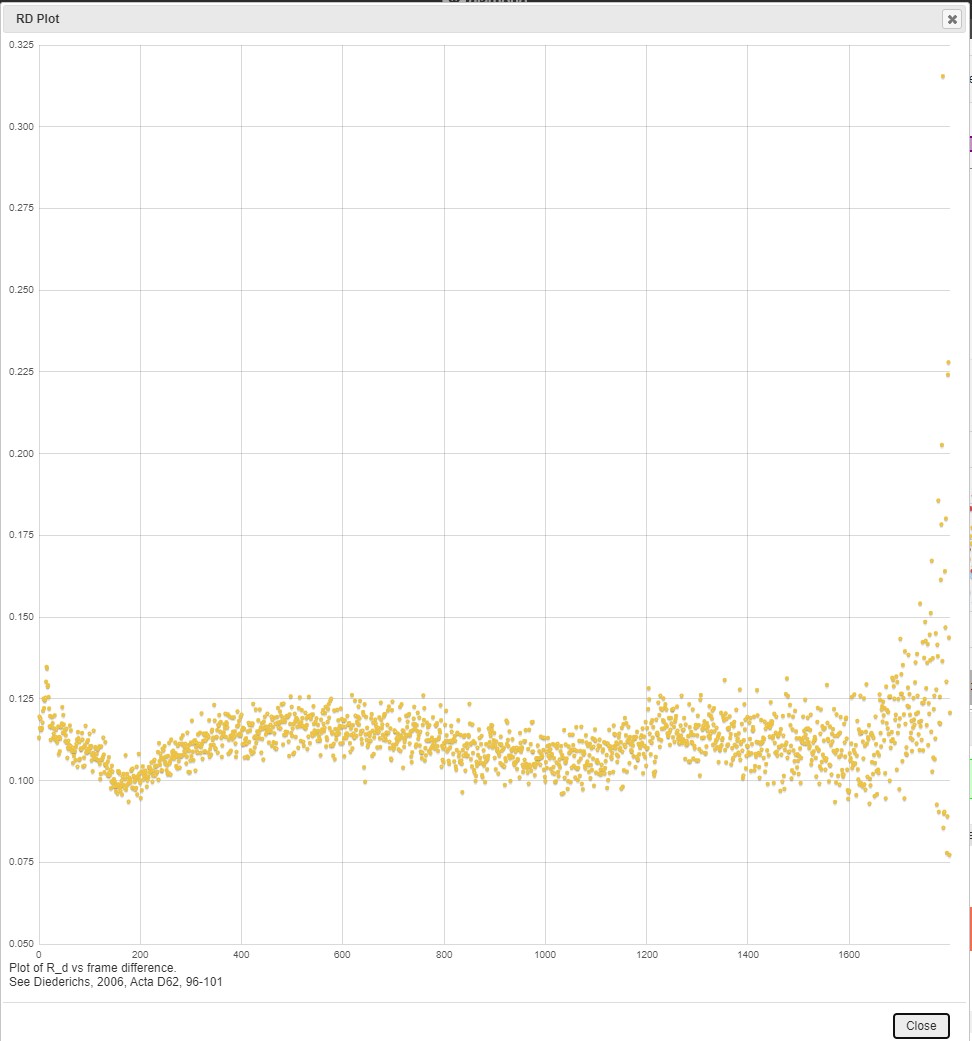
low radiation damage plot

In this example, the increased slope of Rd versus frame number implies some radiation damage over the dataset. Similarly, the spots become more spread apart, further indicative of damage:
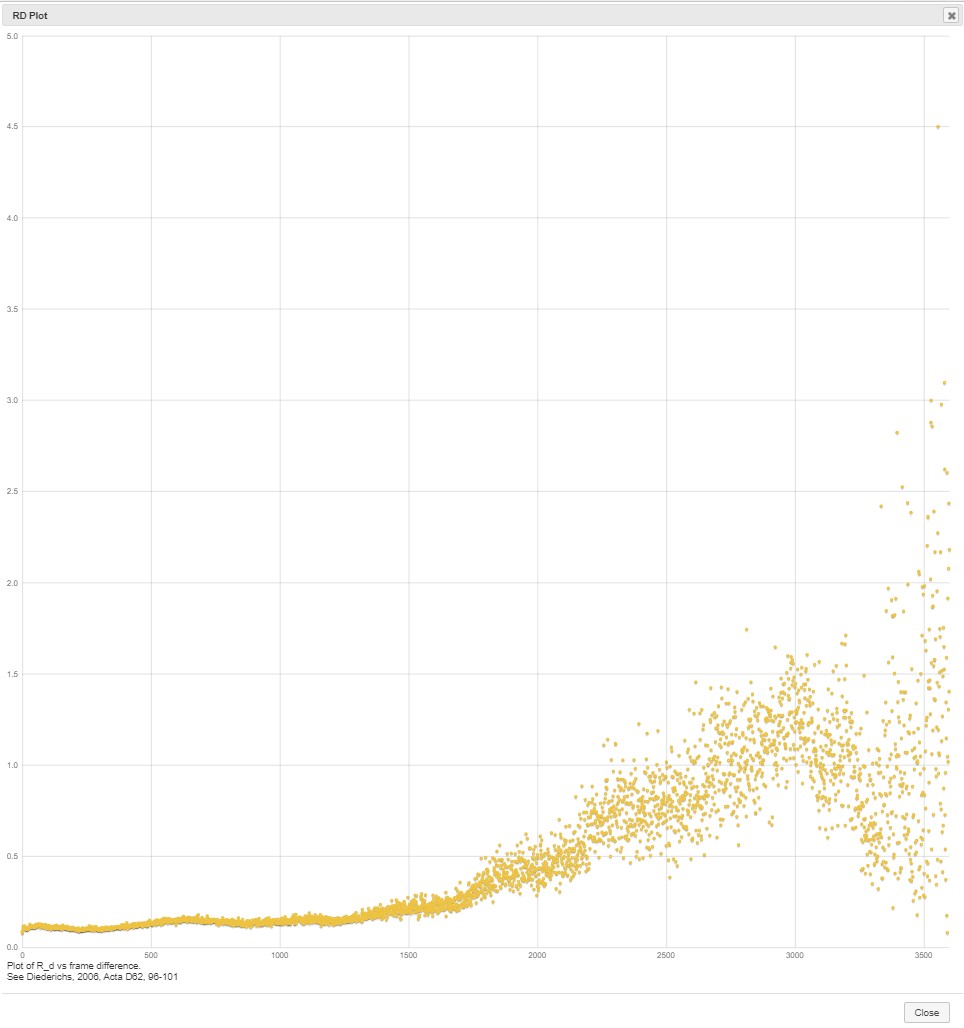
high radiation damage plotNote that this can sometimes be seen as a downward slope in the Per-Image Analysis plot.

  • Contact Us
  • About Diamond Light Source
  • Procurement
  • Supply Chain Transparency
  • Cookie Policy
  • Website Terms of Use
  • Privacy Notice

Diamond Light Source

Diamond Light Source is the UK's national synchrotron science facility, located at the Harwell Science and Innovation Campus in Oxfordshire.

Follow us on Facebook Follow us on Linkedin Follow us on Instagram Follow us on Bluesky

Diamond Light Source Ltd
Diamond House
Harwell Science & Innovation Campus
Didcot
Oxfordshire
OX11 0DE

See on Google Maps

Copyright © Diamond Light Source. Diamond Light Source® and the Diamond logo are registered trademarks of Diamond Light Source Ltd

Registered in England and Wales at Diamond House, Harwell Science and Innovation Campus, Didcot, Oxfordshire, OX11 0DE, United Kingdom. Company number: 4375679. VAT number: 287 461 957. Economic Operators Registration and Identification (EORI) number: GB287461957003.

feedback