 Macromolecular
 Soft Condensed
  Imaging and
 Biological
 Magnetic
 Structures and
 Crystallography
  Spectroscopy
 Several statistics have been developed to measure the quality of processed data. This can help decide between different analysis pipelines, and also inform whether your experimental decisions (i.e. does more data need to be collected?).
This page provides a brief overfiew of the common statistics displayed in ISPyB.
| Statistic | Description | What is good? |
| CC1/2 |
Pearson correlation coefficient between half-sets of the data. Measure of internal consistency. Varies from -1 to 1. |
As close to 1 as possible. CC1/2 = 0.3 often used as the approximate resolution limit. |
| Rpim/Rmeas |
Measures of internal consistency. |
Lower is better. |
| Completeness |
Percentage of possible reflections that were measured (within the chosen resolution limit). Varies from 0 to 100. |
As close to 100 as possible, but don't throw away high resolution data that is incomplete but good CC1/2. |
| <I/σ> | Mean signal-to-noise ratio. | Higher is better, but not the most reliable way to choose between pipelines as σ is estimated differently. |
| Multiplicity | The number of times each unique reflection was measured. | Higher is better: measuring each reflection several times reduces random errors, but systematic errors can remain. |
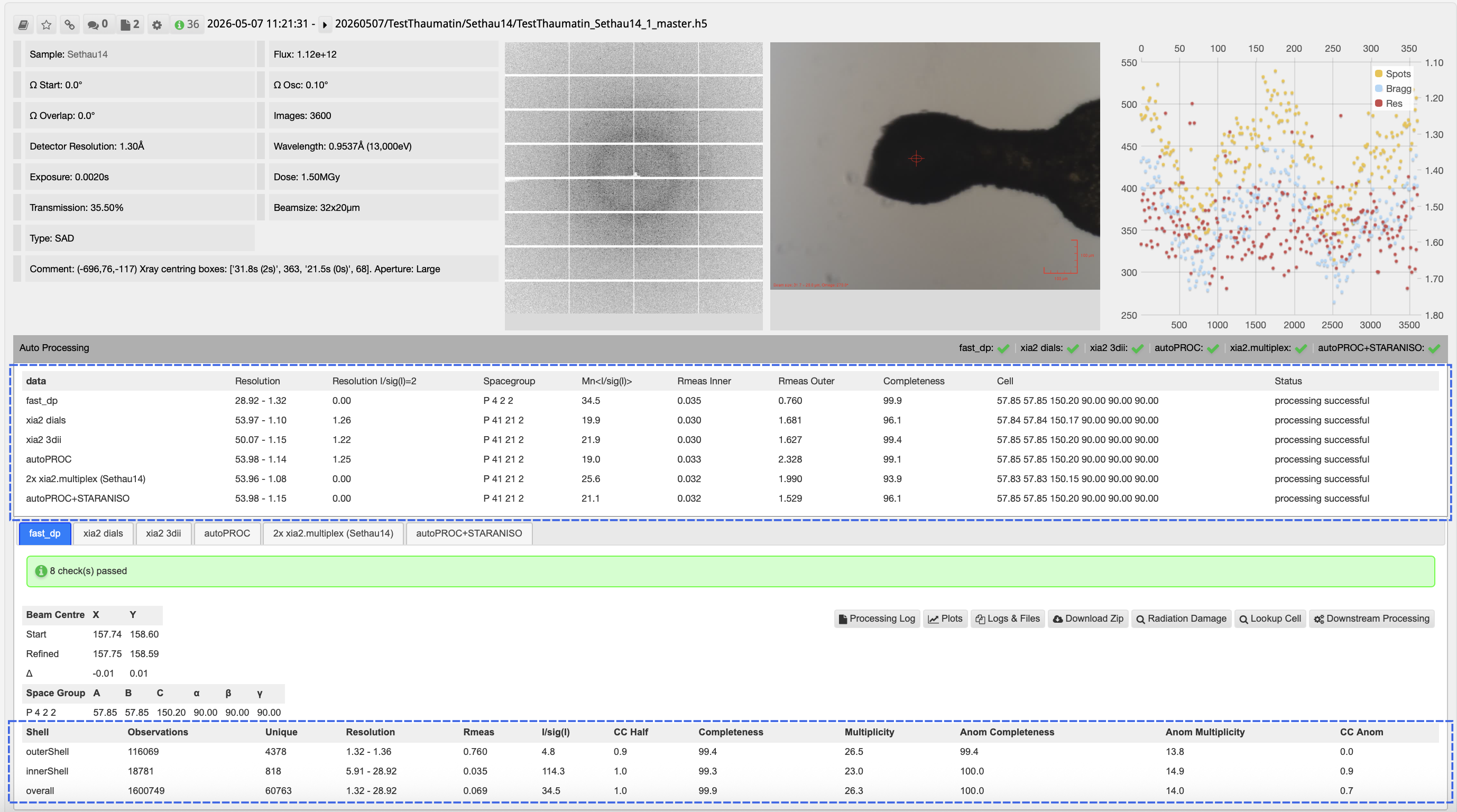
In ISPyB, these statistics are displayed underneath the experiment information. By opening one of the auto processing pipelines you will further see the statistics for the high resolution (outerShell) and low resolution (innerShell) ranges. You can also visualise the data quality statistics over different resolution ranges using the Data Quality Plots accessible by the plots button.
Recommended reading for data quality metrics:
- Karplus, P.A. and Diederichs, K. (2015) Assessing and maximizing data quality in macromolecular crystallography. Current Opinion in Struct.Biol. 34, 60-68.
- Karplus, P.A. and Diederichs, K. (2012) Linking crystallographic model and data quality. Science 336, 1030-1033.
- Evans, P. (2006) Scaling and assessment of data quality. Acta Cryst. D62, 72-82.

Diamond Light Source is the UK's national synchrotron science facility, located at the Harwell Science and Innovation Campus in Oxfordshire.
Diamond Light Source Ltd
Diamond House
Harwell Science & Innovation Campus
Didcot
Oxfordshire
OX11 0DE
Copyright © Diamond Light Source. Diamond Light Source® and the Diamond logo are registered trademarks of Diamond Light Source Ltd
Registered in England and Wales at Diamond House, Harwell Science and Innovation Campus, Didcot, Oxfordshire, OX11 0DE, United Kingdom. Company number: 4375679. VAT number: 287 461 957. Economic Operators Registration and Identification (EORI) number: GB287461957003.