 Macromolecular
 Soft Condensed
  Imaging and
 Biological
 Magnetic
 Structures and
 Crystallography
  Spectroscopy
 The difference map pipeline Dimple is a useful tool for quickly finding regions of unmodelled density in diffraction data - ideal for locating ligands. Dimple takes a known protein structural model and fits it to processed diffraction data to provide a refined structure and electron density maps, including a difference map showing unmodelled electron density.
Running Dimple at Diamond
At Diamond, Dimple will automatically run upon the completion of any successful upstream data-reduction pipelines if a structural model is provided in PDB format for the protein. The protein strcuture can either be uploaded protein in ISPyB as a PDB file or code or saved as a pdb file in the `tmp/pdb/` or `processing/pdb/` directories within the visit directory. Multiple structures can be provided and Dimple will select the one with the most similar unit-cell to run against. If the observed unit cell is significantly different to the model, Dimple will run molecular replacement before refinement.
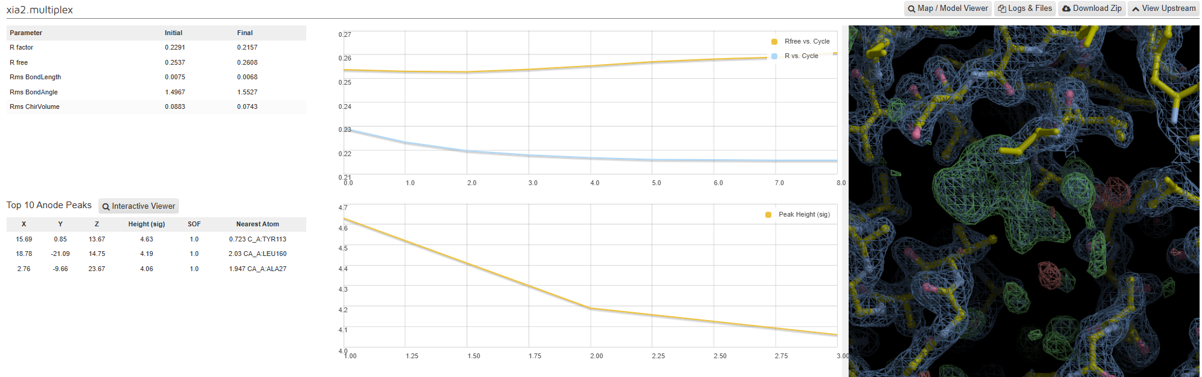
Dimple Results in ISPyB
Upon success, Dimple results will display in the ISPyB web interface under the downstream processing tab. A separate set of results will be displayed for each data-reduction pipeline (e.g. fast_dp, xia2-dials) that dimple was run from.
Refinement Statistics
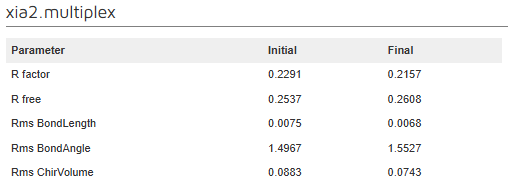
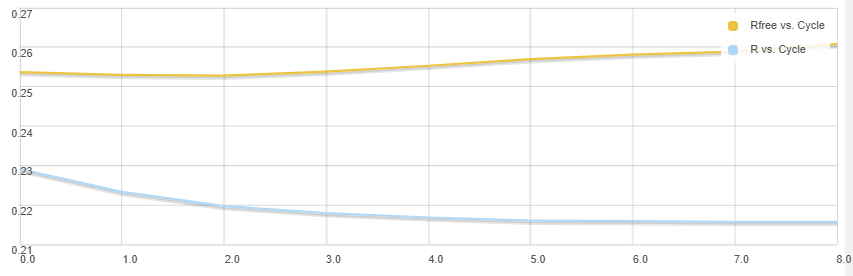
For each run of Dimple, a table indicating the initial and final refinement statistics is shown, along with a graph showing the change in R factors over the refinement cycles. A downward trend in the R factors with each cycle is a good indication that the refinement has been successful.
Visualisation
Dimple generates snapshots of the unmodelled electron density blobs, the largest of which will be diplayed in the web interface.
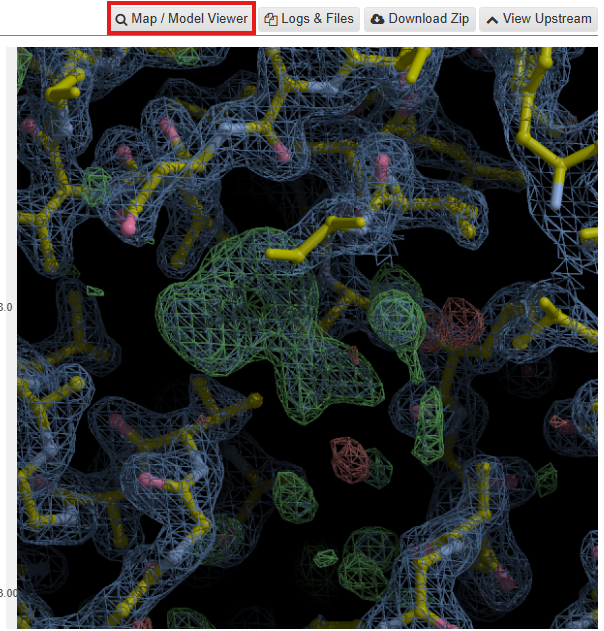
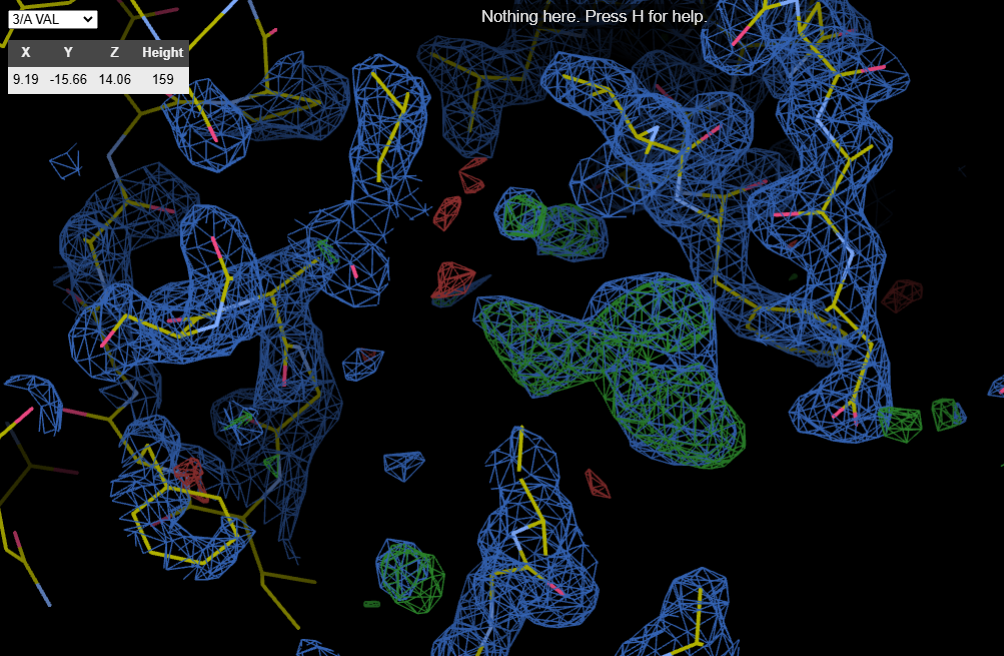
An interactive visualisation of the Dimple results can be viewed in UglyMol by clicking on the Map/Model Viewer button. The viewer shows the refined structural model along with the 2Fo - Fc map (estimation of true electron density) in blue and the Fo - Fc difference map in Green/Red, showing differences between the observed and modelled electron density (Green = unmodelled, Red = overmodelled). The coordinates of any significant unmodelled blobs will be displayed at the top left of the viewer and clicking on them will focus the view on the blob.
ANODE Results
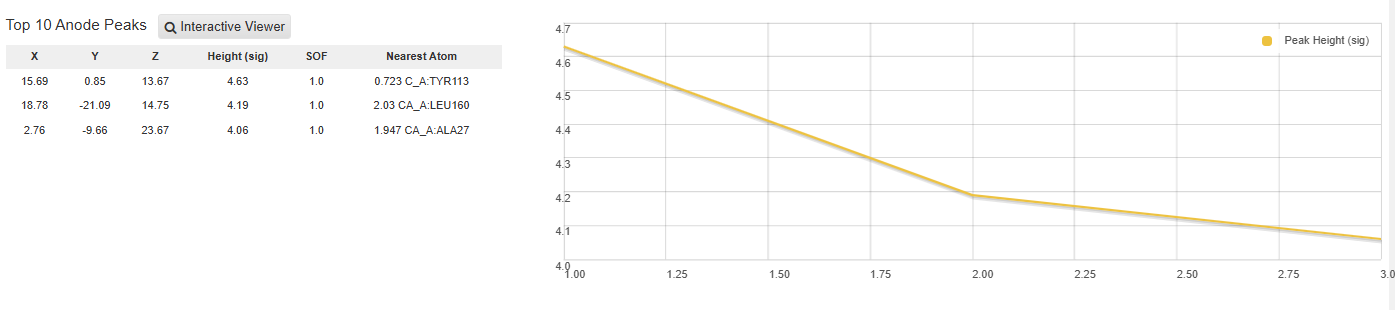
As part of the Dimple pipeline, the software package ANODE from the SHELX suite is also run. ANODE uses the known structural model along with the anomalous diffraction data to generate a density map corresponding to the locations of anomalous scatterers (i.e. heavy atoms) in the structure. A table showing the coordinates, peak height and nearest atoms of peaks in the anomalous density are displayed.
A graph showing the peak height vs peak number is also displayed.
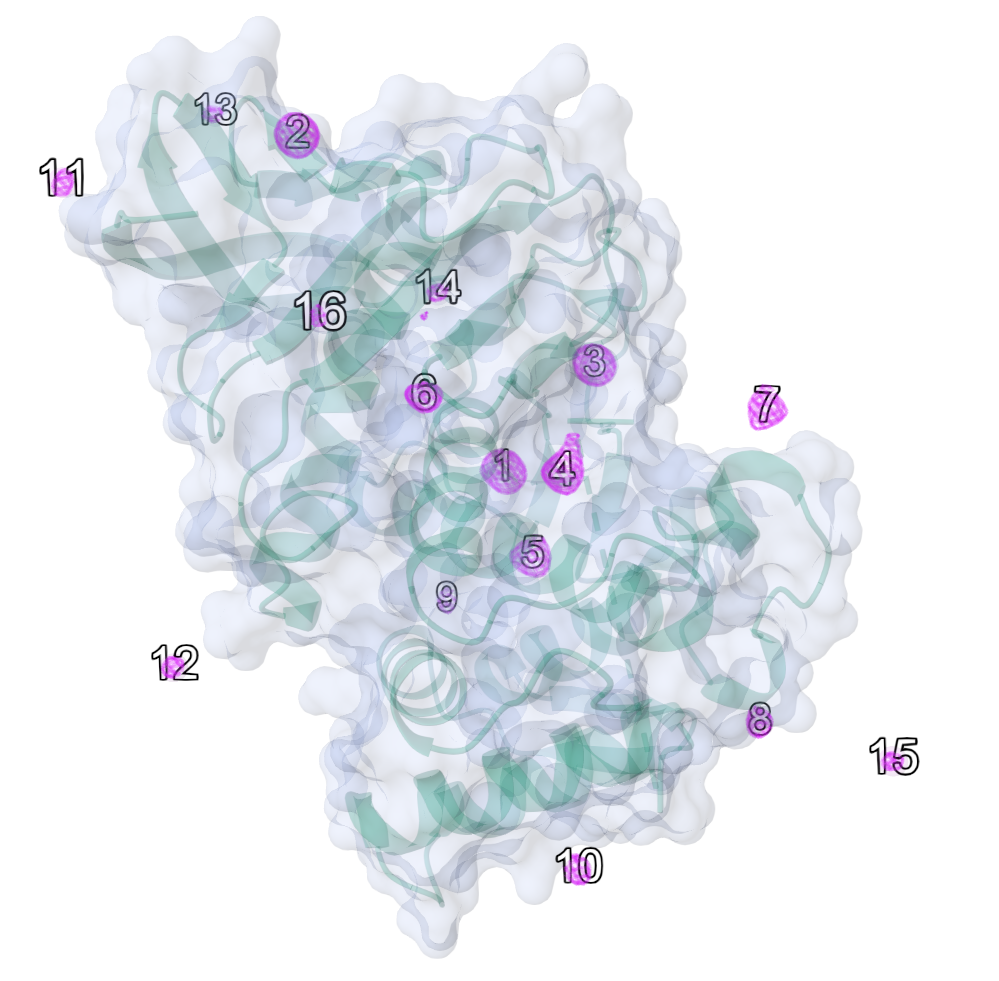
The Interactive Viewer button opens a Mol* visualisation showing the locations of the anomalous peaks within the protein structure.
Results and Log Files
The data files and logs output by Dimple can be accessed via the *Logs & Files* button.
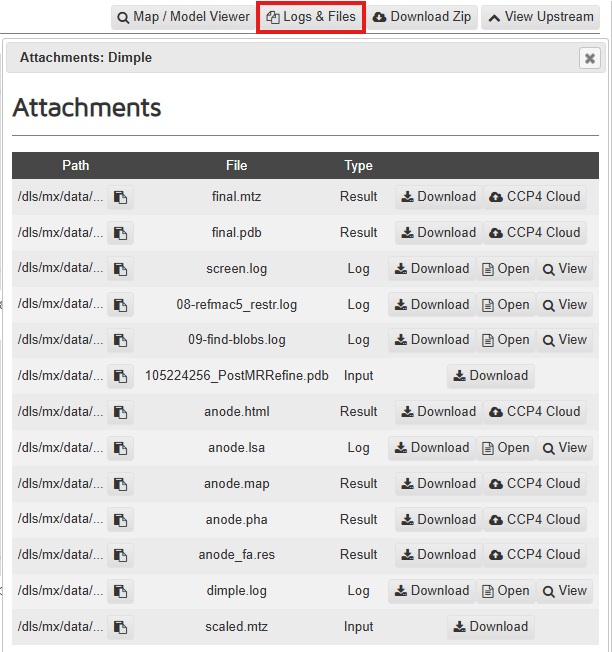
The primary results files are the final.mtz and final.pdb files, which contain the density maps and refined model coordinates respectively. The most significant results and log files are summarised in the table below:
| File | Description |
| final.mtz | MTZ file containing the 2Fo–Fc electron-density map and Fo–Fc difference map |
| final.pdb |
Coordinates of the refined structural model |
| dimple.log | Primary DIMPLE log file detailing the individual pipeline steps |
| anode.map | CCP4 map showing anomalous scatterer (heavy-atom substructure) density |
| anode.html | HTML visualisation of the ANODE results |
Citation
Please remember to cite the appropriate autoprocessing pipeline used prior to Dimple, the programs that Dimple calls (see dimple.log file to see which programs were called) as well as the following reference for Dimple itself:

Diamond Light Source is the UK's national synchrotron science facility, located at the Harwell Science and Innovation Campus in Oxfordshire.
Diamond Light Source Ltd
Diamond House
Harwell Science & Innovation Campus
Didcot
Oxfordshire
OX11 0DE
Copyright © Diamond Light Source. Diamond Light Source® and the Diamond logo are registered trademarks of Diamond Light Source Ltd
Registered in England and Wales at Diamond House, Harwell Science and Innovation Campus, Didcot, Oxfordshire, OX11 0DE, United Kingdom. Company number: 4375679. VAT number: 287 461 957. Economic Operators Registration and Identification (EORI) number: GB287461957003.