 Macromolecular
 Soft Condensed
  Imaging and
 Biological
 Magnetic
 Structures and
 Crystallography
  Spectroscopy
 Experimental approaches to identify and locate specific elements within a macromolecular structure is often essential for interpreting biological function. For example, metal ions can play critical catalytic or structural roles, and mis-assignment (or absence) of these elements can lead to incorrect mechanistic conclusions.
Anomalous scattering, while traditionally used for experimental phasing, can also be exploited to identify and locate elements with absorption edges accessible to photon energy ranges of MX beamlines. In this approach, phases are obtained from a known protein model and used in a manner analogous to the inverse of experimental phasing to derive structure factors corresponding only to the anomalous substructure. However, this type of analysis does not distinguish between different types of anomalous atoms and therefore cannot directly identify the elements present.
Element-specific identification can instead be achieved by collecting diffraction data above and below the absorption edge of the element of interest. This effectively switches the anomalous signal from that element “on” and “off”. By subtracting the resulting anomalous difference maps, a residual map can be obtained that highlights only the contribution from the target element, enabling its unambiguous identification within the structure.
Metal ID pipeline
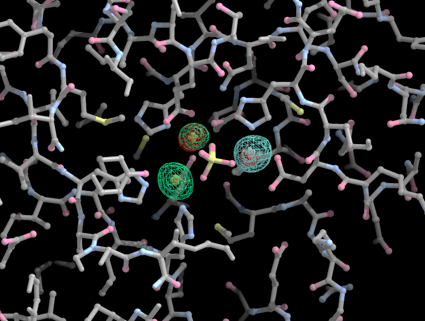
At Diamond, data processing for element analysis can be performed using the Metal ID processing pipeline. Though named "Metal" ID it can in fact be used to identify any element with an absorption edge within a beamline's photon energy range. It takes in scaled and merged diffraction data (in the form of mtz files), along with the protein structure (in pdb format) and outputs a map file (in ccp4 .map format) showing the density corresponding to the element of interest.
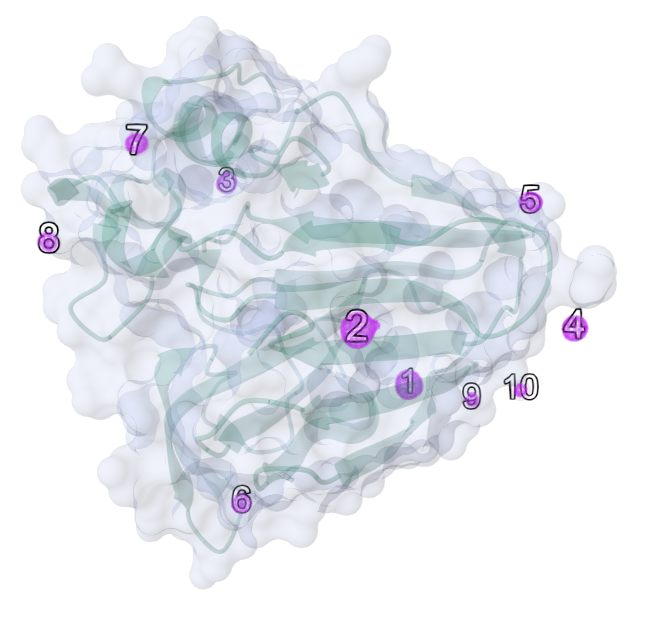
The pipeline works by first running pointless to ensure the two datasets have compatible symmetry and to put the datasets into the same spacegroup. The datasets are then put onto the same scale using SCALEIT. Dimple is then run separately on the above and below data, applying the option to generate anomalous difference maps using ANODE from the SHELX suite of software. The output final.pdb file from the run of Dimple on the above-edge data is used as input to the run of Dimple on the below-edge data to increase likelihood that both runs will return the same structural coordinates. The pipeline then checks that both final.pdb files are similar and uses Coot to generate a difference map of the two anomalous difference maps from each dimple run, which should correspond to the electron density from the element of interest. Peaks in the difference map are then found and a visualisation of the peaks and their location in the protein structure is created as an html file using mol*.
Running Metal ID manually
To use Metal ID, on a Diamond workstation or via a NoMachine session run the following in a terminal session:
module load metal_id
metal_id above_edge.mtz below_edge.mtz structure.pdb
This will create a directory called metal_id and will output results there. A different output directory path can be specified by adding -o path/to/output/directory to the command. The main results files from the pipeline are as follows:
- diff.map - The double anomalous difference map that corresponds to the electron density of the element of interest.
- final.pdb - The final refined protein structure.
- found_peaks.dat - A list of the found peaks in the density map.
- metal_id.html - html file containing an embedded visualiser for viewing the found peaks in the electron density and their location in the protein.
- dimple_above.mtz and dimple_below.mtz - MTZ output files from individual runs of dimple on the above and below data.
Running Metal ID as an automated pipeline
Metal ID has been implemented as an automated pipeline in a very limited capacity. It will run if the data is collected as a MAD wedge type experiment on I23, where repeat wedges are taken at multiple energies of a sample. A PDB file will also need to be uploaded for the sample.
The long-term aim is to implement the Metal ID pipeline on a dedicated Metal ID type experiment that can be conducted in unattended data collection (UDC) mode on other beamlines.

Diamond Light Source is the UK's national synchrotron science facility, located at the Harwell Science and Innovation Campus in Oxfordshire.
Diamond Light Source Ltd
Diamond House
Harwell Science & Innovation Campus
Didcot
Oxfordshire
OX11 0DE
Copyright © Diamond Light Source. Diamond Light Source® and the Diamond logo are registered trademarks of Diamond Light Source Ltd
Registered in England and Wales at Diamond House, Harwell Science and Innovation Campus, Didcot, Oxfordshire, OX11 0DE, United Kingdom. Company number: 4375679. VAT number: 287 461 957. Economic Operators Registration and Identification (EORI) number: GB287461957003.