Instruments by Science Group
 Macromolecular
 Soft Condensed
  Imaging and
 Biological
 Magnetic
 Structures and
 Crystallography
  Spectroscopy
 I14 Contact
I14 Control room:
Tel: +44 (0) 1235 778570
Principal Beamline Scientist:
Majid Kazemian
Email: [email protected]
Tel: +44 (0) 1235 778222
Science Group Leader
Julia Parker
Email: [email protected]
Tel: +44 (0)1235 778924
I14 Hard X-ray Nanoprobe
Status: Operational
Beamsize: 50nm x 50nm
Energy: 5 - 20 keV
Energy: 5 - 20 keV
Energy materials
Materials for solar cells (e.g. perovskites), cathodes for batteries, and in situ imaging of batteries at work are some of the energy materials research topics ongoing at the beamline.
The nano-scale beam is particularly useful for examining the small scale changes that lead to macroscale improvements in efficiency as we drive towards more sustainable energy sources.
Materials for solar cells
Perovskites are a key material of interest for optoelectronic devices including in photovoltaic cells. In collaboration with the Stranks group at Cambridge, we are developing new techniques for imaging these materials in situ in devices as well as on a fundamental level.
For more information: Nanoscale chemical heterogeneity dominates the optoelectronic response of alloyed perovskite solar cells, K. Frohna, 2022, Nature Nanotech., 17, 190-196, https://doi.org/10.1038/s41565-021-01019-7
Faraday Institution - CATMAT project
Paul Quinn (Co-Investigator) and Dorota Matras (PDRA) are part of the Faraday Institution's CATMAT project, which consists of three workpackages: (1) looking into fundamental mechanisms within the nickel-rich and lithium-rich cathode materials, (2) design of new cathode materials with enhanced properties and (3) their synthesis scale up.
Their role is to investigate chemical and morphological changes occuring in the cathode materials, designed within the CATMAT project, by the appplication of X-ray techniques available at the I14 nanoprobe beamline. They are employing the X-ray absorption spectroscopy to investigate changes in the electronic state of the main cathode materials as well as the the X-ray fluorescence spectrosopy to determine the presence and the distribution of chemical elements. They combined these chemical techniques with projection mapping and tomography data collection strategies and to further improve the spatial resolution of the obtained images they also employ ptychography-based techniques.
In addition, they are looking into design of cells suitable for insitu/operando characterisation of battery materials.
Some examples from their work can be found in the following publications and presentations:
(1) Heenan et al., Identifying the Origins of Microstructural Defects Such as Cracking within Ni-Rich NMC811 Cathode Particles for Lithium-Ion Batteries. Adv. Energy Mater. 2020, 10, 2002655.
(2) Dorota Matras, X-ray chemical imaging for characterisation of batteries – from electrode to device level, Faraday Institution Annual Conference 2021, Early career research day.
InFuse Prosperity Partnership
A partnership between Imperial College London, Shell and Diamond Light Source progressing the transition to net zero pollution (InFUSE Prosperity Partnership).
This diversified research group is split into three main silos, each tackling a different aspect of the Energy Transition: 1) Digital Rocks; carbon capture and storage, 2) Fluids and Lubricants; e-mobility, 3) Energy Materials; battery storage.
Connor Wright (PhD at Imperial) and Huw Shiel (PDRA at Imperial, both at Imperial-staff-students); and Miguel Gomez-Gonzalez (co-investigator at Diamond), showcase this partnership with investigations into the high voltage degradation of up-and-coming sodium-ion battery materials. Using cheaper and more earth-abundant materials than their lithium-based counterparts, sodium-ion batteries are widely considered to be the next generation of grid-scale energy storage solutions.
Utilizing the high spatial resolutions available at the I14 nanoprobe beamline, their role is to probe the morphological and chemical evolution of cathode particles at and around their working voltages. By implementing X-ray fluorescence and spectroscopy methods, the team are able to track the distribution of vanadium within single particles of sodium-ion’s archetypal polyanionic cathode material NVP. The aim is to understand why the material degrades so rapidly when pushed beyond its traditional voltage limits, hoping to allow for higher working voltages and, thus, energy densities. Some initial results are shown in Figure 1 below. In addition, X-ray absorption spectroscopies are being employed to track changes to vanadium’s electronic structure within a single 10 mm particle throughout the charge/discharge/overcharge processes.
A key part of the InFUSE Partnership is to develop new, flexible methodologies that would allow the type of investigations mentioned above to be directly correlated to other information accessed at different beamlines. A second-generation prototype of the “sealed system” modular electrochemical cell is currently being developed with the aim of allowing a wide variety of X-ray techniques. The cell will be customisable to accommodate different samples and X-ray regimes (soft, tender and hard), techniques (spectroscopy, imaging or diffraction) and modalities (transmission or fluorescence).
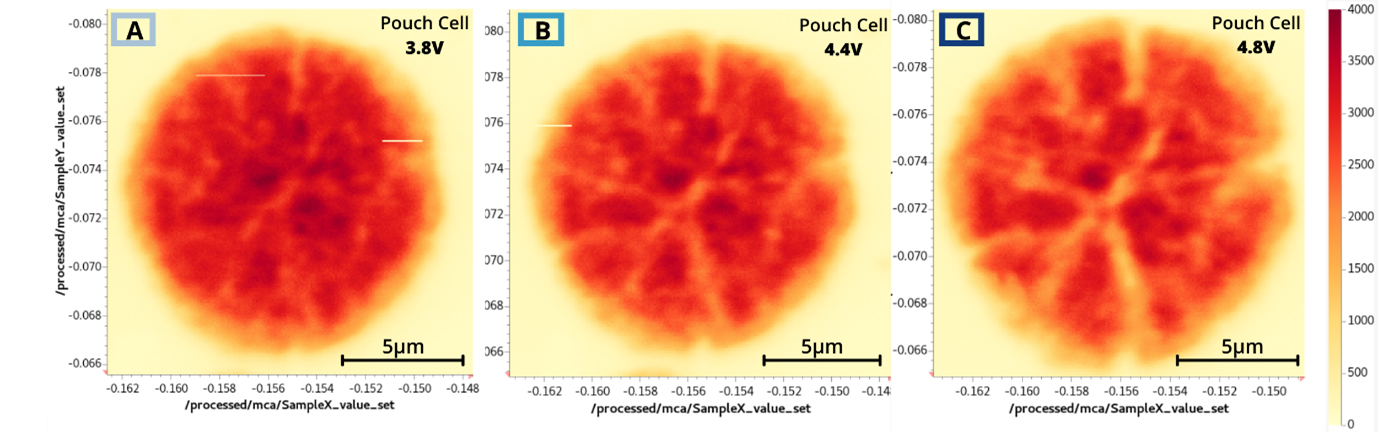
(a) at its regular upper cut-off voltage of 3.8V vs. Na/Na+, (b) overcharged to 4.4V vs. Na/Na+,
and (c) overcharged to 4.8V vs. Na/Na+. Unpublished, manuscript in preparation, all rights reserved.


Diamond Light Source is the UK's national synchrotron science facility, located at the Harwell Science and Innovation Campus in Oxfordshire.
Diamond Light Source Ltd
Diamond House
Harwell Science & Innovation Campus
Didcot
Oxfordshire
OX11 0DE
Copyright © Diamond Light Source. Diamond Light Source® and the Diamond logo are registered trademarks of Diamond Light Source Ltd
Registered in England and Wales at Diamond House, Harwell Science and Innovation Campus, Didcot, Oxfordshire, OX11 0DE, United Kingdom. Company number: 4375679. VAT number: 287 461 957. Economic Operators Registration and Identification (EORI) number: GB287461957003.