Instruments by Science Group
 Macromolecular
 Soft Condensed
  Imaging and
 Biological
 Magnetic
 Structures and
 Crystallography
  Spectroscopy
 I19 Contact
Beamline Phone Number:
+44 (0) 1235 778418
Principal Beamline Scientist:
Dave Allan
Tel: +44 (0) 1235 778644
E-mail: [email protected]
Science Group Leader
Philip Chater
Email: [email protected]
Tel: +44 (0)1235 778677
I19 Small Molecule Single Crystal Diffraction
Status: Operational
Wavelength: 0.5 - 2.5 Å
Energy: 5 - 25 keV
Energy: 5 - 25 keV
Several run lists are now available in the GDA giving coverage with the detector set to either 160 mm (in practice, this is as close in as possible for a reasonable omega sweep) and further back at 300 mm.
At a detector distance of 160 mm, 2θ=30° is the maximum value where the beamstop is still visible.
At a detector distance of 300 mm, 2θ=20° is the maximum value where the beamstop is still visible.
Run lists do not need to be used in their entirety – just select the rows required to be collected.
The Strategies page should provide some guidance to each run list and can used to modify or prepare your own run list.
The standard sphere can be loaded by clicking on the "Load Default Run List" button

Or, other options can be loaded using the "Select Collection Strategy" button.

This will open a window towards the top left of the screen – Default always shows up as the default option.
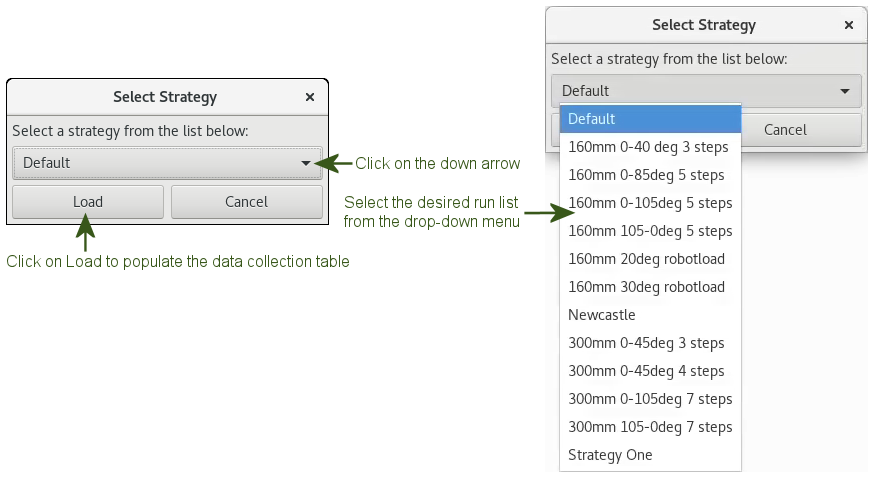
NOTE: The run list selected will overwrite any existing runs in the table.
Things to consider
- Check the folder and prefix fields in the data collection table are empty on loading the run list. Over time, these can become populated and the values in the table take precedence over the names given in the default fields above. Please let a member of staff know if this happens so it can be fixed.
- The first line of all run lists is a screening run consisting of 450 0.1° images – this should not be collected as part of the full dataset.
- The transmission setting is not the same for all run lists – typically the high angle run lists have the transmission set to 100% while the others have the default set at 1% - remember to update the transmission to the appropriate value for the sample.
- The time per image is not consistent for all run lists – generally this is set to 0.2 seconds but the time per image has been increased for the high angle collections - change the image collection times as appropriate.

Diamond Light Source is the UK's national synchrotron science facility, located at the Harwell Science and Innovation Campus in Oxfordshire.
Diamond Light Source Ltd
Diamond House
Harwell Science & Innovation Campus
Didcot
Oxfordshire
OX11 0DE
Copyright © Diamond Light Source. Diamond Light Source® and the Diamond logo are registered trademarks of Diamond Light Source Ltd
Registered in England and Wales at Diamond House, Harwell Science and Innovation Campus, Didcot, Oxfordshire, OX11 0DE, United Kingdom. Company number: 4375679. VAT number: 287 461 957. Economic Operators Registration and Identification (EORI) number: GB287461957003.