Instruments by Science Group
 Macromolecular
 Soft Condensed
  Imaging and
 Biological
 Magnetic
 Structures and
 Crystallography
  Spectroscopy
 Contact
eBIC admin enquiries
Tel: +44 (0) 1235 56 7480
Email: [email protected]
Office hours: 08.30-16.30(UK) Mon-Fri
Science enquiries
Peijun Zhang
Tel: +44 (0) 1235 77 8878
Email: [email protected]
Daniel Clare
Tel: +44 (0) 1235 56 7501
Email: [email protected]
Yuriy Chaban
Tel: +44 (0) 1235 77 8207
Email: [email protected]
Christos Savva
Tel: +44 (0) 1235 77 8976
Email: [email protected]
Vojtech Pražák
Tel: +44 (0) 1235 77 8131
Email: [email protected]
Training enquiries
Lorna Malone
Tel: +44 (0) 1235 394182
Email: [email protected]
Science Group Leader (interim)
Daniel Clare
Email: [email protected]
Tel: +44 (0) 1235 56 7501
Funded by a grant from



eBIC
Status: Operational
Accelerating Voltages: 3-30, 200 & 300 kV
New sample and shipping process - SCAUP
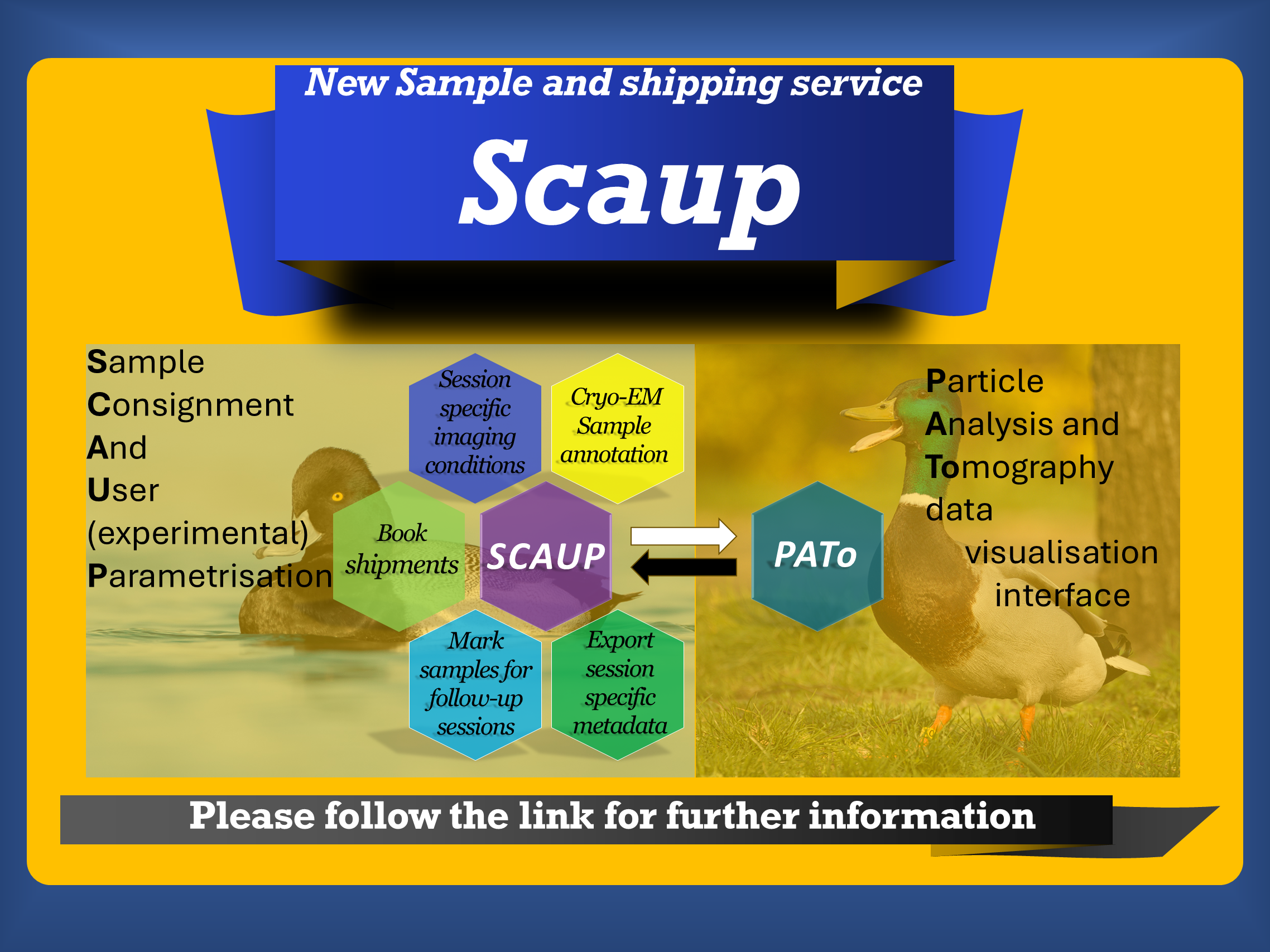
We are pleased to announce SCAUP, a new sample and shipping service to all eBIC users. Now integrated with eBIC PATo, the new Cryo-EM sample and shipping management system offers a streamlined way to record, track, and optimize your experiments. Built specifically for Cryo-EM workflows at eBIC, users can quickly annotate sample details—such as grid type, grid box, and puck type—using intuitive drop-down menus. The new shipping service is intuitive and faster to set up, making your session preparation smoother than ever.
With the newly introduced Sample and Shipping service (SCAUP), users can make more informed decisions based on sample-specific processing statistics. Track sample locations, input imaging parameters like magnification and dose, and directly link processing data to sample conditions—all in one place.
The system doubles as an e-notebook, enabling easy export of comprehensive metadata for your eBIC sessions. Smarter, faster, and fully integrated—PATo and SCAUP take your Cryo-EM session planning and execution to the next level!
For further information on the latest updates, contact details, and step-by-step instructions, please click box below:
Vojta Pražák joins eBIC

May 2026
The electron Bio-Imaging Centre (eBIC) has expanded its senior team with the appointment of Principal Electron Microscopist Vojtěch Prazak. Vojta Pražák brings a strong background in integrative structural cell biology, specializing in cryo-electron tomography (cryoET) and subtomogram averaging to dissect host-pathogen interactions. He joins the facility following postdoctoral work within the teams of Lindsay Baker in Oxford and Kay Grünewald in Oxford and Hamburg. He looks forward to applying this background at eBIC to help strengthen the facility’s in situ and correlative capabilities, translating challenging structural questions into robust, routine workflows.
This appointment marks a strategic push to make advanced, native-context workflows more routine and accessible for researchers studying how filamentous pathogens interact with their plant and animal hosts. This builds upon active, ongoing collaborative projects with key UK research groups in the field, including those led by Neil Gow (University of Exeter), Paul Birch (University of Dundee), Pieter van West (University of Aberdeen), and Tolga Bozkurt (Imperial College London). Vojta has substantial expertise in correlative cryo-FIB lift-out and cryo serial-sectioning for thicker tissues, while also driving the development of super-resolution cryoET to localize rare molecular events via accessible workflows like cryo SOFI and Vulcrom developed with Rainer Kaufmann (University of Hamburg).
Alongside imaging infrastructure, Vojta is integrating laboratory sustainability into eBIC's daily operations. Recognizing that high-end electron microscopy is resource-intensive, he focuses on practical, day-to-day initiatives to reduce laboratory waste and build greener habits into institutional workflows.
BCI user meeting 2026
April 2026
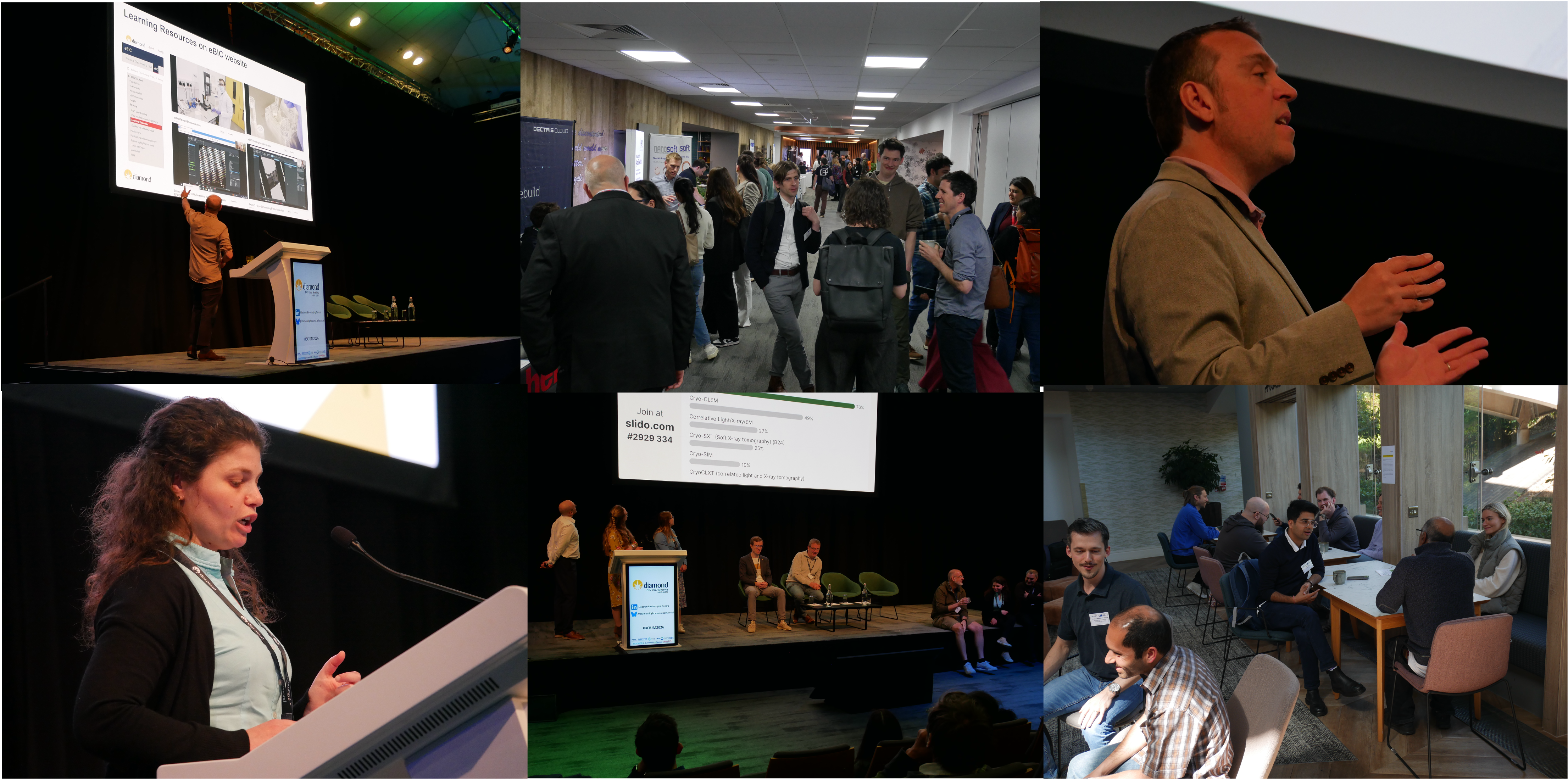
We were delighted to host our annual Biological Cryo‑Imaging (BCI) User Meeting on 22nd April at the East Midlands Conference Centre (EMCC) in Nottingham. The meeting provided an opportunity for delegates to hear about the latest developments at eBIC and B24, learn about cutting‑edge research being carried out by our user community, and contribute to discussions shaping the future direction of biological cryo‑imaging at Diamond.
We would like to thank Alfred Fernández Castañé (Aston University) for presenting his research using correlative microscopy completed at B24 to study magnetotactic bacteria. It was inspiring to see the science being enabled by access to Diamond’s facilities.
We also thank Richard Collins (University of Manchester), Diamond User Committee (DUC) representative, for chairing an engaging and insightful user meeting discussion and stimulating constructive dialogue between attendees and scientists at Diamond. This discussion session provided valuable insight into user priorities for eBIC and B24, including demand for specific imaging and sample preparation techniques, approaches to data processing and archiving, and preferred routes for communication and engagement with the facilities.
In the evening, delegates enjoyed a drinks and buffet reception followed by a ceilidh hosted by Blackbeard’s Tea Party. As always, this networking event offered an excellent opportunity to reconnect with colleagues and establish new collaborations.
We are grateful to our sponsors for making the event possible — Agar Scientific, Dectris, Gatan, JEOL, Nanosoft, Nuclera, Quantifoil, Subangstrom and Thermo Fisher Scientific — and thank Dave Farmer for once again capturing the meeting through his excellent photography.
We are delighted to continue hosting the BCI user meeting alongside CCP-EM’s Spring Symposium, jointly coordinating logistics for one of the largest European forums for disseminating new developments in cryo-EM. Together, these events welcomed 311 in-person delegates and 489 virtual participants this year.
At this year’s CCP‑EM Spring Symposium (23–24 April), the scientific programme showcased emerging approaches in sample preparation, including time‑resolved vitrification and accelerated lamella fabrication, alongside advances in data processing tools. Talks highlighted methods for feature detection and the increasing use of AI and machine learning to support cryo‑EM and cryo‑ET workflows. We were pleased to see Éilís Bragginton and Christian Orr present their work on accelerating cryo-FIB sample preparation with femtosecond laser for lamella, which received lots of interest from attendees.
The symposium also featured two poster sessions displaying over one hundred posters, reflecting the breadth and vitality of current cryo‑EM research. Poster prizes were awarded to Alice Brinkworth (University College London) in session one and Varun Ramaswamy (Institute of Cancer Research) in session two. Thank you to Peijun Zhang, Werner Kühlbrandt and Alexey Amunts for sitting on the judging panel for the Karen Davies Poster Prize this year, which they awarded to Sreehari Gopinathan from Bertram Daum’s lab at the University of Exeter. The Karen Davies Prize, established by Diamond, is intended to commemorate Karen’s work and celebrate her life. It is awarded annually for the best poster presented at the CCP-EM Spring Symposium.
eBIC visit to LMB Cambridge
October 2025
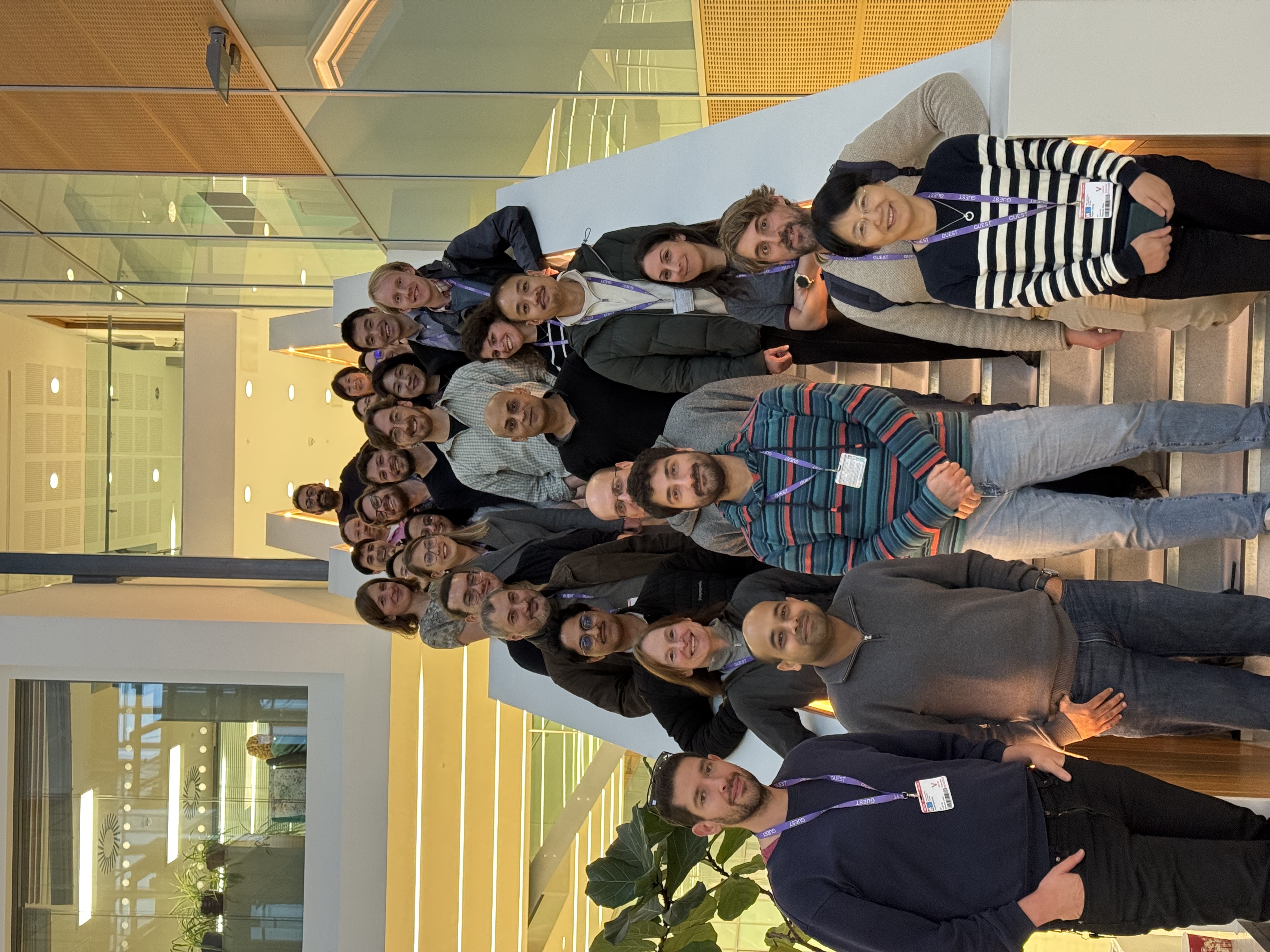
On 30th October eBIC were pleased to visit the LMB Cambridge, together with colleagues from the Rosalind Franklin Institute.
During the day we shared science talks covering a variety of topics, with interesting discussions taking place. eBIC presentations included Stephen Riggs talking about 'Smart data collection and processing at eBIC', and Zhen Hou presenting on 'In situ visualisation of HIV-1 nuclear import and intranuclear trafficking'.
Many thanks to Shaoxia Chen and her team for hosting our group, we look forward to your return visit to eBIC.
In Situ cryoET training course at eBIC
September 2025
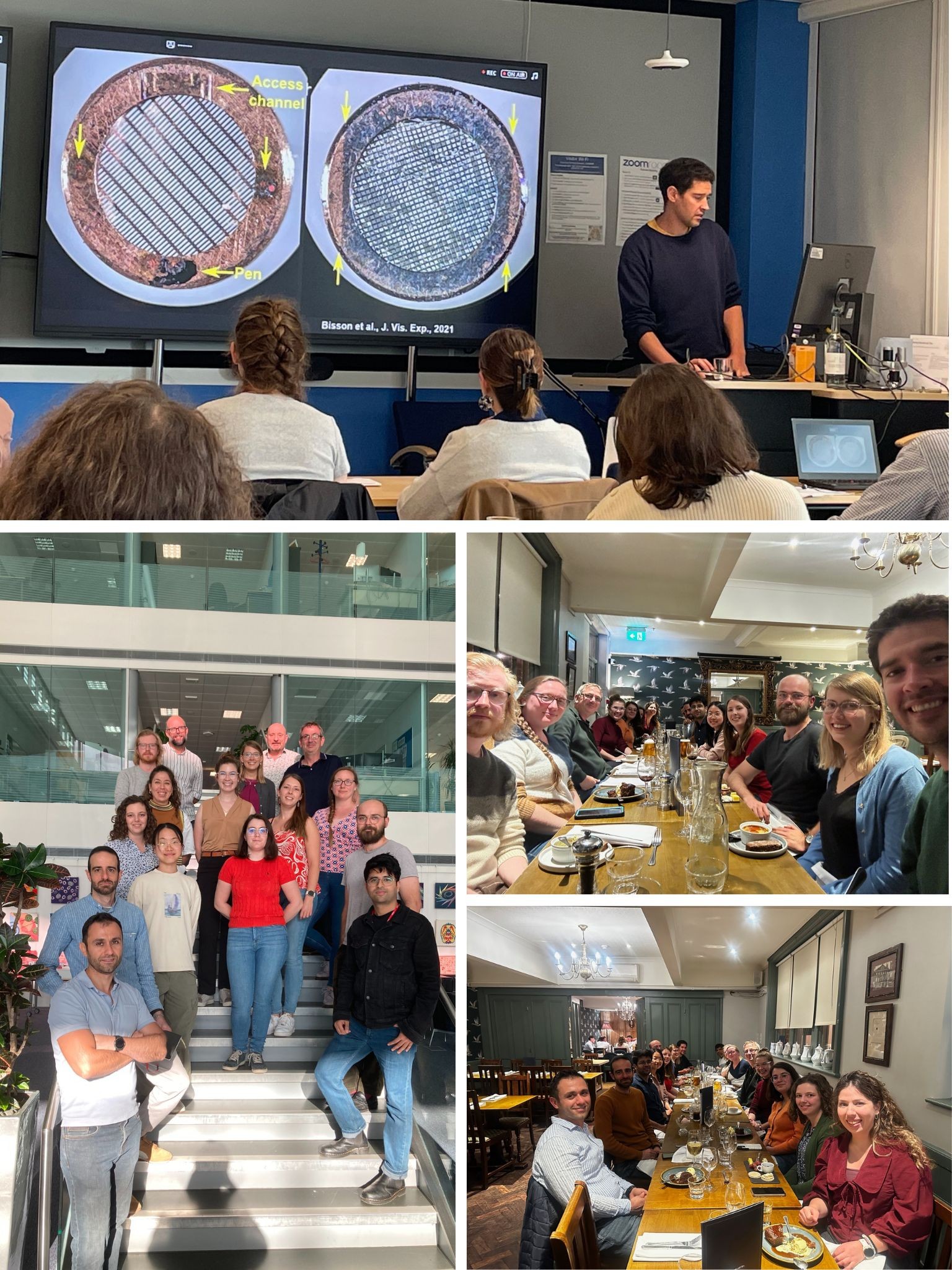
The eBIC In Situ Cryo-ET Course came to a successful conclusion this past Friday (12th Sept).
Our on-site delegates received lectures and hands-on practicals on a wide variety of subjects including sample prep, FIB-milling and cryo-ET data collection. We finished off the week with a data processing demo/practical.
More details on the course and link to the programme available here: In Situ cryo-ET course
We would like to thank all those who participated on-line and in person and our terrific instructors and lecturers who made this possible.
LinkedIn: electron Bio-Imaging Centre (eBIC)
New Demo Videos Now Available on Our Learning Resources Page
August 2025
We’re excited to share several demo videos now available on the Learning Resources section of our website, covering both sample preparation and data collection workflows.
For sample preparation, you’ll find a video guide on how to plunge freeze samples using a Vitrobot—a technique widely applicable to a range of samples from purified proteins to isolated organelles. We’ve also made a new demonstration specifically for those working with cells adhered to grids. This video walks you through the full workflow: from preparing and seeding the grids, all the way to plunge freezing using the GP2.
On the data collection side, we’ve uploaded in-depth video tutorials on setting up EPU and TOMO sessions at eBIC, recorded during recent training courses. These step-by-step guides are ideal for both new users and users looking for a refresher. You can use them in combination with your user guide to prepare for and support your session.
Visit our Learning Resources page to explore the videos.
Conceptual Course in Macromolecular Structure Determination
July 2025
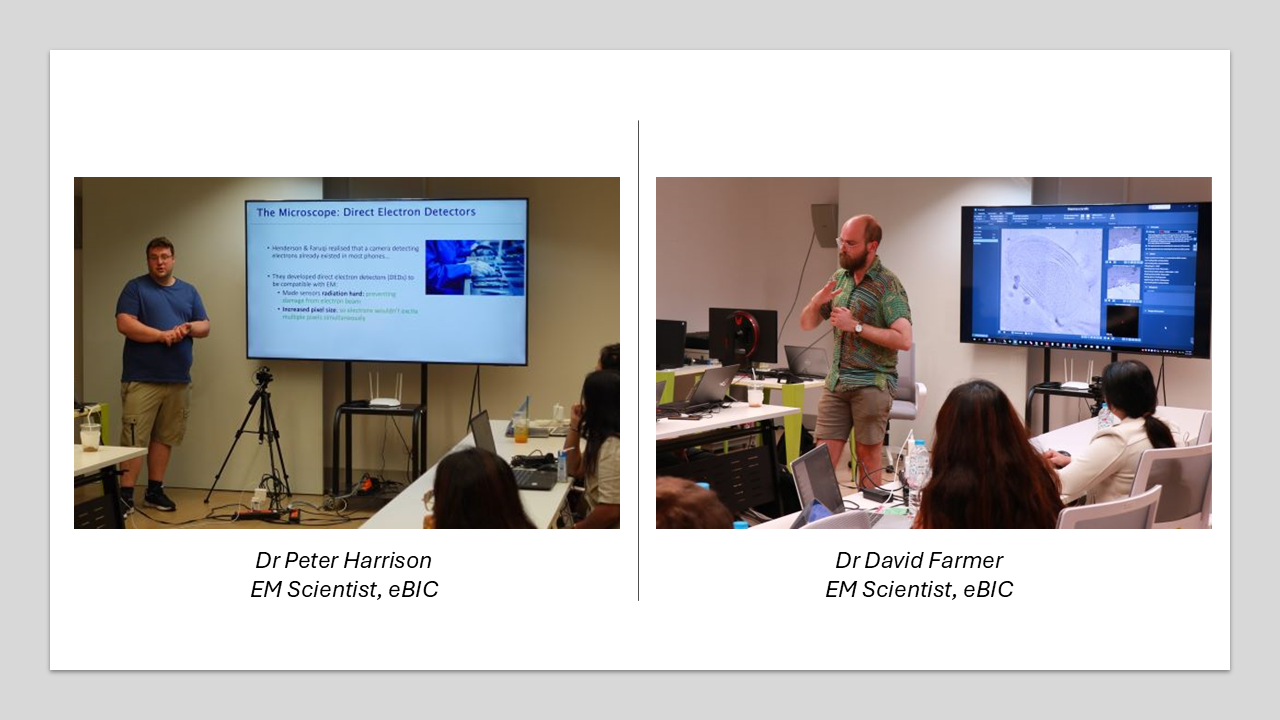
Staff from eBIC and CCP-EM recently participated in a ‘Conceptual Course in Macromolecular Structure Determination’ at King Mongkut's University of Technology in Bangkok, Thailand. David Farmer and Peter Harrison from eBIC gave an overview of electron microscopy and explained the fundamentals of single particle cryoEM and tomography. Attendees were also given a hands on session with one of eBICs 200 keV microscopes. George Coldstream and Nick Whyatt from CCP-EM delivered a structure determination and model building workshop with Doppio and the CCP-EM suite.
"Thanks so much for joining us in Bangkok last month, we enjoyed having you guys here and are
grateful for your contribution to the course. It made everybody's experience much more enjoyable."
Leela Ruckthong & Nukri Sanishvili, organisers of the course held at KMUTT

Diamond Light Source is the UK's national synchrotron science facility, located at the Harwell Science and Innovation Campus in Oxfordshire.
Diamond Light Source Ltd
Diamond House
Harwell Science & Innovation Campus
Didcot
Oxfordshire
OX11 0DE
Copyright © Diamond Light Source. Diamond Light Source® and the Diamond logo are registered trademarks of Diamond Light Source Ltd
Registered in England and Wales at Diamond House, Harwell Science and Innovation Campus, Didcot, Oxfordshire, OX11 0DE, United Kingdom. Company number: 4375679. VAT number: 287 461 957. Economic Operators Registration and Identification (EORI) number: GB287461957003.