-
annual review
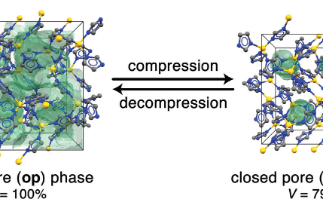
Over the past few years, responsive materials - materials that change their structure when chemical, thermal, or mechanical stimuli
are applied - have been studied extensively. A team of researchers used high-pressure X-ray diffraction on the Extreme Conditions
beamline (I15) to study stimuli-responsive metal-organic frameworks (MOFs), a class of synthetic, crystalline, and porous materials
constructed from organic and inorganic building units. Some MOFs are known to be flexible, and to ...
-
annual review
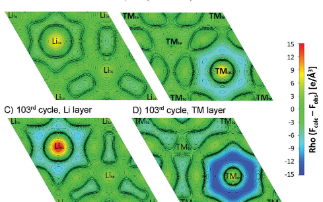
Climate change, dwindling supplies of fossil fuels, and growing environmental awareness are all contributing to a surge of interest in electric vehicles. However, battery-powered electric vehicles cost more, and have a shorter range, than petrol/diesel vehicles, due to the energy density of lithium-ion batteries, for which cathode materials are currently a limiting factor.
-
annual review
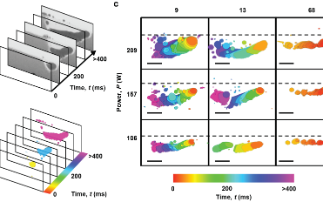
A type of 3D printing called laser additive manufacturing (LAM) uses a high-energy laser beam to melt powder particles into a solid
structure in under 1/1000th of a second. The powder melting process controls how materials are formed, governing the overall product
performance. However, the fast laser-material interaction makes it difficult to optimise the processing conditions, resulting in
defects. The presence of defects slows down the adoption of LAM for safety-critical engineering ...
-
annual review
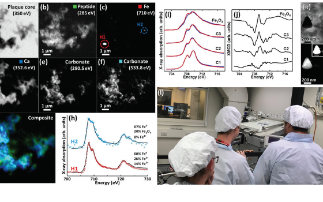
Alzheimer’s disease is the most common form of dementia, yet its cause is unclear and there is no effective treatment. A hallmark of
Alzheimer’s disease is the formation of amyloid plaques in the brain that disrupt its normal function. There is also an imbalance of
metals, with increased levels of iron and harmful reactive iron forms being associated with amyloid plaques.
-
annual review
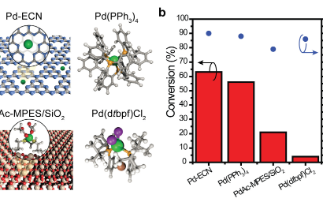
The chemical industry produces a tremendous amount of waste. Often this arises from the need to separate the product from a solution
containing by-products and a dissolved catalyst. 85% of all industrial chemical processes use catalysts, chemicals that speed up a
reaction but do not get used up in the process, and they are often expensive metals such as palladium.
-
annual review
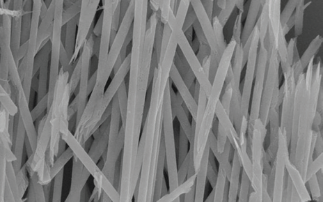
Aragonite is a common crystalline form (polymorph) of calcium carbonate, an important biomineral found, for example, in
seashells. Outside of the natural environment, aragonite usually only crystallises from solution at high temperatures, or in the
presence of magnesium ions. However, although organisms can readily form aragonite, the way in which they do so remains
unclear.
-
annual review
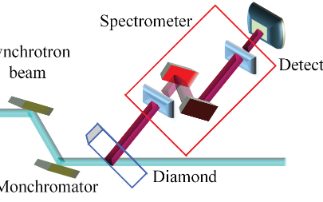
An international team of researchers has demonstrated a novel method for studying the microscopic structure of chemical bonds,
the valence electron density of crystals, and light-matter interactions at the atomic scale resolution, with synchrotron radiation.
-
annual review
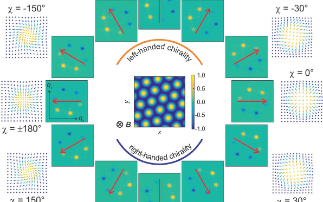
Magnetic skyrmions are promising candidates for the next generation of memory devices as they allow increased storage density,
and require less energy.
-
annual review
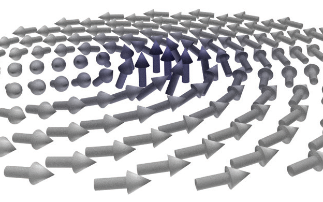
Computers based on silicon are energy-hungry, and the search for energy-efficient alternatives is increasingly important. Electronic
components based on insulating magnetic oxides should be much more efficient at storing and manipulating information. In order
to operate at room temperature, such devices would rely on the presence of ‘magnetic knots’ (vortices), which would protect stored
information from thermal fluctuations.omputers based on silicon are energy-hungry, and the search for ...
-
annual review
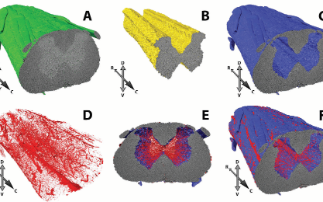
C
omplementary techniques that can maximise information derived from precious soft tissue samples are extremely valuable. A team
from the Wolfson Centre for Age Related Diseases wanted to use 3D imaging to track how disease spreads through spinal tissue,
followed by traditional 2D histology to probe the regions of interest identified in these scans at the molecular level. However, most 3D
imaging methodologies require tissue preparation that prevents its subsequent use, or are too slow ...