-
highlight
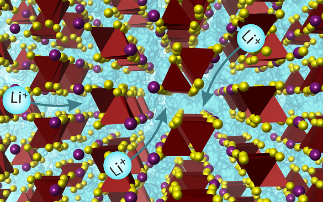
Batteries are a critical technology for the transition to a sustainable energy economy. Rechargeable lithium ion (Li ion) batteries power
-
highlight
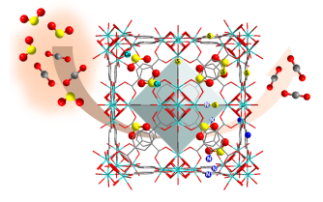
Researchers from the University of Manchester used Diamond's B22 and I11 beamlines to enable the visualisation of Zr-MOFs at the atomic level
-
highlight
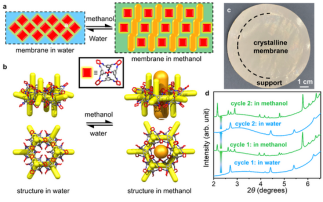
A team of researchers from the University of Liverpool and Imperial College London aimed to fabricate a crystalline membrane using a porous organic cage molecule (POC)
-
highlight
Synchrotron studies show an aluminium compound can remove toxic chromium from polluted water
-
highlight
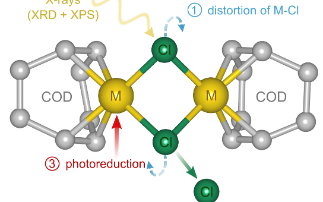
A systematic study is helping to quantify the effect of X-rays on small molecular systems.
-
highlight
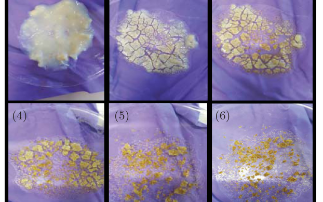
Researchers find a simple way to make analogue dust samples could shed light on early solar system history
-
highlight

Researchers at Diamond used the I11 beamline to track X-ray diffraction data from clathrate hydrates to help understand the Martian Cryosphere
-
highlight
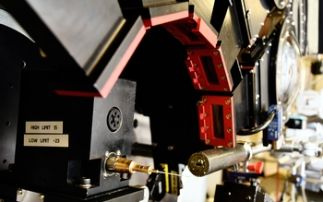
Collaborative research at Harwell Campus paves the way for innovation
-
highlight

Two unique facilities working together
-
highlight

Improving health & safety in nuclear power stations
-
highlight
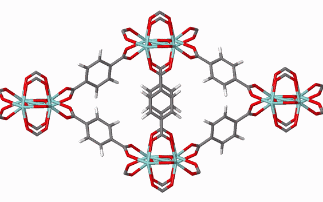
Characterising the structure of breathing MOFs
-
highlight
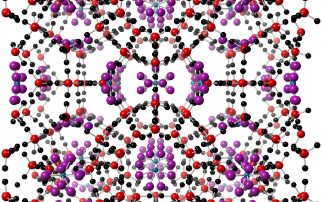
Experimental measurements shed new light on icy moons
-
highlight
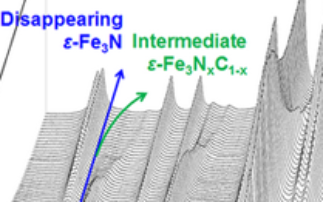
Watching a fuel cell catalyst grow
-
highlight
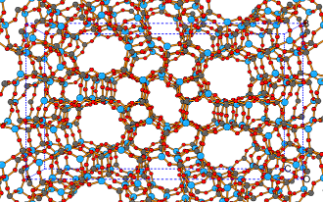
X-ray diffraction measurements aid solving of most crystallographically complex zeolite structure published to date
-
highlight

A collaboration of scientists from the University of Nottingham, STFC’s ISIS Neutron and Muon Source, Diamond Light Source, the University of Oxford and Peking University in China, have created a new low-cost material that can capture harmful gases, offering exciting prospects for combating atmospheric pollution.
-
highlight
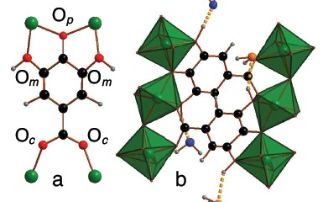
Inorganic-organic frameworks, particularly metal-organic frameworks (MOFs), have attracted considerable attention over the last decade because they exhibit a wide range of interesting physical properties.1 These include the ability to store or separate gases and perform catalytic reactions in nanoporous MOFs; while fascinating magnetic and electronic properties are found in denser frameworks. The transition metal gallate frameworks, M(C7HxO5)·2H2O (M = metal and x = 3 or 4) have ...
-
highlight
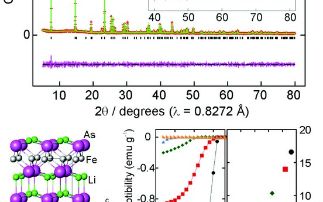
A range of techniques have been used to show that the behaviour of the superconductivity in LiFeAs is quite different from that in the other iron arsenide superconductors, and the system shows some similarities with the FeSe system.
-
highlight
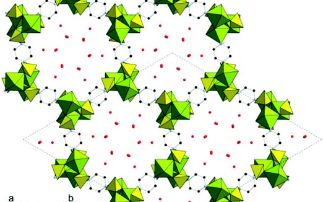
Crystalline porous solids, such as aluminosilicate zeolites have achieved widespread use in commercial processes of adsorption and catalysis. However, they are limited for many fine chemical conversions of complex organic molecules by the size of their pores, which typically do not exceed 1 nm. Mesoporous silicas are known with pore sizes of 3 nm upwards, but these lack long range order, so that crystallography cannot be used to measure, understand and improve their catalytic performance. ...
-
highlight
Combinatorial high-throughput screening at Diamond may prove useful in discovering novel bulk hydrogen storage materials, according to new research published this month in the Royal Society of Chemistry’s Faraday Discussions journal.
A team of researchers from the ‘HyStorM’ project, a collaboration between Oxford University, Johnson Matthey, Ilika Technologies and the ISIS facility, funded by the Technology Strategy Board, used innovative high-resolution Powder X-Ray Diffraction (XRD) ...
-
highlight
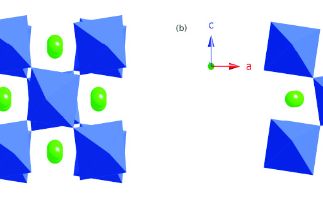
A polar phase of the perovskite NaNbO3 has been successfully synthesised using sol-gel techniques. Detailed characterisation of this phase has been undertaken using high-resolution powder diffraction (X-ray and neutron) and 23Na multiple-quantum (MQ) MAS NMR, supported by second harmonic generation (SHG) measurements and density functional theory (DFT) calculations. Samples of NaNbO3 were also synthesised using conventional solid-state methods and were observed to routinely comprise a ...
 Macromolecular
 Soft Condensed
  Imaging and
 Biological
 Magnetic
 Structures and
 Crystallography
  Spectroscopy