Instruments by Science Group
 Macromolecular
 Soft Condensed
  Imaging and
 Biological
 Magnetic
 Structures and
 Crystallography
  Spectroscopy
 I11 Contact
Beamline Phone Number:
+44 (0)1235 778905
Principal Beamline Scientist:
Stephen Thompson
Tel: +44 (0)1235 778546
E-mail:
[email protected]
Science Group Leader
Philip Chater
Email: [email protected]
Tel: +44 (0)1235 778677
I11 High Resolution Powder Diffraction
Status: Operational
Wavelength: 0.5-2.1 Å
Energy: 6-25 (30*) keV - optimised at 15 keV
Energy: 6-25 (30*) keV - optimised at 15 keV
The call for proposals for Long Duration Experiments is OPEN
for the Period of Mar 2026 - Dec 2027
The deadline for proposal submissions is Friday 27th Feb 2026, 17:00hrs UTC/GMT
With the dark period for the Diamond-II upgrade starting December 2027 and the LDE facility likely to be closed during that period, there is now a time-limited opportunity for implementing targeted experiments able to take advantage of the unique capabilities of this facility.
To make best use of the time remaining, experiments that can use existing LDE sample environments, or compatible ready-made environments that are easy to integrate, will receive priority. Although I11 LDE experiments can in principle run for years, shorter experiments of around a few months duration are also invited.
If you wish to make an enquiry, please contact beamline scientists Dr. Sarah Day and/or Dr Stephen Thompson.
Please also refer to the technical information (in the tabs above) and our Application Guidelines.
About the LDE Facility
To complement the existing I11 high resolution and fast time-resolved facilities, the LDE facility opens up new opportunities for those experiments which require weeks to months of periodically monitoring “slow” changes.
LDE measurements are performed once per week, nominally every Monday, with each experiment having up to 2 hours of data collection with beam. No data will be collected during the regualr shutdown periods, however, sample environments can continue to run during this time.
It is of particular benefit to research areas where important information on the development of phases over time cannot be obtained via ex-situ methods (e.g. batteries, fuel cells).
Other research areas that will similarly benefit include studies of crystallisation, gas storage, mineral evolution, seasonal effects, thermal and electrical power cycling and corrosion science, etc.
The key instrumental parameters for the LDE upgrade are given below. A large second experimental hutch (EH2) houses the LDE facility and a new larger control room and lab space have been constructed to the side of the beamline.
| Energy range: |
25 keV |
| EH2 size: | ~5 x 8 m |
| Beam size: | 400 um2 |
| Photon flux: | ~1013 phs/s/0.1% at 25 keV |
| Detector: | Pixel area detector, active area of 420x420 mm2 or bigger, pixel size = 200 um or less, speed = minutes – ms per frame (pattern) |
LDEs are mounted on a large sample table equipped with adjustable linear drives, to automatically and periodically move sample cells in and out of the beam. A Pixium area detector is driven by a motorised stage to record diffraction patterns. LDEs are set up and left in place with programmed automated data collections. Sample environments such as cryogenic systems, incubators, heating stages, climate simulators and high pressure gas cells can be accommodated for user operation.

Schematic of the LDE Hutch during experiments
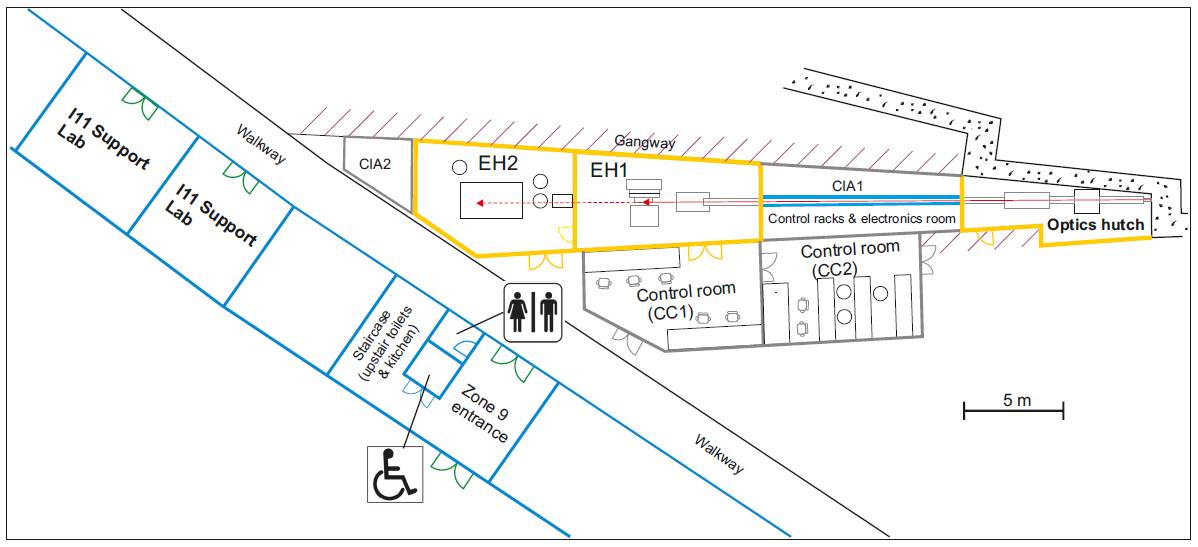
Schematic layout of the new hutches and control cabins
The end station (EH2) is equipped with suitable components to allow multiple sample environments or cells to be accommodated, so as to maximise the number of experiments running in sequence. Below is the schematic layout of the components and equipment for EH2. The diagnostic table (1) provides a platform for beam monitoring equipment, focussing optics, slits to condition the beam and other components. LDE sample cells are mounted on various platforms (large goniometers, sample tables and a robotic carousel - (2) to (6)).
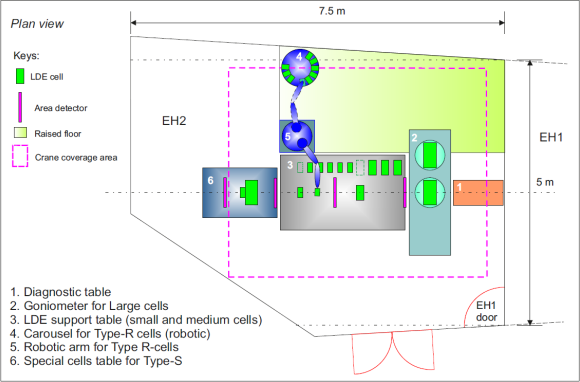
Schematic layout of experimental components and equipment in EH2
We define five groups of sample cells or environments:

(i) Small cells with services (electrical, water and/or other coolants). These are small scale environments which could have heating, cooling, liquid circulation or electrical cycling to study long term effects of materials subjected to these conditions, e.g. seasonal changes, solution crystallisation and charged/discharged battery materials.
(ii) Medium cells with services (electrical, water and/or other coolants). Their functions are very similar to the small cells, but have a larger capacity to handle more material, or allow space or more services.
(iii) Large cells with services (electrical, water and/or other coolants). These are heavy duty systems to simulate industrial conditions, e.g. alloy degradation under tension and humidity effect in pharmaceuticals in large volume storage. Each sample environment should be placed on a goniometer (heavy duty) to be manipulated into position.
(iv) Small cells (Type-R) are cells with the size module defined in 1, but without the service requirement. These will be stored on a carousel or shelves and designed with a locating pin for pick/place by robotic arm. These are for self contained systems such as slow chemical reactions, corrosion or the aging of materials such as pharmaceuticals and biofuels.
(v) Special cells (Type-S) are those that do not fit to any of the above specifications and will be treated as special cases to be dealt with individually. A platform with sufficient room will be set aside to accommodate one or two such cells.
The dimensions and other specifications for these classes are summarised in the table below. The classification of an individual cell is important, allowing its assignment to a particular platform or stage stated in the table and above figure.
Summary of LDE sample cell classification.
| Class |
Cell dimensions (mm) |
Weight (kg) |
Services* required | Platform, stage | No. of bases |
| (i) Small cell | ≤ 100x100x50 |
≤ 2 |
yes | Large sample table (3) |
6 |
| (ii) Medium cell |
≥ 100x100x50 ≤ 300x300x150 |
≥ 2 ≤ 5 |
yes | Large sample table (3) |
4 |
| (iii) Large cell |
≥ 300x300x150 ≤ 500x500x300 |
≥ 5 ≤ 30 |
yes | Heavy-duty goniometer (2) |
2 |
| (iv) Type-R | ≤ 100x100x50 |
≤ 2 |
No (robotic) |
Carousel/ shelf (4,5) |
10 |
| (v) Type-S | TBD (user) |
TBD |
TBD | TBD (6) |
TBD |
* Services include electricity, gases, water and/or other coolants, etc.
Technical drawing of the LDE End Station highlighting the locations of the large (L), medium (M) and small (S) sample cells

Technical drawing of the sample hotel, where small cells will be stored when not being studied on the beamline
The current suite of cells/environments consists of:
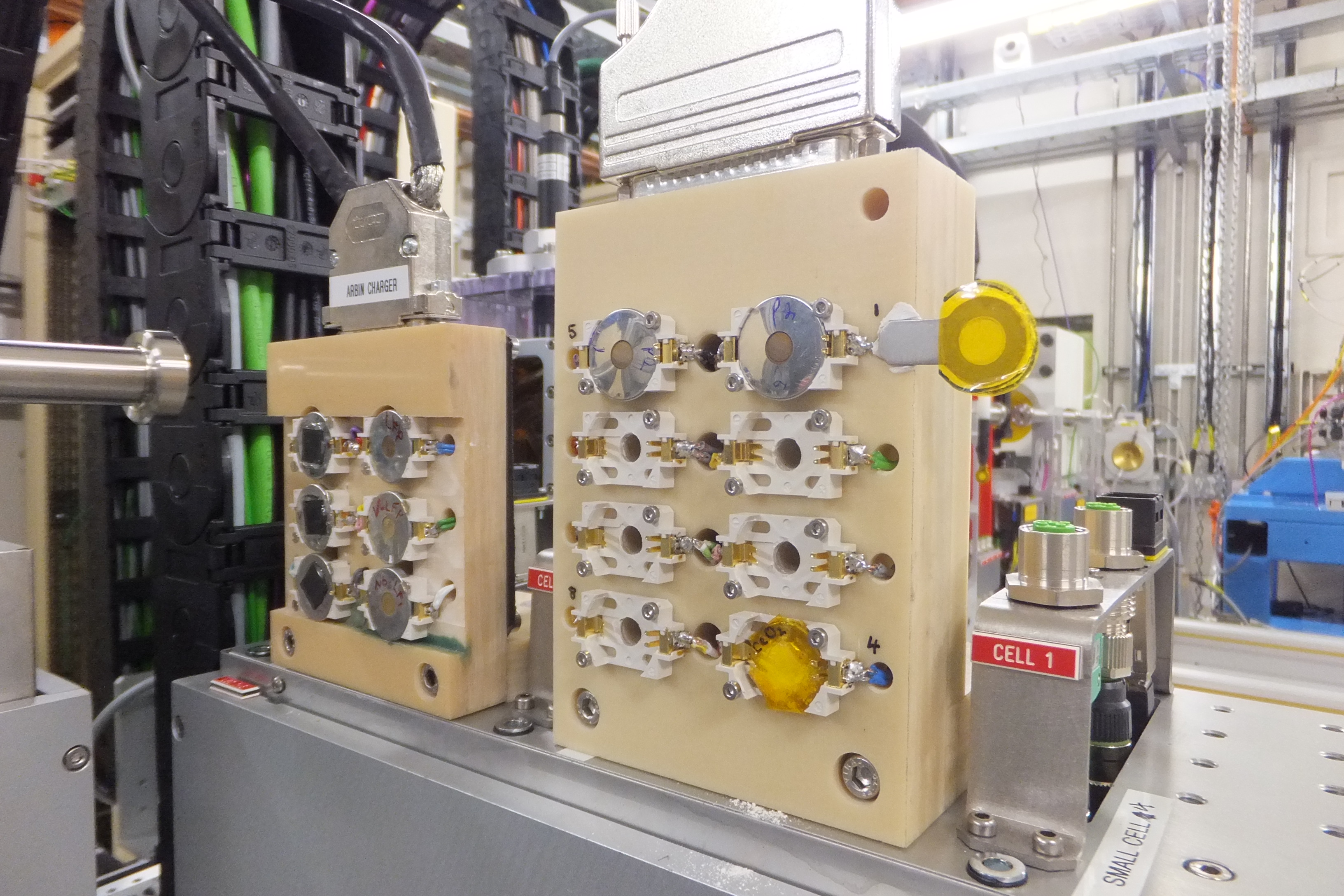
· Operando battery cycling for multi-cell experiments using dedicated potentiostats. CR2032 coin cells, Ampix-style cells and pouch cells can be accommodated. Off-line preparation facilities including moisture-free Ar Glovebox, Hohsen 2032 coin cell crimper and de-crimper, and vacuum and Buchi ovens for drying cell components are available.
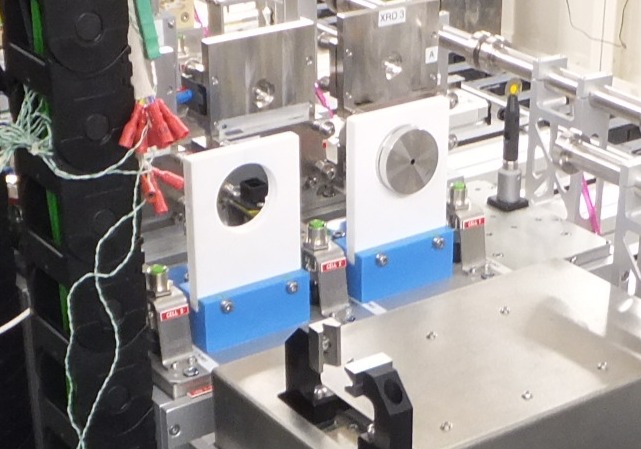
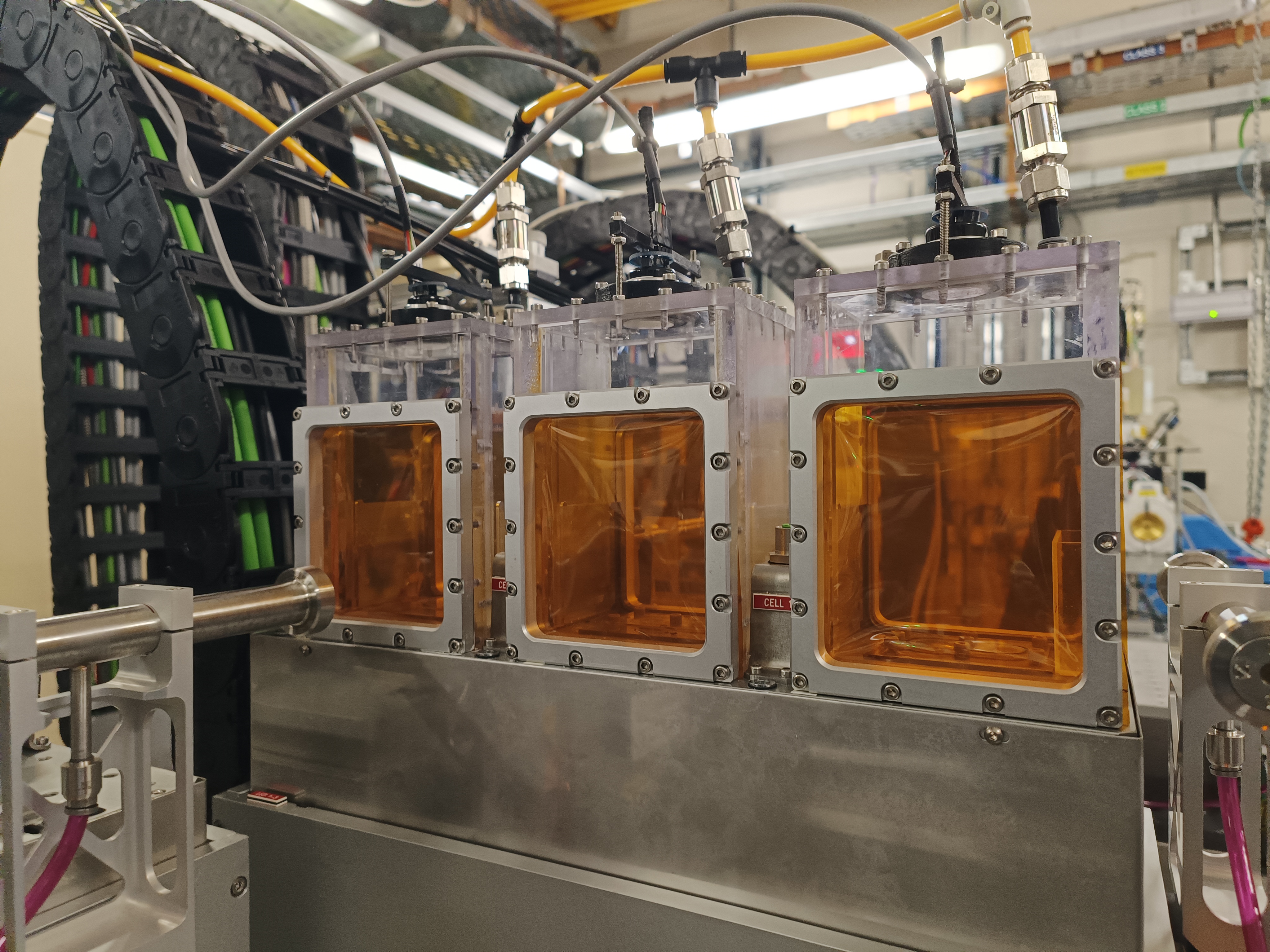
· Three multi-sample, controlled humidity and inert atmosphere chambers.
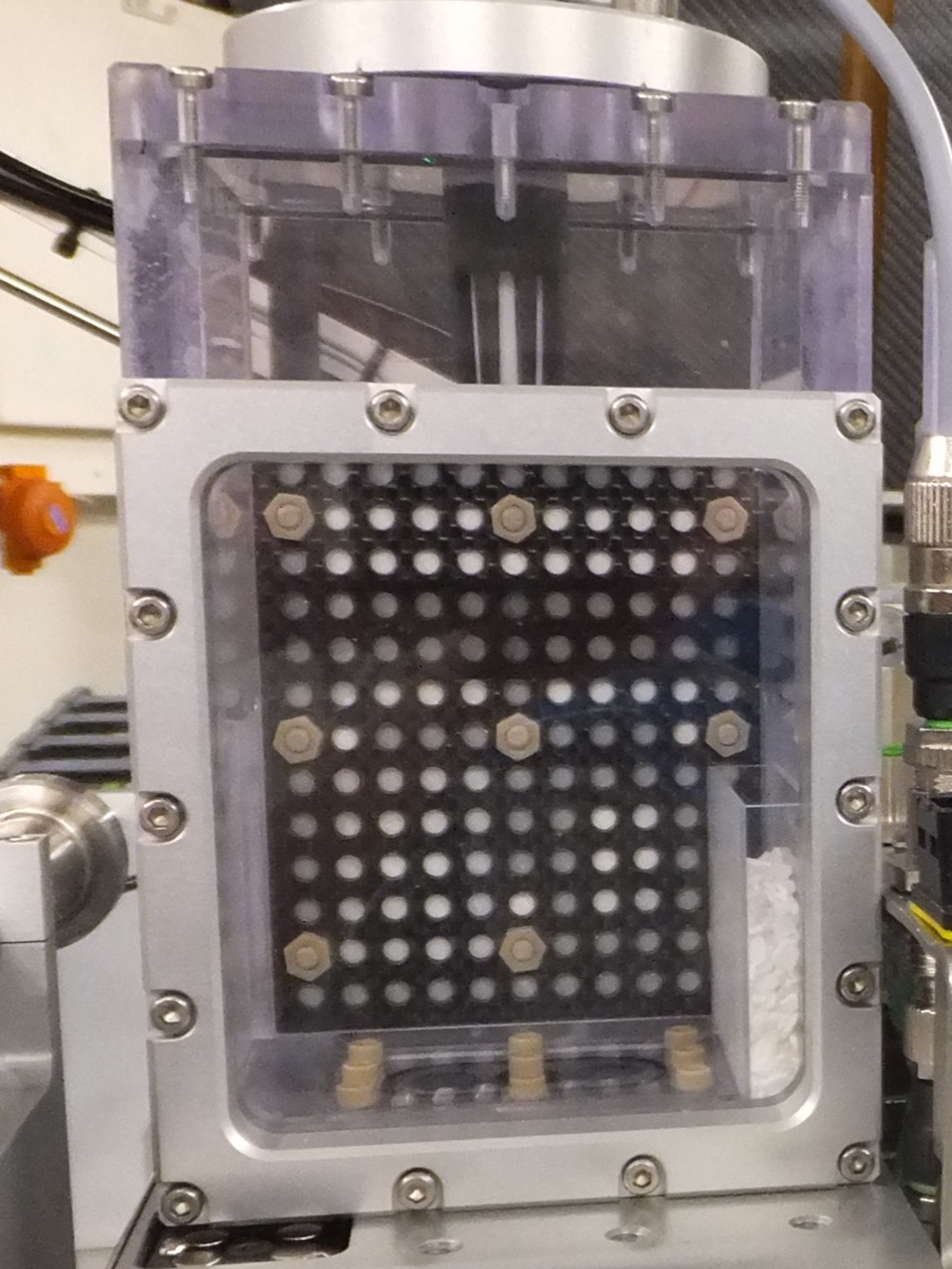
· Two Low fixed-pressure gas cells.
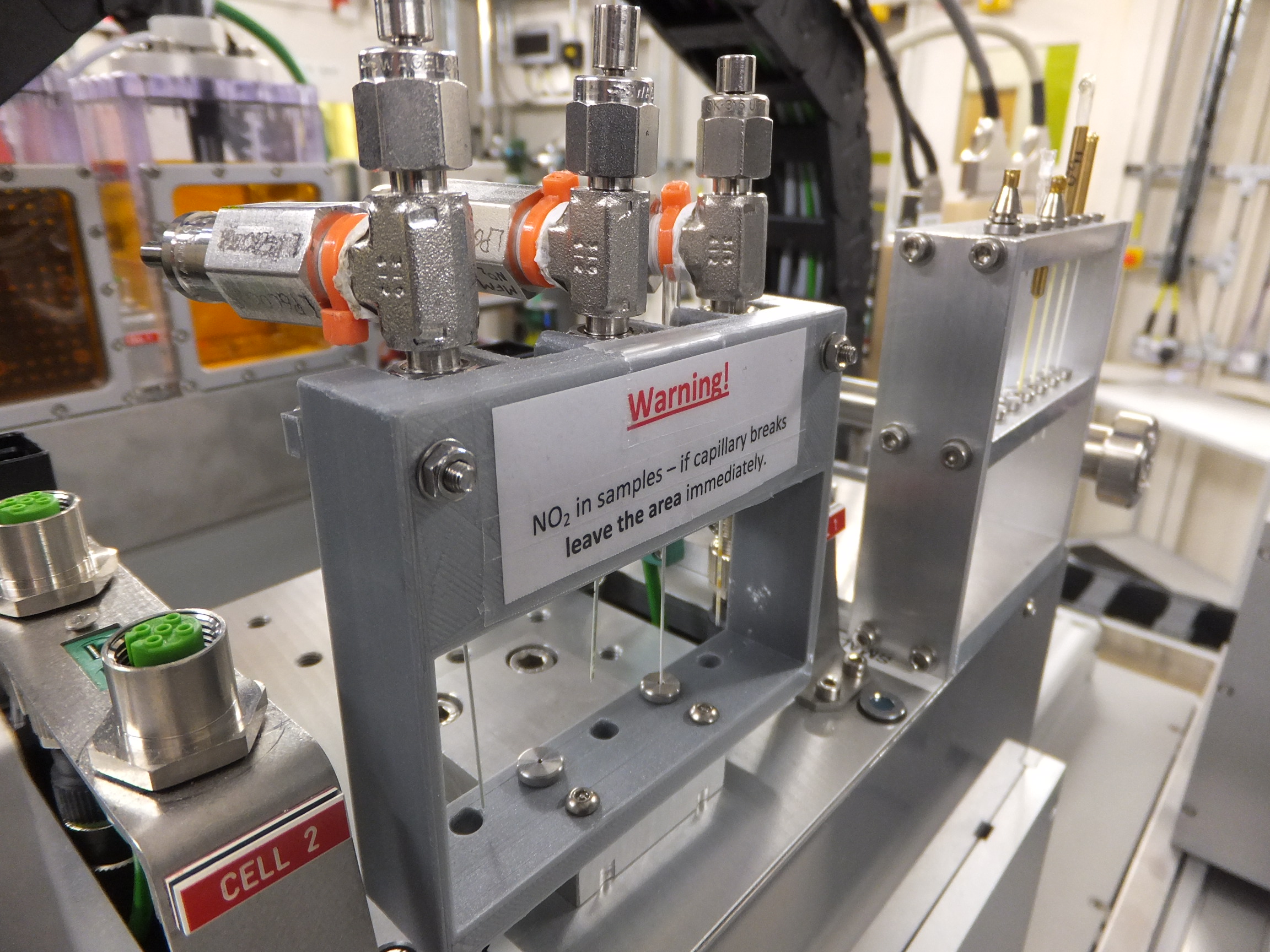
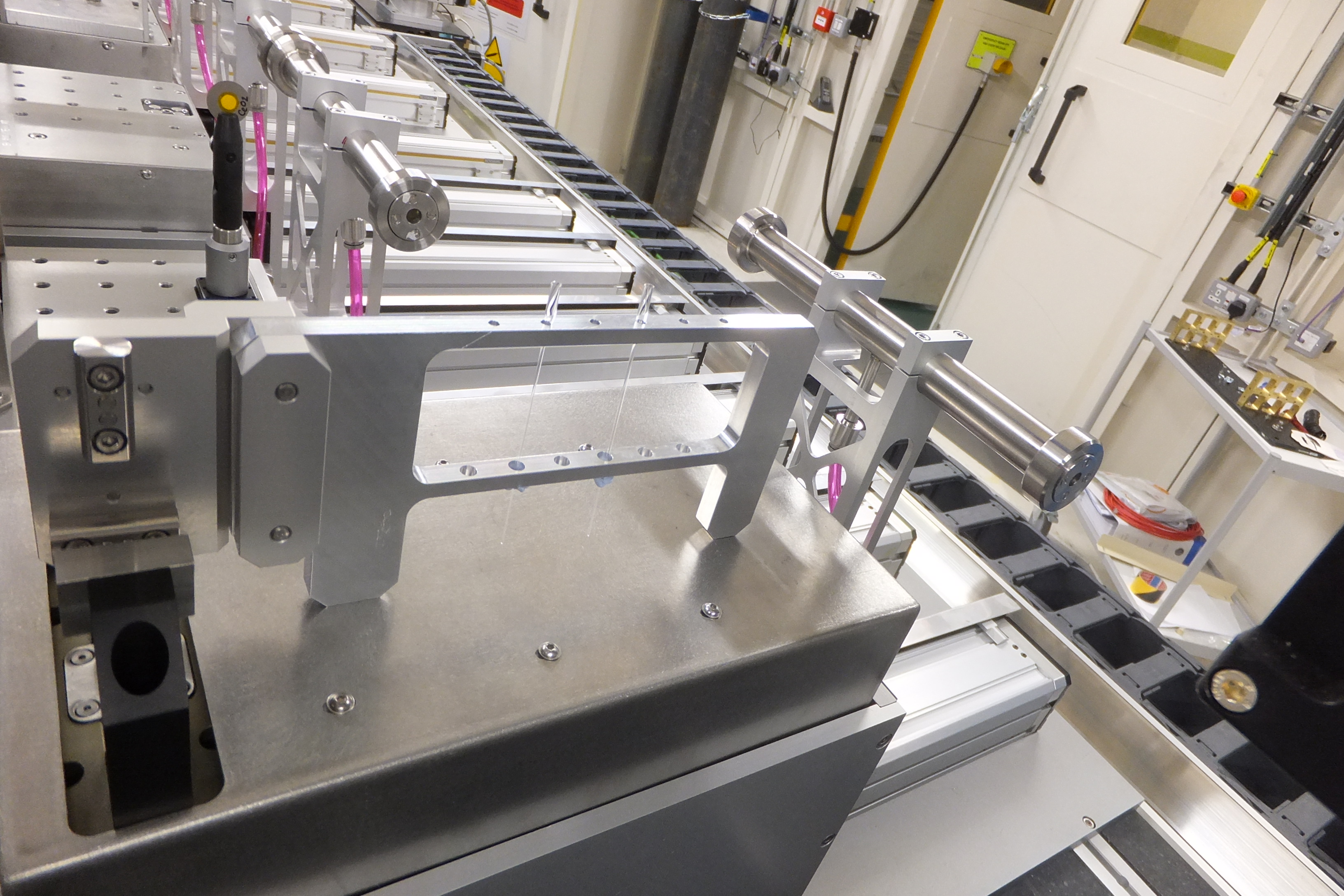
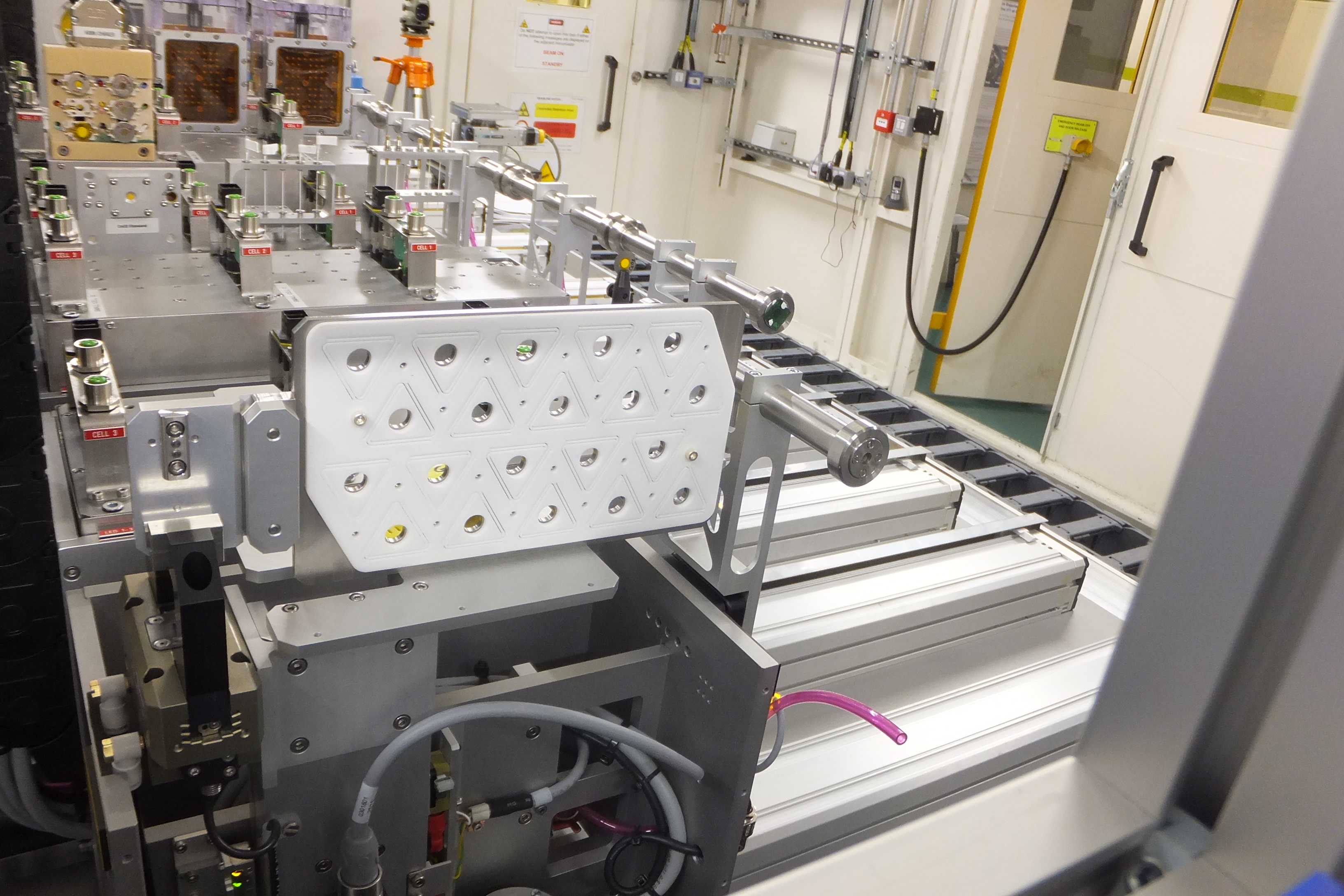
· Robotic arm and multi-sample well plates for ambient ageing and curing.
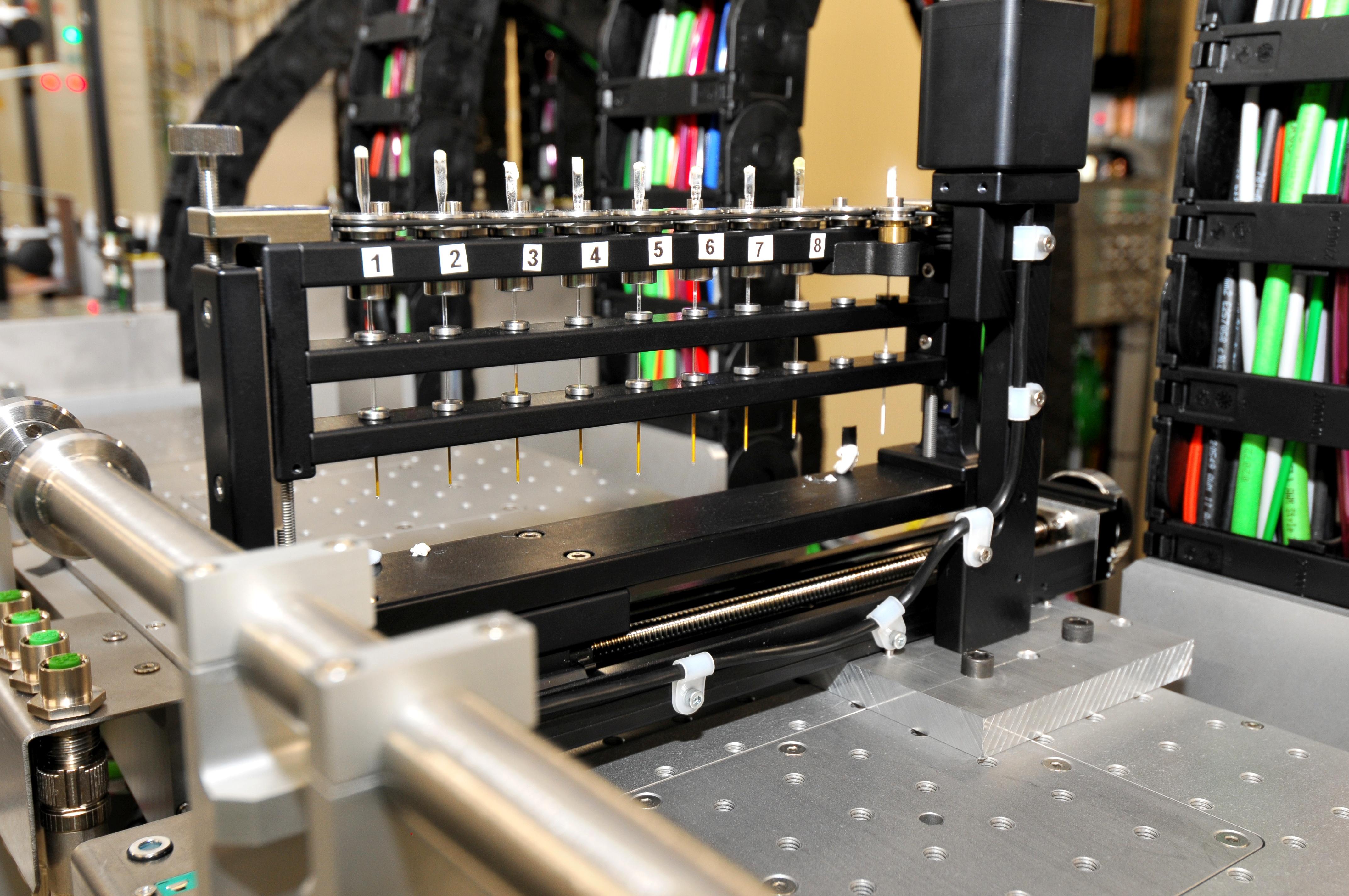
· Nine-position capillary spinner for ambient ageing/curing.
We are also open to working with users to design other suitable sample environments should those above not be suitable. These woudl need to be designed to fit onto the pre-existing stage bases as defined below:
(i) Small cells with services (electrical, water and/or other coolants). These are small scale environments which could have heating, cooling, liquid circulation or electrical cycling to study long term effects of materials subjected to these conditions, e.g. seasonal changes, solution crystallisation and charged/discharged battery materials.
(ii) Medium cells with services (electrical, water and/or other coolants). Their functions are very similar to the small cells, but have a larger capacity to handle more material, or allow space or more services.
(iii) Large cells with services (electrical, water and/or other coolants). These are heavy duty systems to simulate industrial conditions, e.g. alloy degradation under tension and humidity effect in pharmaceuticals in large volume storage. Each sample environment should be placed on a goniometer (heavy duty) to be manipulated into position.
(iv) Small cells (Type-R) are cells with the size module defined in 1, but without the service requirement. These will be stored on a carousel or shelves and designed with a locating pin for pick/place by robotic arm. These are for self contained systems such as slow chemical reactions, corrosion or the aging of materials such as pharmaceuticals and biofuels.
(v) Special cells (Type-S) are those that do not fit to any of the above specifications and will be treated as special cases to be dealt with individually. A platform with sufficient room will be set aside to accommodate one or two such cells.
The dimensions and other specifications for these classes are summarised in the table below. The classification of an individual cell is important, allowing its assignment to a particular platform or stage stated in the table and above figure.
Summary of LDE sample cell classification.
| Class |
Cell dimensions (mm) |
Weight (kg) |
Services* required | Platform, stage | No. of bases |
| (i) Small cell | ≤ 100x100x50 |
≤ 2 |
yes | Large sample table (3) |
6 |
| (ii) Medium cell |
≥ 100x100x50 ≤ 300x300x150 |
≥ 2 ≤ 5 |
yes | Large sample table (3) |
4 |
| (iii) Large cell |
≥ 300x300x150 ≤ 500x500x300 |
≥ 5 ≤ 30 |
yes | Heavy-duty goniometer (2) |
2 |
| (iv) Type-R | ≤ 100x100x50 |
≤ 2 |
No (robotic) |
Carousel/ shelf (4,5) |
10 |
| (v) Type-S | TBD (user) |
TBD |
TBD | TBD (6) |
TBD |
* Services include electricity, gases, water and/or other coolants, etc.
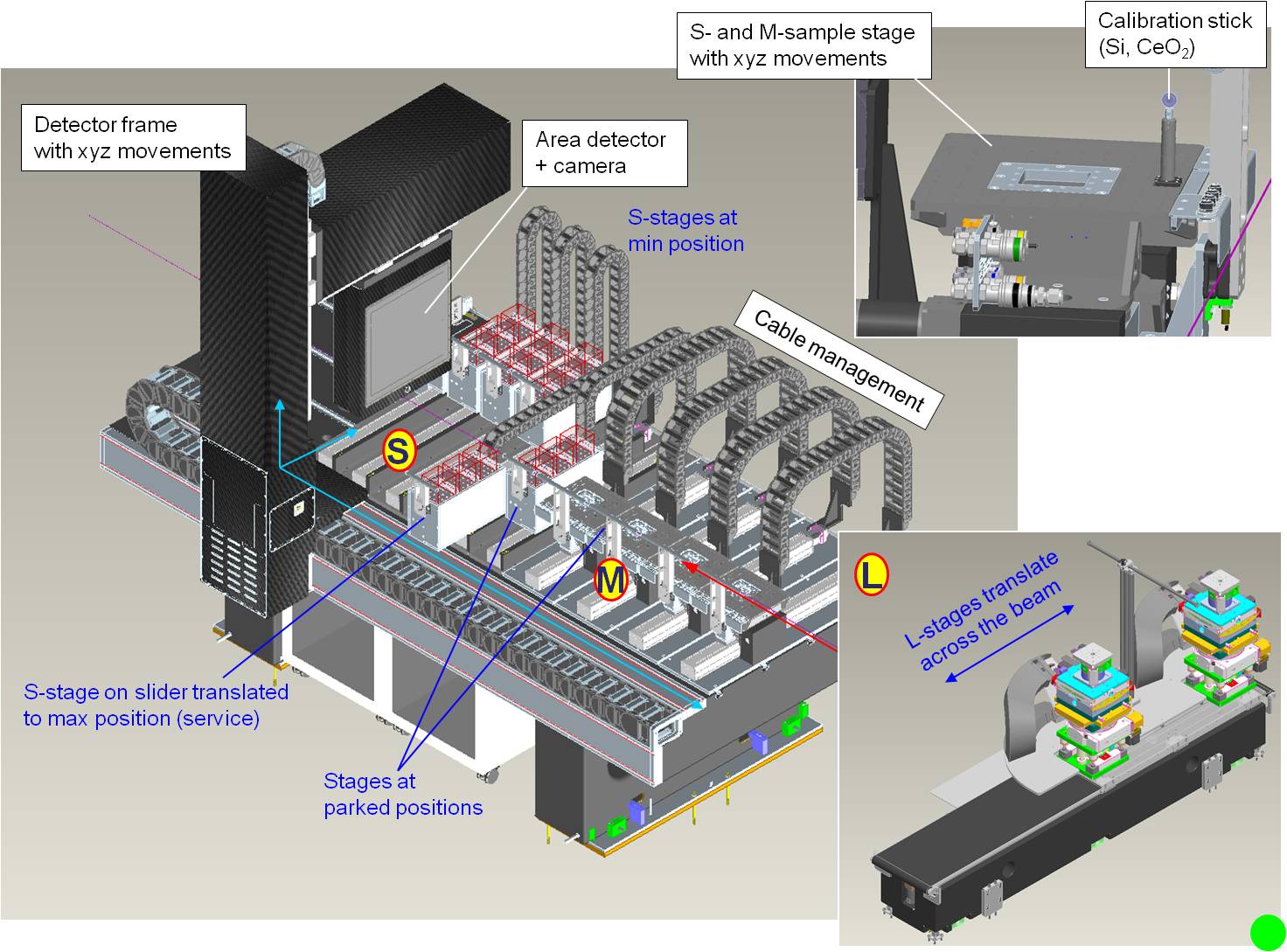
Technical drawing of the LDE End Station highlighting the locations of the large (L), medium (M) and small (S) sample cells
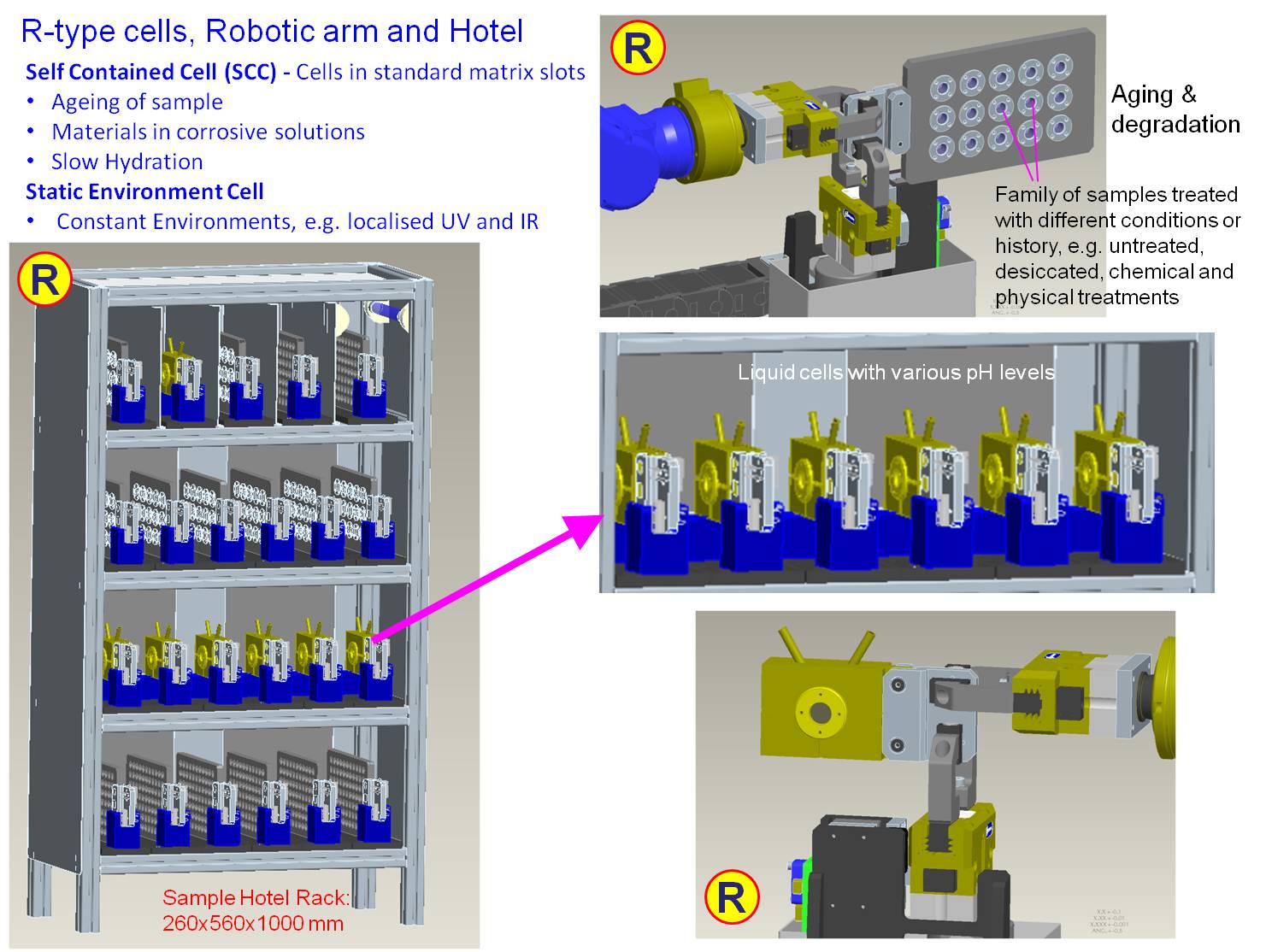
Technical drawing of the sample hotel, where small cells will be stored when not being studied on the beamline
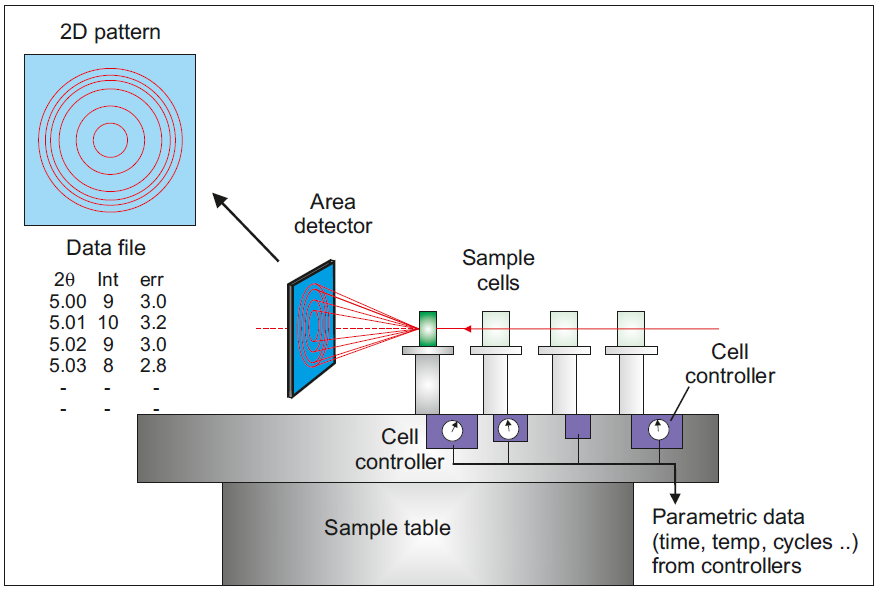
Schematic of the LDE Hutch during experiments

Diamond Light Source is the UK's national synchrotron science facility, located at the Harwell Science and Innovation Campus in Oxfordshire.
Diamond Light Source Ltd
Diamond House
Harwell Science & Innovation Campus
Didcot
Oxfordshire
OX11 0DE
Copyright © Diamond Light Source. Diamond Light Source® and the Diamond logo are registered trademarks of Diamond Light Source Ltd
Registered in England and Wales at Diamond House, Harwell Science and Innovation Campus, Didcot, Oxfordshire, OX11 0DE, United Kingdom. Company number: 4375679. VAT number: 287 461 957. Economic Operators Registration and Identification (EORI) number: GB287461957003.