Instruments by Science Group
 Macromolecular
 Soft Condensed
  Imaging and
 Biological
 Magnetic
 Structures and
 Crystallography
  Spectroscopy
 I22 Contact
Beamline phone numbers:
+44 (0) 1235 77 8617
+44 (0) 1235 77 8713
Principal Beamline Scientist:
Nick Terrill
Tel: +44 (0) 1235 778047
E-mail: [email protected]
Science Group Leader
Robert Rambo
Email: [email protected]
Tel: +44 (0)1235 56 7675
Ultra-Small Angle Scattering (USAXS) is a structural characterisation technique probing length scales between several hundred nanometres and several microns. These length scales are not currently achievable on the pinhole SAXS instruments at Diamond but can be accessed with a Bonse-Hart camera, consisting of two channel-cut silicon crystals and a simple diode detector. This project was set up between Brian Pauw, Wim Bras and Nick Terrill to investigate the possibility of producing a cost effective, portable USAXS end station for use on lab sources and synchrotron beamlines, incl. DUBBLE at the ESRF and I22 at Diamond. The I22 team have been collaborating with the Bundesanstalt für Materialforschung und -prüfung (BAM) in Berlin and DUBBLE at the ESRF to develop a drop-in Bonse-Hart instrument. An instance of this instrument now lives permanently at Diamond for use by the UK USAXS community.
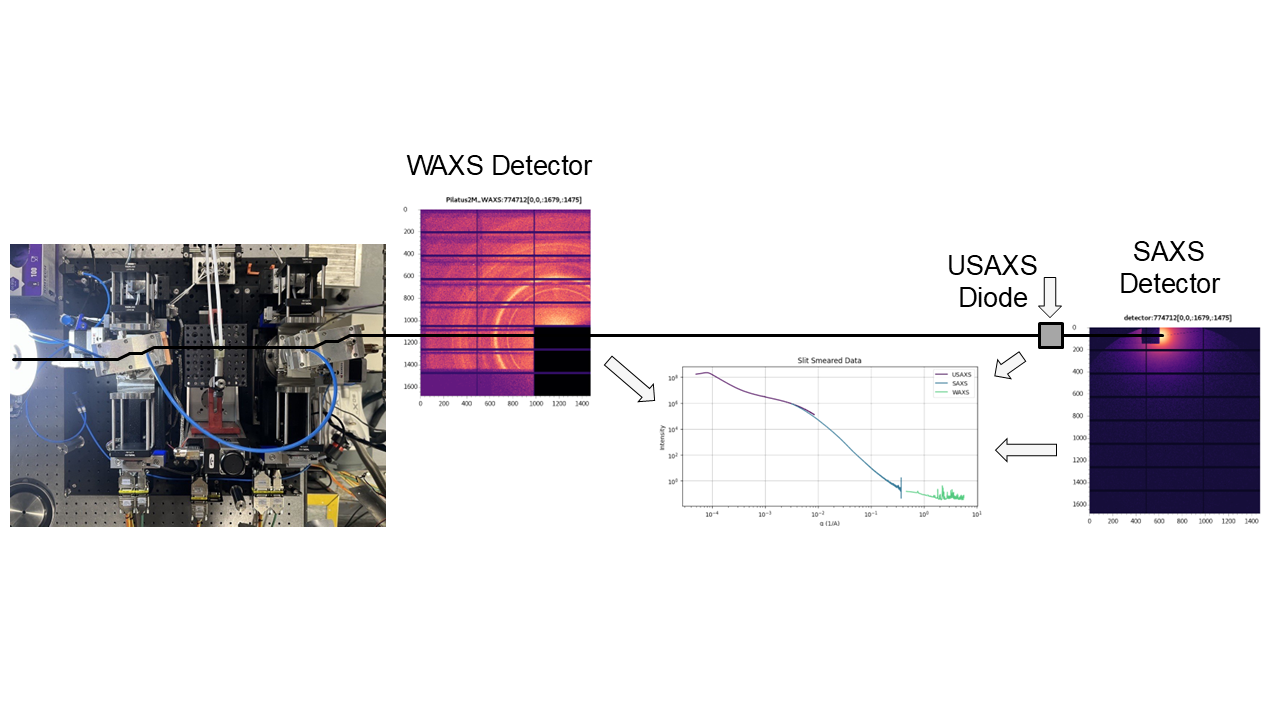
Its design is an evolution of a preceding variant of the instrument tested on the beamline. The instrument consists of two towers topped with the channel-cut crystals. A pair of sample stages reside in the middle, for easy mounting and alignment.
The two towers and the central sample stage are designed to move between two positions: the normal SAXS measurement position (i.e. with the crystals out of the way), and the USAXS position. The USAXS position will span a q-range from 0.0008 to 0.042 nm-1, whereas the normal SAXS camera will provide some of overlap and cover the remaining range from 0.036 to 4.0 nm-1 (when used at 18 keV). The central sample area is approximately 120 mm wide (along the beam direction) to allow a range of sample stages to be mounted. Potential sample environments include: capillary ladders, flow-through capillary cells, and others. Two stages which allow 100 mm of movement in both x and y are available, as well as a rotation stage which allows rotation about the y axis (yaw).
Collection of only USAXS data currently takes 30 seconds, with a fully interleaved USAXS/SAXS/WAXS scan taking 90 seconds. Total sample exposure to beam during this 90 second window is ~ 20 seconds.
USAXS is currently available for use with 18 keV, 14 keV and 12.4 keV, though due to the large air gap (~600 mm) 18 keV is recommended. USAXS data collection is achieved with a PIN diode held within the beamstop chamber (~ 6 meters from sample position) which allows for minimisation of both noise and slit smearing. Photon beamsize FWHM at the sample position is 290 (H) by 240 (V) um.
Latest USAXS Publication
Extending synchrotron SAXS instrument ranges through addition of a portable, inexpensive USAXS module with vertical rotation axes
Brian R. Pauw, Andrew J. Smith, Tim Snow, Olga Shebanova, John P. Sutter, Jan Ilavsky, Daniel Hermida-Merino, Glen J. Smales, Nicholas J. Terrill, Andreas F. Thünemann and Wim Bras
Journal of Synchrotron Radiation, 28 (3), 2021, 824-833
DOI: 10.1107/S1600577521003313

Diamond Light Source is the UK's national synchrotron science facility, located at the Harwell Science and Innovation Campus in Oxfordshire.
Diamond Light Source Ltd
Diamond House
Harwell Science & Innovation Campus
Didcot
Oxfordshire
OX11 0DE
Copyright © Diamond Light Source. Diamond Light Source® and the Diamond logo are registered trademarks of Diamond Light Source Ltd
Registered in England and Wales at Diamond House, Harwell Science and Innovation Campus, Didcot, Oxfordshire, OX11 0DE, United Kingdom. Company number: 4375679. VAT number: 287 461 957. Economic Operators Registration and Identification (EORI) number: GB287461957003.