 Macromolecular
 Soft Condensed
  Imaging and
 Biological
 Magnetic
 Structures and
 Crystallography
  Spectroscopy
 Allocation Period (AP) details
The current Allocation Period is AP38 which will run until 31st March 2026. Then AP39 starts from 1st April 2026 to 30th September 2026.
The proposal call for AP40 (1st October 2026 - 31st March 2027) is currently open. The deadline for submission is at 17:00hrs UTC:GMT on 1st April 2026.
We accept requests for rapid access at any point in time. See here for details.
Run details
Details of Run 5 of 2025 and Run 1 in 2026:
| Run 5 2025 | Start Date | End Date |
| MX Sample Shipping | From 7th November | To arrive on/by 11th December |
| MX User Beamtime | From 13th November | Ends at 9am on 19th December |
| Run 1 2026 | Start Date | End Date |
| MX Sample Shipping | From 5th January | To arrive on/by 6th March |
| MX User Beamtime | From 15th January | Ends at 9am on 13th March |
October-November Shutdown Details
- There are planned upgrades from RHEL7 to RHEL8 for the majority of the MX beamline servers during this shutdown period.
User outreach
- Just a gentle reminder to share your feedback to Diamond senior management via the DUC (Diamond User Committee) by 14th November. The form can be accessed from here.
- While it is highly recommended that you backup all your data as soon as your visit to Diamond completes, in case you wish to look at your old data please check our updated page to retrieve your data.
Training
- Our next Onsite MX User Training session is scheduled for 11th & 12th February 2026. This session will be particularly designed for people who are new to both macromolecular crystallography and to using Diamond. Applications for this will open in November, and close in January. Please check the events page for updates.
ISPyB / SynchWeb Updates
Until recently, shipment creation in ISPyB relied on a command-line CSV uploader. While effective, the method posed a few challenges. To overcome such challenges and to improve accessibility and ease of use, we’ve now introduced a browser-based version of the uploader. It uses the same CSV file format as before, but offers a more user-friendly interface and is easier to support and develop going forward.
To use it, copy your CSV file onto Diamond's filesystem as before, then open an NX session and browse to dls.mx/csv. Log in if needed, then select your CSV file. If the shipment is for UDC, turn on the "Queue For UDC" slider, then click "Submit". You should then be given a link to your new shipment in ISPyB. Please note, every file uploaded creates a new shipment, so make sure your shipment is complete before uploading and shipping to Diamond. More details can be found here and for any problems and queries, please contact Mark Williams.
Meet and Greet
Our staff will be attending the following meetings and would be pleased to connect with you. Feel free to stop by for a conversation or to discuss any questions you may have.
- CCP4 Northern Structural Biology Meeting - Adam Crawshaw, Christian Orr
- Bayesian biostatistics 2025 - Rachel Tang (DIALS)
New Features
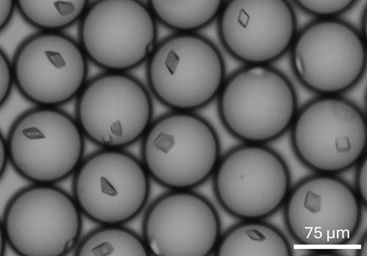
- Microcrystals grown in picolitre droplets for serial crystallography
Droplet Microfluidics for Protein Crystallisation
The XFEL Hub at Diamond is pleased to announce a new droplet microfluidics setup that is now available to the Diamond macromolecular crystallography (MX) community at the Research Complex at Harwell (RCaH). This equipment enables the fabrication of PDMS-based microfluidic devices designed specifically for generating highly uniform protein microcrystals in droplets, a powerful tool for serial crystallography and sample delivery development.
Learn more about this exciting update from Jack Stubb's article here.
Processing snippets
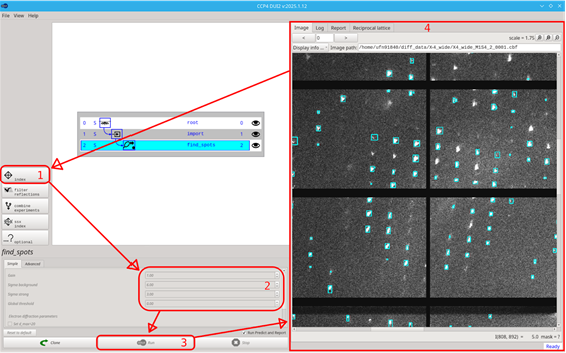
Dui2 can be used to process single data sets instead of Xia2 if the user wants to control each DIALS command through a user interface rather than the command line. Users often turn to Dui2 for image dataset processing when Xia2 encounters problems or fails to complete the task. The content below offers a quick glimpse into the processing workflow through a simple example — intended to introduce the basic steps for processing using Dui2 before tackling more complex scenarios
Importing the Dataset
Begin by importing your image dataset. Click “Open images” on the left panel, select any image from your dataset, and then click “Run” (the button with the DIALS logo).
This action triggers the first DIALS command within the ‘import’ node. From here, follow these four steps (Shown in the figure) for each subsequent node/command.
- Select a Command
Click one of the buttons in the top-left command column. This list updates automatically as you move through different nodes in the graph.
- Adjust Parameters (if needed)
Below the control graph, you’ll find two tabs for input parameters: “Simple” and “Advanced”. These tabs are synchronized, so you can modify parameters in either one.
- Execute the Command
Click the “Run” button and wait for the DIALS command to complete.
- Review the Output
Use the tabs on the right-hand side to inspect the results. If everything looks good, return to step 1 to continue processing.
If the result from step 4 isn’t satisfactory, you can fork the workflow by clicking the “Clone” button (bottom-left corner). Modify the parameters and click “Run” again. Dui2 will create a sibling node, allowing you to explore an alternative processing path. All branches and nodes remain accessible for review or further editing at any time.
Dui2 is a standalone software which you can download (https://github.com/ccp4/DUI2) with three different ways to install and does come pre-installed with CCP4. Alternatively it can be accessed on Diamond servers using command “module load dui2” from terminal and then the command "dui2". For a more in-depth tutorial on how to use Dui2, please refer to the resource available here (THAS1 · ccp4/DUI2 Wiki · GitHub). If you have any feedback or comments regarding the usage of the DIALS GUI (DUI) please let us know or contact the developer Luis Fuentes-Montero.
Selected Publications
Interesting review highlighting how microcrystals are advancing experimental strategies across synchrotron and XFEL sources, unlocking new insights into complex biological systems.
Tremlett, C.J.†, Stubbs, J.†, Stuart, W.S., Shaw Stewart, P.D., West, J., Orville, A.M., Tews, I. & Harmer, N.J., 2025. Small but mighty: the power of microcrystals in structural biology. IUCrJ, 12(3).
Take a look at the paper that explores the structural basis of chaperone repression, describes how the Diamond I04 and B21 beamlines were instrumental in the study.
Lisa Neidhardt, Joanne Tung, Miriam Kuchersky, Jakub Milczarek, Vasileios Kargas, Katherine Stott, Rina Rosenzweig, David Ron, Yahui Yan. A structural basis for chaperone repression of stress signaling from the endoplasmic reticulum, Molecular Cell, 2025.
Science in focus
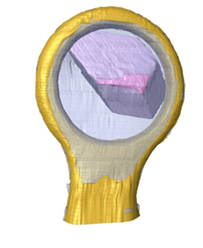
- Volume rendering of segmentations a protein crystal sample
Long wavelength X-ray diffraction experiments enable the measurement of anomalous signal from biologically relevant ions and elements, natively found in macromolecules.
To compensate for the increase in absorption (at longer wavelengths) and enable accurate calculations of structure factor amplitudes, it becomes necessary to apply absorption corrections factors. At I23, analytical absorption correction factors are calculated by complementing the diffraction experiment with X-ray microtomography.
Read more from Ramona Duman's article for this Newsletter ..
Users who wish to contribute to an upcoming issue by sharing their scientific story or describing how Diamond has supported their research are invited to contact us via E-mail with your suggestions.

Diamond Light Source is the UK's national synchrotron science facility, located at the Harwell Science and Innovation Campus in Oxfordshire.
Diamond Light Source Ltd
Diamond House
Harwell Science & Innovation Campus
Didcot
Oxfordshire
OX11 0DE
Copyright © Diamond Light Source. Diamond Light Source® and the Diamond logo are registered trademarks of Diamond Light Source Ltd
Registered in England and Wales at Diamond House, Harwell Science and Innovation Campus, Didcot, Oxfordshire, OX11 0DE, United Kingdom. Company number: 4375679. VAT number: 287 461 957. Economic Operators Registration and Identification (EORI) number: GB287461957003.