 Macromolecular
 Soft Condensed
  Imaging and
 Biological
 Magnetic
 Structures and
 Crystallography
  Spectroscopy
 Precision Crystallisation Precision Crystallisation in Picolitre Droplets
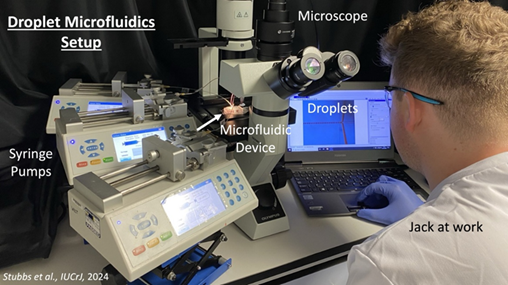
- A microfluidic setup in the RCaH is available for producing homogenous slurries of microcrystals.
Droplet microfluidics allows proteins and reagents to be encapsulated in picolitre-scale droplets, each essentially acting as an isolated microreactor. This approach offers several advantages for crystallisation:
- Uniform crystal size (e.g. 3 – 5 µm): Controlled nucleation by seeding within droplets leads to reproducible microcrystal populations.
- High-throughput screening: Thousands of droplets can be generated and analysed rapidly.
- Low sample consumption (~ 50 – 500 µL): Ideal for scarce or sensitive targets.
- Compatibility with serial delivery: Droplet-grown crystals are well-suited for serial experiments at XFELs and synchrotrons.
- Electronic absorption microspectroscopy within drops is currently under investigation, which is likely to be a good strategy to help characterise samples and reactivity
This capability is now supported by the Henniker plasma cleaner at RCaH, which enables reliable PDMS-glass bonding a critical step in microfluidic chip fabrication. Researchers can replicate published designs or potentially develop bespoke devices tailored to their crystallisation and/or reaction initiation needs.
The new setup complements ongoing efforts at Diamond to improve sample delivery and crystallisation workflows for serial crystallography. By enabling on-site prototyping and testing of droplet devices, the XFEL Hub team aims to support:
- Development of droplet-based crystallisation protocols
- Preparation of microcrystals for serial crystallography experiments
- Exploration of droplet formats for beamline compatibility
The current focus includes creating robust, reproducible crystallisation strategies that yield homogenous slurries, thereby laying the groundwork for future dynamic studies. Several reaction initiation strategies and sample delivery strategies are already available within the Hub. To those we are actively developing complementary time-resolved mixing applications using microfluidics.
This new capability builds on previous work led by Jack Stubbs, whose PhD research was jointly based at Diamond Light Source XFEL Hub and the University of Southampton, in collaboration with Douglas Instruments. Jack’s work demonstrated how droplet microfluidics can be used to grow microcrystals suitable for serial crystallography, inspiring new approaches to sample preparation and delivery; For more information, please see the aticle, Droplet microfluidics for time-resolved serial crystallography. We’re delighted to share that Jack has returned to the XFEL Hub as a short-term postdoctoral research associate, bringing his expertise in droplet-based crystallisation directly into the heart of the Diamond MX community.
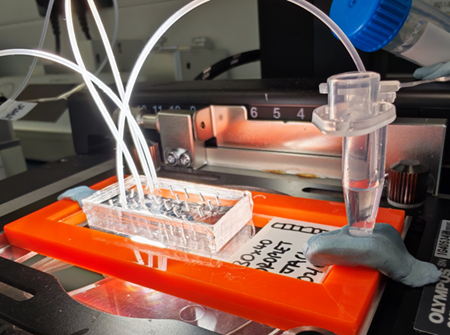
- A PDMS microfluidic chip is mounted on the microscope stage, with syringe pumps delivering aqueous and oil phases through connected tubing to enable droplet generation. The plug-and-play design allows rapid prototyping and directs the resulting emulsion into an outlet tube prefilled with mineral oil for stable droplet collection.
The XFEL Hub group welcomes collaborations and is keen to support scientists exploring droplet microfluidics for protein crystallisation and time-resolved structural biology. Whether you're preparing for XFEL experiments or developing new crystallisation strategies, this capability is ready to accelerate your research. To learn more or discuss project ideas, please contact the XFEL Hub team and/or Jack directly ([email protected]).

Diamond Light Source is the UK's national synchrotron science facility, located at the Harwell Science and Innovation Campus in Oxfordshire.
Diamond Light Source Ltd
Diamond House
Harwell Science & Innovation Campus
Didcot
Oxfordshire
OX11 0DE
Copyright © Diamond Light Source. Diamond Light Source® and the Diamond logo are registered trademarks of Diamond Light Source Ltd
Registered in England and Wales at Diamond House, Harwell Science and Innovation Campus, Didcot, Oxfordshire, OX11 0DE, United Kingdom. Company number: 4375679. VAT number: 287 461 957. Economic Operators Registration and Identification (EORI) number: GB287461957003.