Recommended viewing

Want to learn more about one of science's heroes from history, Henry Moseley? Moseley solved one of chemistry's greatest puzzles - determining what distinguishes elements from one another and developed a means of identifying elements based on their atomic characteristics. Sadly he lost his life fighting at Gallipoli in WWI.
Learn more about his life and legacy by watching our online film here.
Post-Transition Metals
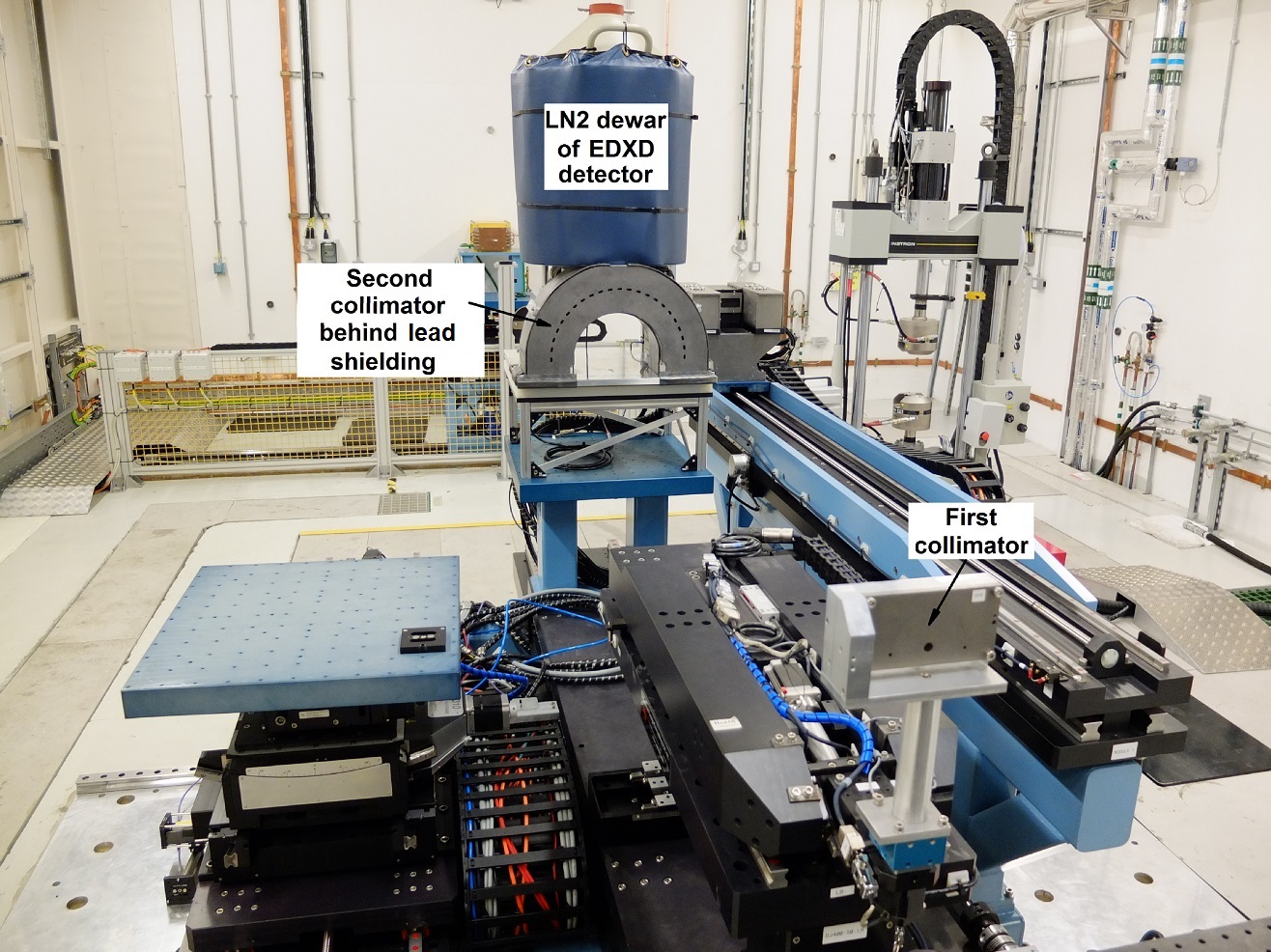
- EDXD detector on Module 2 of Large Detector Table 2 (LDT2) on our I12 beamline. The second collimator (detector slits) is placed just in front of the detector front-plate and is hidden behind lead shielding.
In the periodic table, the post-transition metals sit between the transition metals on their left, and the metalloids on their right. These metallic elements include aluminium, gallium, indium, tin, thallium, lead, and bismuth. Most are soft or brittle, with poor mechanical strength, and have melting points lower than the transition metals.
Lead is a heavy metal, with the highest atomic number of any stable element. Soft and malleable, it has a relatively low melting point. A freshly cut lead surface is silvery blue, but it tarnishes to dull grey on exposure to air. Notable uses include bullets, and radiation shielding.
Lead is one of the seven metals of antiquity that humans identified and made use of in prehistoric times (the other six are gold, silver, copper, tin, iron, and mercury). Lead is now used in alloys, solder, and roofing. Gallium and indium are semiconductors, and thallium is highly toxic and has been used as a pesticide.
Featured Element: Lead
A soft metal with a low melting point, lead is easily shaped and doesn't corrode much, making it incredibly useful. We know that humans have been making use of lead for a very long time. Researchers found a smelted lead object dating back to the late 4000s BCE in Israel. They traced the ores used to make it to the Taurus mountains (in what is now Turkey). Lead is relatively abundant, and our ancestors discovered that they could easily extract it from galena, lead sulfide ore. The smelting process can be as simple as putting rocks in a fire and extracting the lead from the ashes.
Some Native Americans used lead to create black body paint, by grinding up the ore and mixing it with water. Later they traded the ore to European settlers and learned how to melt it and form metal objects from them. The largest lead deposits in the world are in Missouri (USA), which made galena the state mineral in 1967. It's also the state mineral of Wisconsin, where lead mining has been taking place since at least the 17th century. Several towns in the USA are named galena, due to their mining history.
However, lead is toxic, and our historic uses cause problems today. Lead water pipes were common until the 1950s, and although they were later banned, ageing infrastructure can lead to lead poisoning. This was brought to light in America by the water crisis in Flint, Michigan. The tetraethyl lead added to petrol for decades poisoned children and increased inner-city crime rates.
One of the more modern uses of lead is for radiation shielding, protecting living organisms from the damage that can be inflicted by ionising radiation. Lead's high density and high atomic number mean it's great for stopping X-rays and gamma rays. Here at Diamond, we use lead (and steel, and concrete) to shield the optics and experiment hutches on the beamlines and keep staff and users safe when the beam is on.
Lead-free piezoelectric ceramics

Piezoelectric materials can generate an electric charge in response to applied mechanical stress. They have a lot of applications, finding their way into many everyday items from cigarette lighters and easy-light barbecues to quartz watches and scientific instruments. The market for piezoelectric materials is worth more than $10 billion a year, and the primary material used is the ceramic lead zirconate titanate (PZT), which contains up to 60% by weight of lead. Given the environmental and health issues associated with lead, there is increasing interest in developing lead-free piezoelectric ceramics. Researchers used the high-energy synchrotron radiation available on the Extreme Conditions Beamline (I15) to demonstrate an electric-field-induced phase transformation in the lead-free piezoelectric KNBT. Read more here.
Metal munching earthworms

Could worm poo hold the key to cleaning up toxic metals in contaminated soils? Diamond's intense X-rays were used to probe the tiny granules of calcium carbonate excreted by earthworms that had been living in lead-contaminated soil. Although tiny to us, the granules scaled up would be like a human excreting a spikey football!
The research team found that the excreted calcium carbonate granules contained a substantial amount of lead. When the earthworms ingest the lead, it associates with the calcium carbonate granules and is excreted out as insoluble metal carbonates. This could immobilise the metal, making it less available to plants. Read more here.
For Art's Sake
 Painted in 1876, Edgar Degas' 'Portrait of a Woman' is a striking example of French Impressionism. It's also an intriguing success story for science. Observers first noticed that something wasn't quite right with the shadowy, black-clothed subject of Degas' painting back in the 1920s, but to work out what was going on, scientists needed to explore beneath the surface layer of paint. Using X-ray Fluorescence Microscopy at the Australian synchrotron, they were able to identify the elemental make-up of the painting and revealed the presence of an older image underneath.
Degas had painted over the original portrait using layers of lead-based paint, unknowingly initiating long-term chemical reactions. Over time, traces of lead reacted with oils and rose to the surface, leaving the painting tarnished by white blisters. If we can track the migration of lead within the painting and uncover more about how the process works, it might be possible to prevent it. A group of experts using spectroscopy beamline I18, are using chemical tomography to image the composition of paintings. They hope to learn exactly how the white blisters form and whether a chemical intervention could counteract the process and save these masterpieces.
Read more about 'Portrait of a Woman' here, or the team investigating the white lead deposits on Old Master paintings here.
Silver alterations in medieval altarpieces
 Altarpieces from the 15th century AD often have silver areas created by the application of a thin foil of metal. Treatises from the period describe the addition of small amounts of lead white to the drying oil to help its polymerisation and the drying process. Over time, the silver can blacken or disappear altogether, but the causes of degradation are not well understood, and this limits conservation efforts. A group of researchers used several analytical techniques to analyse samples, including µSR-FTIR for the glues, varnishes and binding media, and µSR-XRD to determine the alteration to the silver compounds.
Their results showed that the conservation state of the silver foil is directly related to contact with the atmosphere. A paint layer or a well-preserved resin coating preserves the silver foil in a good conservation state. Where the protective layer is damaged or absent, leaving the silver surface exposed to the atmosphere, the silver alteration products are all that is left.
Read more here.
And did you know?
On Venus, it snows lead. The greenhouse effect caused by the thick atmosphere on Venus means the surface temperatures of the planet reaches 462°C, making Venus the hottest planet in the Solar System. So we know that the layer of 'snow' at the very top of Venus' mountains isn't the frozen water with which we're familiar. In fact, those mountains are capped with two types of metal: galena and bismuthinite. It's so hot on the Venusian plains that reflective pyrite minerals are vaporised, producing a metallic mist. This mist condenses at higher altitudes, leaving shiny, metallic frost on the tops of the mountains.
It's quite apt that Venus, named after the Roman goddess of lead, should shine with the metal. The Ancient Romans were vast users of lead, turning it into everything from cookware, wine jugs and coins. Roman plumbing was a marvel of the ancient world, at least until they 'upgraded' to using lead pipes. Their infatuation with lead even caused them to use lead acetate as a sweetener, usually in wine. Ever since then, there has been a lingering suspicion that lead poisoning may have contributed to the demise of the Roman Empire, but that theory is disputed.

Diamond Light Source is the UK's national synchrotron science facility, located at the Harwell Science and Innovation Campus in Oxfordshire.
Diamond Light Source Ltd
Diamond House
Harwell Science & Innovation Campus
Didcot
Oxfordshire
OX11 0DE
Copyright © Diamond Light Source. Diamond Light Source® and the Diamond logo are registered trademarks of Diamond Light Source Ltd
Registered in England and Wales at Diamond House, Harwell Science and Innovation Campus, Didcot, Oxfordshire, OX11 0DE, United Kingdom. Company number: 4375679. VAT number: 287 461 957. Economic Operators Registration and Identification (EORI) number: GB287461957003.