Recommended viewing

Want to learn more about one of science's heroes from history, Henry Moseley? Moseley solved one of chemistry's greatest puzzles - determining what distinguishes elements from one another and developed a means of identifying elements based on their atomic characteristics. Sadly he lost his life fighting at Gallipoli in WWI.
Learn more about his life and legacy by watching our online film here.
Halogens
The name "halogen" means "salt-producing", and halogens react with metals to produce a range of salts, including calcium fluoride, sodium chloride, silver bromide and potassium iodide. Elemental halogens are highly reactive and toxic, and chlorine, bromine and iodine, are often used as disinfectants. Organobromides are organic compounds containing carbon bonded to bromine, and are the most important class of flame retardants. Organofluorines are organic compounds that contain the carbon–fluorine bond, and have a wide range of applications, including oil and water repellents to pharmaceuticals, refrigerants, and reagents in catalysis. Some organofluorines (such as CFCs) are environmental pollutants, contributing to ozone depletion, global warming, and toxicity.
Featured Element: Chlorine
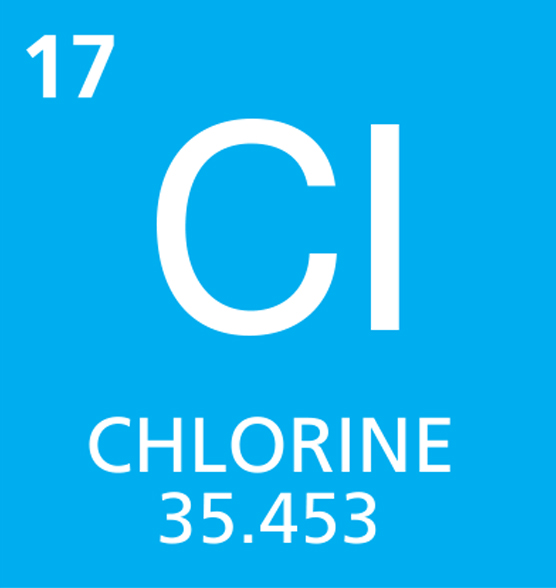 Chlorine is a yellow-green gas at room temperature, and is named from the Ancient Greek khlôros, meaning 'pale green'. It is a highly reactive and oxidising element, and all of the chlorine in the Earth's crust is in the form of ionic chloride compounds. The most common of these, sodium chloride (common salt), has been known since ancient times. First synthesised in 1630, chlorine wasn't recognised as an element until 1810.
Elemental chlorine is commercially produced from saltwater by electrolysis, and it is used in bleaches and disinfectants and for many processes in the chemical industry. It also has the dubious honour of being the first gaseous chemical warfare agent, used in World War I. Despite its toxicity, chloride ions are necessary for life.
Protecting herbarium staff from mercury-contaminated specimens
All over the world, plant samples dried and pressed onto sheets of paper are stored in herbaria. Some of the examples have been there for centuries, and it's easy to think that we've learned all we can from them. The truth, however, is that herbarium samples are crucial to modern research, and can help us discover (for example) how natural environments are changing over time.
The University of Manchester museum herbarium was founded in 1860 and contains over a million specimens from all over the world. Over the centuries, botanists have used a wide range of techniques to keep the plant samples safe from bacteria, fungi, insects and rodents.
Mercury salt solutions, such as mercury chloride, were used as a preservative from the 17th century until the 1980s. The question now is whether the mercury presents a health risk to herbarium staff? As well as the threat from handling the specimens directly, mercury vapour is released from the containers whenever they are opened.
A team of researchers from the university used beamline B18 to characterise the mercury in herbarium specimens and to identify ways of limiting the release of mercury vapour from contaminated specimen boxes. They incorporated filters impregnated with selenium nanoparticles into the specimen boxes, and then placed samples in the beam to understand how the mercury was trapped and to identify whether this is a suitable long term solution. They found was that the selenium efficiently sequestered the mercury vapour, reducing the level by around 47%. Read more here.
Atomically Dispersed Gold Species Can Act as Catalysts
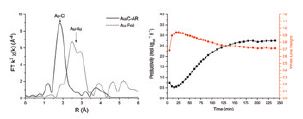
- (a) k3- weighted c EXAFS Fourier transform of aqua regia prepared 1% Au/C catalyst and Au foil standard (b) Normalised white line intensity correlated with VCM productivity over the course of the reaction induction period.
Vinyl chloride is the monomer used to make PVC, which finds its ways into everything from piping and tubing to gels and lubricants. The current method for producing vinyl chloride uses a mercury-based catalyst. As mercury is one of the most toxic substances on the planet, we need a more environmentally-friendly alternative.
We know that gold supported on carbon could be used as an alternative catalyst for this reaction, and industry is working on commercialising its use. However, the reaction to make vinyl chloride is typically carried out at 200°C, using corrosive gas mixtures that can rapidly deactivate catalysts, and we don't yet know how well the new catalyst will perform in these harsh conditions.
X-ray absorption spectroscopy (XAS) is the ideal tool for observing the reaction in situ, and the quick acquisition time available on B18 gave a team of researchers the time-resolution needed to see activation and deactivation during the reaction. Their results offer the first example of a single site catalyst remaining atomically dispersed and working under such harsh reaction conditions, and will enable more rational catalyst design to find a replacement for the current mercury catalyst. Read more here.
Perovskites: high-performance materials for thin-film solar panels

Figure 1: GI-SAXS scattering patterns from a CH3NH3PbI3-xClx perovskite film before annealing (top), and after being annealed for 120 minutes (middle). Note that the slight shading on the right side of the feature is due to shading from the beam-stop, and thus data were thus taken from the left side of the feature. The bottom panel shows evolution of the GI-SAXS data slice in qy during thermal anneal at 80°C, with the same data presented as a relative intensity as compared to the data at 0 min.
The development of thin-film solar cell (photovoltaic) devices is of growing interest for the development of low-carbon electricity. Perovskites are crystalline semiconductors with a similar efficiency to conventional silicon-based solar cells, but they are potentially cheaper and easier to manufacture.
In recent years, organometal halide perovskites have become a hot topic in thin-film solar cell research. The most commonly-studied materials are composed of methylammonium lead trihalide (CH3NH3PbX3, where X is a halogen atom such as chlorine, iodine or bromine).
Researchers used grazing-incidence small-angle X-ray scattering (GI-SAXS) on the Small Angle Scattering and Diffraction beamline (I22) to To gain an improved understanding of how the processing conditions used to 'grow' a perovskite film affect its ability to act as a photovoltaic material.
The results shed light on the processes that determine optimum photovoltaic device efficiency and will lead to new generations of perovskite materials for solar cells that have improved efficiency and enhanced operational stability. Read more here.
Corrosion - it's the pits
Where safety is critical, such as in pipelines, aircraft and nuclear waste storage vessels, our infrastructure relies on "corrosion-resistant" metals. Ironically, these materials are vulnerable to a form of corrosion known as pitting.
Corrosion pits can occur in metals such as stainless steel, and nickel. A highly concentrated acidic metal chloride solution develops inside these pits, from which a layer of salt crystals can precipitate. This affects the corrosion rate, but it's challenging to study the structure and chemistry of these layers.
Scientists from the University of Birmingham used beamline I18 to carry out in situ X-ray diffraction and X-ray absorption spectroscopy studies on salt layers and solutions in one-dimensional artificial corrosion pits designed to be characteristic of real pits. The results revealed that the phases present in salt films on dissolving iron, nickel and stainless steel surfaces can vary through their thickness and showed that the metal ions have different chemical coordination environments depending on their proximity to the dissolving metal surface.
By learning how these pits form and propagate, we can build more accurate models of corrosion to predict the lifetime of components and plan when they need inspecting or replacing.
And did you know?
 The same man who added lead to petrol, Thomas Midgley Jr., also pioneered the use of dichlorodifluoromethane, a chlorofluorocarbon (CFC), in residential refrigerators and air conditioners. His company manufactured the gas under the brand name Freon-12. Midgley was fond of demonstrating that his compounds were 'safe', and he inhaled a large amount of Freon-12 and then blew out a candle flame to show the gas was non-toxic and non-flammable.
By the 1980s, we were starting to suspect that CFCs were damaging the ozone layer. Susan Solomon provided the first direct evidence that this was the case, and also explained why the holes in the ozone layer formed over Earth's poles. Solomon's work lead to an international treaty - the Montreal Protocol - that phased out the use of synthetic chemicals known to deplete the ozone layer, including CFCs.
During his lifetime Thomas Midgley Jr. received a series of awards for his work. In 1940 he contracted polio and invented a pulley system to help him get in and out of bed unaided. Sadly, this invention proved to be as flawed as his earlier ones. Midgley died in 1944 when he became entangled in it and asphyxiated. Since his death, he has become famous as the man who has harmed the world the most, due to his environmentally-damaging inventions.

Diamond Light Source is the UK's national synchrotron science facility, located at the Harwell Science and Innovation Campus in Oxfordshire.
Diamond Light Source Ltd
Diamond House
Harwell Science & Innovation Campus
Didcot
Oxfordshire
OX11 0DE
Copyright © Diamond Light Source. Diamond Light Source® and the Diamond logo are registered trademarks of Diamond Light Source Ltd
Registered in England and Wales at Diamond House, Harwell Science and Innovation Campus, Didcot, Oxfordshire, OX11 0DE, United Kingdom. Company number: 4375679. VAT number: 287 461 957. Economic Operators Registration and Identification (EORI) number: GB287461957003.