Instruments by Science Group
 Macromolecular
 Soft Condensed
  Imaging and
 Biological
 Magnetic
 Structures and
 Crystallography
  Spectroscopy
 XFEL-Hub contact
XFEL-Hub Principal Scientist:
Allen Orville
Tel: +44 (0) 1235 567505
E-mail: [email protected]
Drop-on-tape
Drop-on-tape is a sample delivery method for serial crystallography, which can be used at synchrotrons and XFELs. In this approach, droplets (on the order of 10s of picoliters) containing microcrystals are deposited onto a moving Kapton tape which delivers the sample into an X-ray beam.
One of the benefits of drop-on-tape sample delivery is that both X-ray diffraction and X-ray emission spectroscopy (XES) can be measured simulataneusly on the same sample by using a von Hamos spectrometer. Room temperature X-ray diffraction using serial crystallography can be used to give the macromolecular structure of a protein at physiological temperature, whilst reducing the radiation dose. If you have a metalloprotein, XES can be used to gain element specific electronic information which can indicate the oxidation state, spin state and information about ligating atoms. We currently have scope to measure the Kα and Kβ emission lines of copper, iron and zinc.
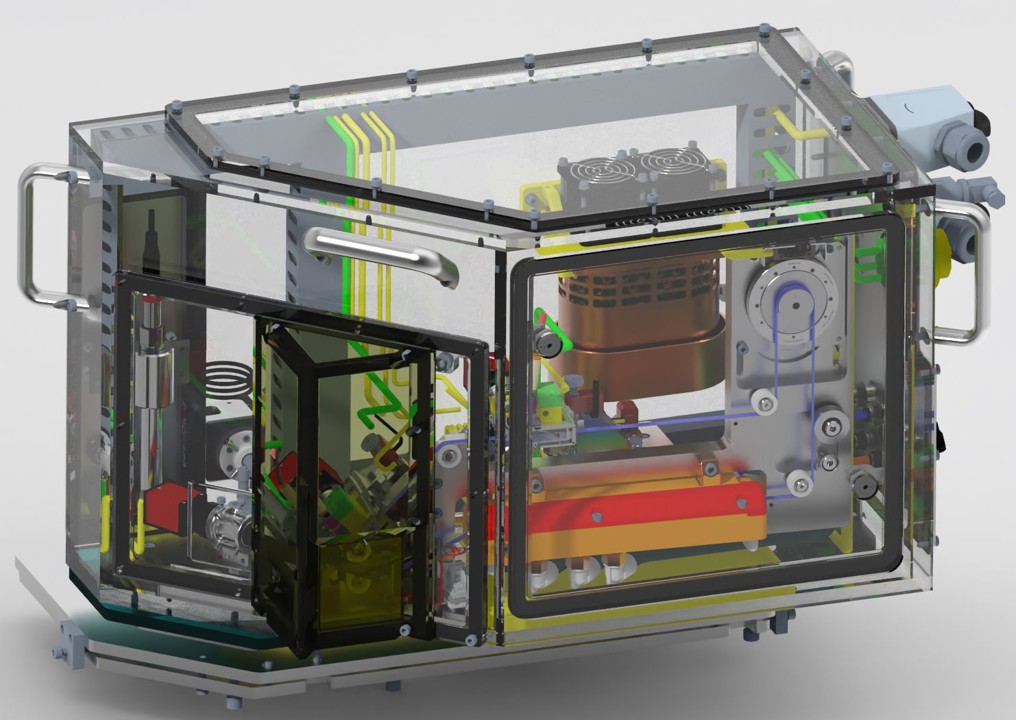
The tape drive sits within a chamber in which we can control the atmosphere, we are able to adjust the humidity and create anaerobic conditions.
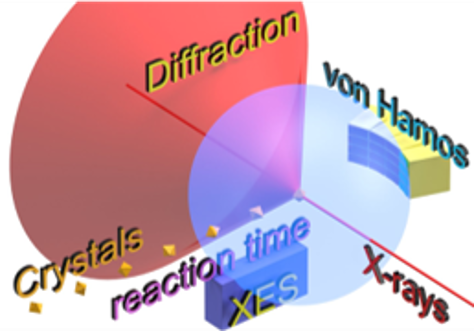
- Using the tape drive sample delivery system, X-ray diffraction of microcrystals can be collected in line with the beam and X-ray emission spectroscopy (XES) can be collected simultaneously by using a von Hamos spectrometer perpendicular to the beam.
Drop-on-drop-on-tape
The drop‑on‑drop‑on‑tape technique builds on established drop‑on‑tape functionality by enabling on‑tape mixing for time‑resolved serial crystallography and X‑ray emission spectroscopy experiments.
Our system uses a Polypico droplet ejector to dispense droplets sized on the order of picoliters directly onto microcrystal-containing droplets as they travel on the tape toward the X‑ray beam. This approach allows reactions to be initiated and by adjusting the tape speed and the position of the Polypico ejector, the reaction delay time can be accurately defined. At VMXi we can reach time points between 125 ms - 10 s, with faster time points available at XFELs.
Publications
For more information on the prototype system please see this pre-print (revised version now accepted in IUCrJ)

Diamond Light Source is the UK's national synchrotron science facility, located at the Harwell Science and Innovation Campus in Oxfordshire.
Diamond Light Source Ltd
Diamond House
Harwell Science & Innovation Campus
Didcot
Oxfordshire
OX11 0DE
Copyright © Diamond Light Source. Diamond Light Source® and the Diamond logo are registered trademarks of Diamond Light Source Ltd
Registered in England and Wales at Diamond House, Harwell Science and Innovation Campus, Didcot, Oxfordshire, OX11 0DE, United Kingdom. Company number: 4375679. VAT number: 287 461 957. Economic Operators Registration and Identification (EORI) number: GB287461957003.