 Macromolecular
 Soft Condensed
  Imaging and
 Biological
 Magnetic
 Structures and
 Crystallography
  Spectroscopy
 Allocation Period (AP) details
Current Allocation Period is AP37 which will run until 30th September 2025.
Next AP38 starts from 1st October 2025 to 31st March 2026.
Please check if your Proposal switches to a new award for AP38 and use the new proprosal for experiments from 1st October.
Proposal call for AP39 (1st April - 30th September 2026) is open. The deadline for submission is at 17:00hrs UTC:GMT on 1st October 2025.
We accept requests for rapid access at any point in time. See here for details.
Run details
Details of Runs 3 & 4
| Start Date | End Date | |
| Run 4 | 10 September | 16 October |
| Run 5 | 12 November | 18 December |
| Shipping Start Date | Shipping End Date | |
| Run 4 | 5 September | 10 October |
| Run 5 | 7 November |
August Shutdown details
- To support upcoming upgrades to our filesystem, the storage system will undergo maintenance during the second week of the shutdown period: Monday 25th August to Friday 29th August. As a result, the Science HPC compute cluster will also be unavailable during this time. We appreciate your understanding and cooperation. Please plan your work accordingly and reach out if you have any questions or concerns.
- ISPyB / SynchWeb will not be available at times during the afternoon of Friday 29th August due to scheduled maintenance.
- There are planned NX Nomachine software updates on 27th August which may affect access to Diamond compute during this period.
User outreach
Training
- Application for the Diamond-CCP4 workshop in November is open which is great place to learn about best practices in data collection, structure solution and much more. For more information please check this page.
- Our next MX User Training session is scheduled for February 2026. Please check the events page for updates.
Meet and Greet
Our staff will be attending the following meetings and would be pleased to connect with you. Feel free to stop by for a conversation or to discuss any questions you may have.
- ECM (Lviv-Poznań) - David Owen (microED & cryoEM), Eilis Bragginton, Vitaliy Mykhaylyk, Ramona Duman
- Serial Crystallography Methods Workshop (Hamburg) - James Beilsten-Edmands (DIALS)
- TR+ workshop (Lund) - Juan Sanchez-Weatherby , Rachel Tang (DIALS)
New Features
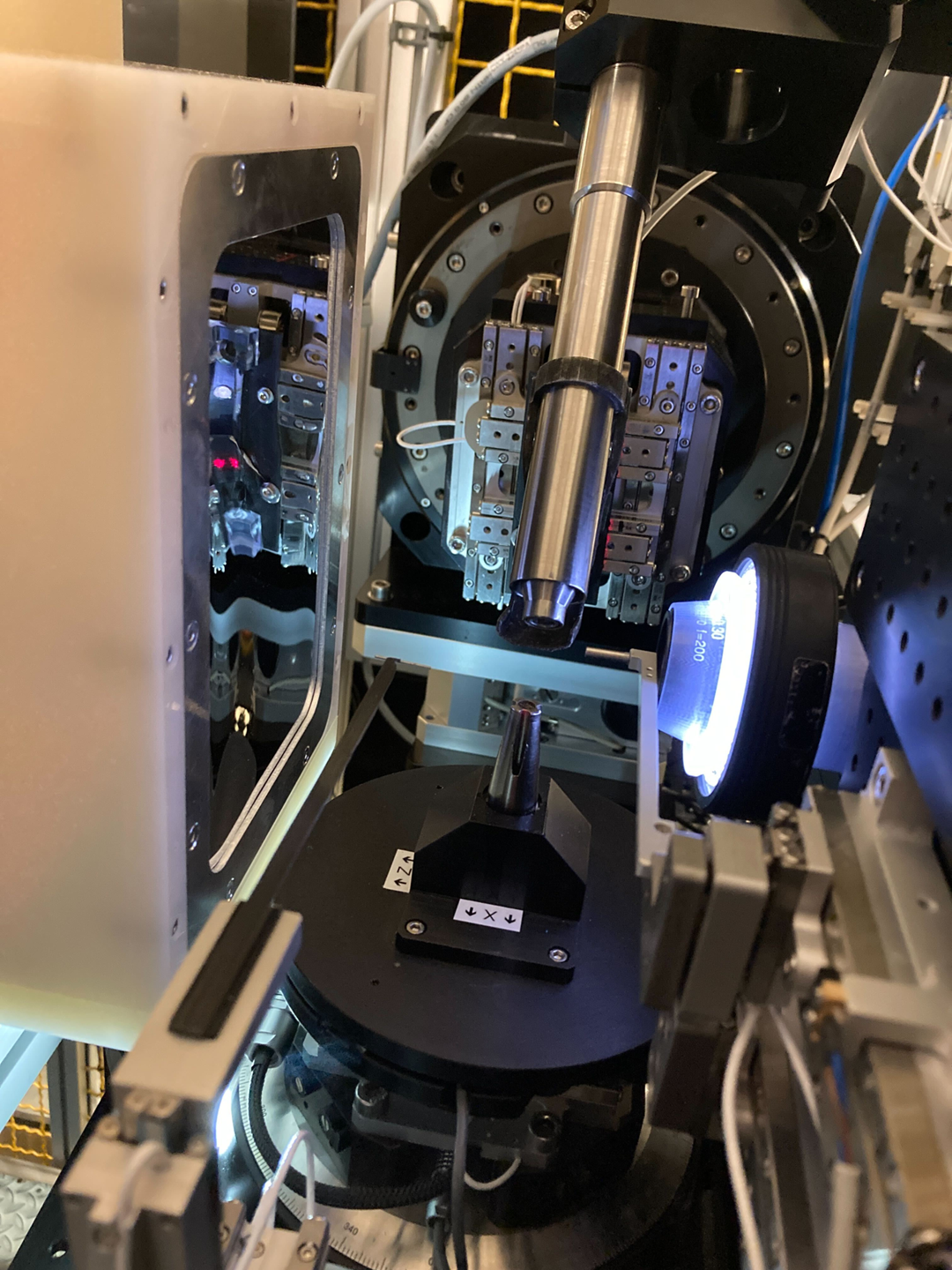
- Single module version of the detector in action at I24
Jungfrau at I24
As part of a series of ongoing upgrades, beamline I24 has been successful in securing BBSRC funding for a new integrating Jungfrau 9M detector supplied by the Paul Scherrer Institut. The Jungfrau detector will replace I24’s Pilatus3 6M which has served users for a good number of years. The CdTe Eiger2 9M detector will be the work-horse detector while the Jungfrau is in a commissioning phase for both rotation and serial data collection.
Learn more about this exciting update from Danny Axford's article here.
Processing snippets
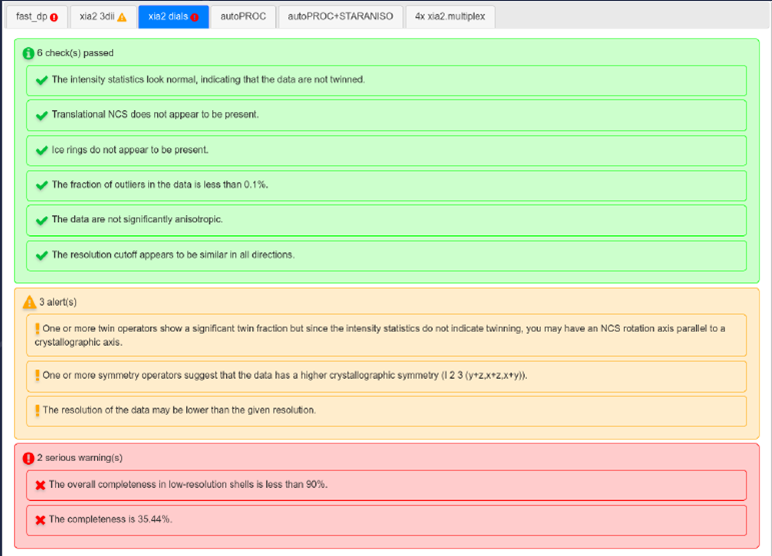
- An example of the alerts and warnings shown for a data collection
Diamond MX provides a comprehensive suite of data and downstream processing pipelines, including experimental phasing. All results are accessible via SyncWeb.
To enable downstream processing pipelines, it is highly recommended to include the following when preparing your samples at shipment and they must be in place prior to data collection:
- Protein sequence, PDB or PBD ID
- Anomalous scatterer (for phasing pipelines if applicable)
- Space group (if required)
If a protein sequence is provided, an AlphaFold model will be generated to support molecular replacement (MR) in addition to any PDB that user have supplied.
⚠️ Important: When viewing data reduction results, please be aware of alerts and warnings that appear immediately upon selection to get an overview of various suggested crystal pathologies in your dataset.
For datasets collected across multiple wedges, orientations, or regions of a crystal — or if trimming is required — data reprocessing tools available on SyncWeb can be used to refine your results.
If you have any questions or feedback regarding the data processing, please feel free to reach out to us.
Publication
1. Interesting paper on multi-crystal approach using intensities-based clustering
Thompson, A. J., Beilsten-Edmands, J., Tam, C., Sanchez-Weatherby, J., Sandy, J., Mikolajek, H., Axford, D., Jaho, S., Hough, M. A. & Winter, G. (2025). Enhanced intensity-based clustering of isomorphous multi-crystal data sets in the presence of subtle variations. Acta Cryst. D81, 278-290.
2. In case if you have missed it, paper from our sub-micron focus beamline (VMXm) is out in JSR
Warren, A. J., Trincao, J., Crawshaw, A. D., Beale, E. V., Duller, G., Stallwood, A., Lunnon, M., Littlewood, R., Prescott, A., Foster, A., Smith, N., Rehm, G., Gayadeen, S., Bloomer, C., Alianelli, L., Laundy, D., Sutter, J., Cahill, L. & Evans, G. (2024).VMXm – A sub-micron focus macromolecular crystallography beamline at Diamond Light Source. J. Synchrotron Rad. 31, 1593-1608.
Science in focus
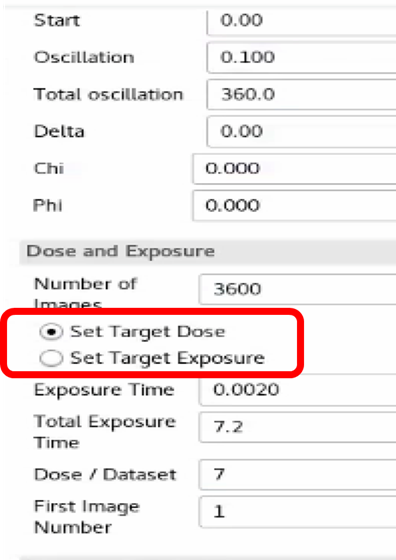
- Dose and Exposure Control Panel at Beamline I04
X-ray crystallography is a powerful technique used to determine the 3D structures of biological macromolecules, which plays a crucial role in understanding their functions and interactions. The quality of the data collected from X-ray diffraction experiments is critical for the success of structure determination and subsequent analyses.
With advancements in technologies, such as brighter synchrotron sources and more sensitive detectors, the limitation in X-ray diffraction data collection has shifted from the capabilities of the instruments to the radiation damage of the sample.
Read more from David Aragão's article for this Newsletter ..
Users who wish to contribute to an upcoming issue by sharing their scientific story or describing how Diamond has supported their research are invited to contact us via E-mail with your suggestions.

Diamond Light Source is the UK's national synchrotron science facility, located at the Harwell Science and Innovation Campus in Oxfordshire.
Diamond Light Source Ltd
Diamond House
Harwell Science & Innovation Campus
Didcot
Oxfordshire
OX11 0DE
Copyright © Diamond Light Source. Diamond Light Source® and the Diamond logo are registered trademarks of Diamond Light Source Ltd
Registered in England and Wales at Diamond House, Harwell Science and Innovation Campus, Didcot, Oxfordshire, OX11 0DE, United Kingdom. Company number: 4375679. VAT number: 287 461 957. Economic Operators Registration and Identification (EORI) number: GB287461957003.