 Macromolecular
 Soft Condensed
  Imaging and
 Biological
 Magnetic
 Structures and
 Crystallography
  Spectroscopy
 Jungfrau update for users
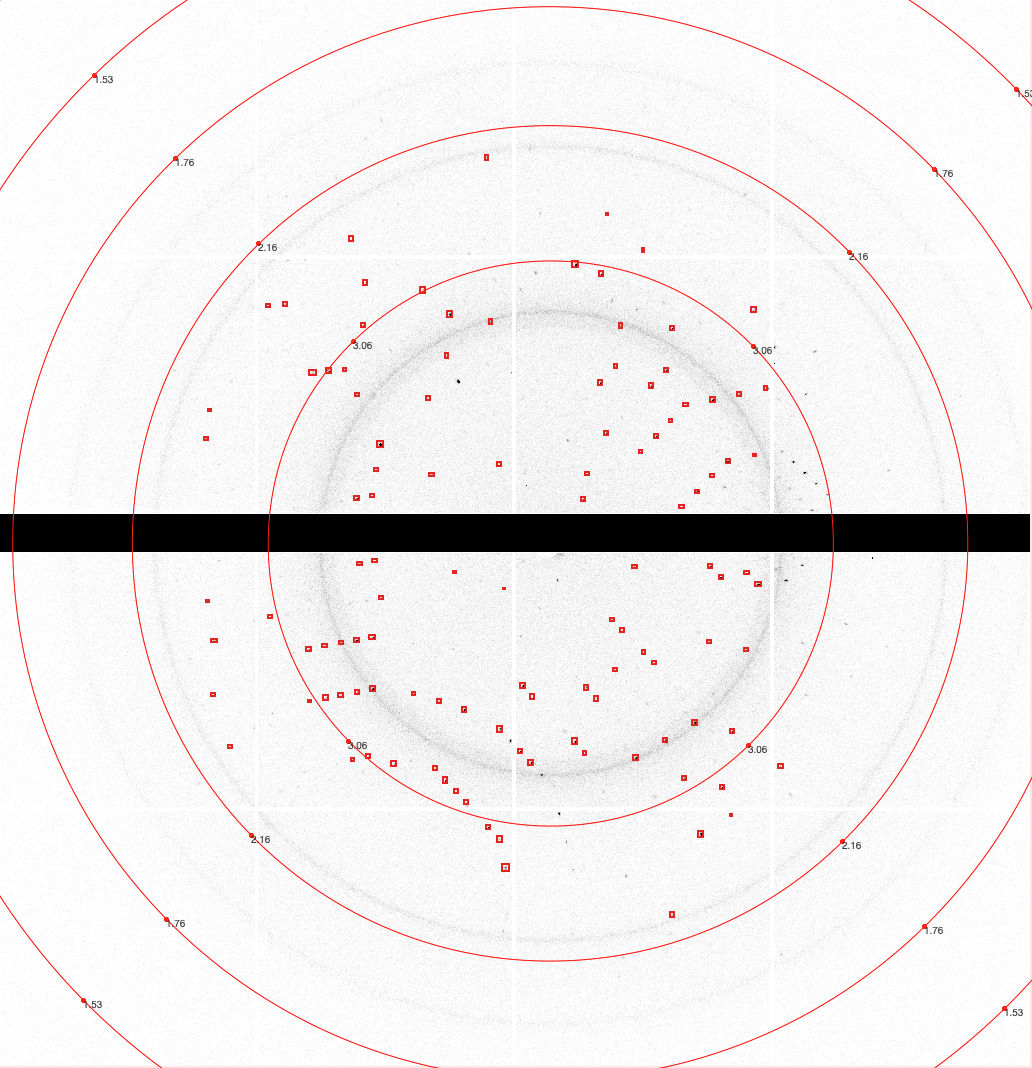
- Diffraction pattern from cubic Inslin recorded with Jungfrau
As part of a series of ongoing upgrades, beamline I24 has been successful in securing BBSRC funding for a new integrating Jungfrau9M detector supplied by the Paul Scherrer Institut. Co-applicants Robin Owen (I24), Mike Hough (VMXi), Graeme Winter (Scientific Software) and Allen Orville (XFEL-Hub) demonstrated the case for utilizing this latest technology in X ray detection for sub-millisecond time-resolved MX experiments. As part of the delivery and development project, a single module version of the detector has been tested on I24 and used to collect ultra-fast rotation data with 360 degrees of data acquired in less than 2 seconds at 2000Hz. Despite the relatively tiny area of this test detector, data from cubic insulin were complete to 1.5 Ang with impressive data-reduction statistics (<<10% overall Rmeas). Nick Devenish and the DLS MX data-analysis team, are exploiting the latest in ‘GraceHopper Superchip’ high-bandpass computing hardware to handle the tremendous data-rates that this detector can generate. Per-image analysis and diffraction indexing will be performed ‘mid-flight’ between detector and filesystem to maximise user feedback for assessment of induced dynamical changes within samples.
The Jungfrau detector will replace I24’s venerable Pilatus3 6M which has served users for a good number of years. The CdTe Eiger9M detector will be the work-horse detector while the Jungfrau is in a commissioning phase for both rotation and serial data collection. After initial with-beam commissioning of the JF9M, the I24 detector support will be completely rebuilt to safely accommodate the Jungfrau and its cooling and data service requirements. This will also provide an upgrade in motion performance, making switching between detectors and access to the hutch faster and more reliable. The combination of new detector technology, improved motion control and the upcoming multi-layer/monochromator upgrade will offer completely new opportunities for data collection at I24
We are actively seeking potential projects that can exploit the 500 micro-second time resolution that now becomes accessible for following structural changes at room-temperature. Please contact I24 or XFEL-Hub staff for more details if interested.

Diamond Light Source is the UK's national synchrotron science facility, located at the Harwell Science and Innovation Campus in Oxfordshire.
Diamond Light Source Ltd
Diamond House
Harwell Science & Innovation Campus
Didcot
Oxfordshire
OX11 0DE
Copyright © Diamond Light Source. Diamond Light Source® and the Diamond logo are registered trademarks of Diamond Light Source Ltd
Registered in England and Wales at Diamond House, Harwell Science and Innovation Campus, Didcot, Oxfordshire, OX11 0DE, United Kingdom. Company number: 4375679. VAT number: 287 461 957. Economic Operators Registration and Identification (EORI) number: GB287461957003.