-
highlight

A team of experimental geoscientists from the University of Bristol has used I15 to recreate the extreme conditions in Earth’s mantle to study the carbon cycle
-
highlight

Investigations at Diamond may lead to easier ways to synthesise nanoparticle supercrystals
-
highlight
Pressure induces changes in magnetic behaviour of rhenium(IV) compounds
-
highlight
Multiferroic MnWO4 wolframite under compression
-
highlight
Investigating protein-protein interactions at high pressure with small angle X-ray scattering
-
highlight
.%20CaB61%20(2).%20CaB61%20(2).%20CaB61%20(2).%20CaB61%20(2).%20CaB61%20(2).%20CaB61%20(2).%20CaB61%20(2).%20CaB61%20(2).%20CaB61%20(2).%20CaB61%20(2).%20CaB61%20(2).%20CaB61%20(2).%20CaB61%20(2).png)
Researchers from the University of Oxford and Diamond Light Source have discovered a new material, a Calcium hexaboride (CaB6) compound crystallising in a previously unknown crystal structure. Published in Physical Review Letters these findings can pave the way to customised boron-based intermetallics. The ordinary CaB6 is a semiconductor with an amazing hardness and high melting temperature governed by a high chemical stability. It has been investigated for a long time due to its relevance ...
-
highlight
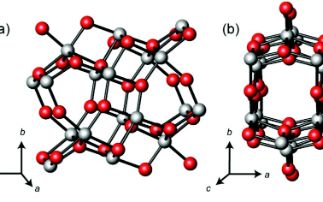
We have made use of the I15 beamline at Diamond Light Source to investigate the high pressure behaviour of Ti2.85O4N, a novel oxynitride synthesized by the unusual route of atmospheric pressure chemical vapour deposition, at pressures up to 68 GPa. At ambient pressure this phase adopts the pseudo-brookite Cmcm structure, and anisotropic compression was observed up 18 GPa, at which pressure a first order phase transition was observed to new orthorhombic (Pmc21) structure. Further compression ...
-
highlight
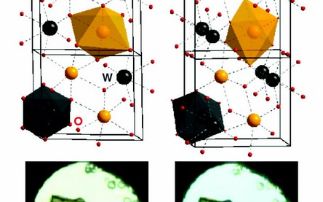
Tungstates of 3d-transition metals form an important family of inorganic materials with applications in various fields. CuWO4 is one of them, being well known as a semiconductor with technological applications in scintillator detectors, laser hosts, photoanodes, optical fibers, etc. In the last few years it has also attracted attention as a multiferroic material with an intriguing magnetic phase diagram. CuWO4 has been studied at ambient pressure to characterize its optical, magnetic, and ...
-
highlight
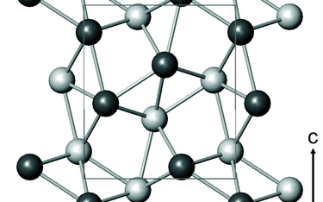
We have used the high intensity x-ray beam on beamline I15 to examine the crystal structures of the alkali metals Na and K to above 100 GPa (1 million atmospheres). In Na, we have utilised the low melting temperature near 100 GPa to grow a single crystal of sodium at 108 GPa, and have investigated the complex crystal structure at this pressure using single-crystal diffraction. We confirm that at this pressure sodium is isostructural with the cI16 phase of lithium, and we have refined the ...
-
highlight

The crystal structure of the high-pressure ζ-form of the explosive CL-20 has been determined using a combination of x-ray single crystal and powder diffraction techniques. Conformational changes in the orientation of the nitro groups of the CL-20 molecule were observed in the γ→ζ transition, such that molecules in the ζ-form adopt the conformation in which all of the nitro groups are exo with respect to the five- and six-membered rings. The level of complexity of this crystal structure ...
-
highlight
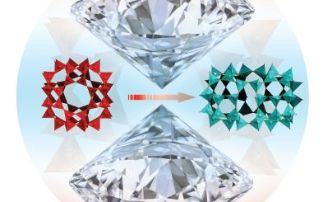
Diamond Light Source has been used to profile a new zeolitic microporous solid, created via a process that had previously been thought impossible. Using beam line I15 researchers were able to perform high-pressure synchrotron X-ray diffraction analysis of a material known as a zeolite ITQ-29, and were able to study how it transitioned into a new zeolite. The research also showed that the daughter zeolite is a more efficient adsorber for carrying out the separation of propene from mixtures ...
-
highlight
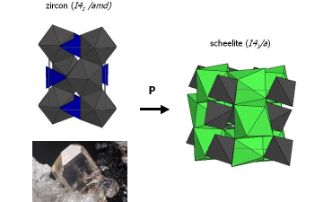
Orthovanadates have recently emerged as promising optical materials for birefringent solid-state laser applications. They can be also used in a number of applications including cathodoluminescent materials, thermophosphors, scintillators, and nuclear waste storage. Given the technological importance of zircon-type orthovanadates, their electronic and optical properties have been extensively studied but their mechanical properties, which are of interest in several areas of materials research, ...
-
highlight
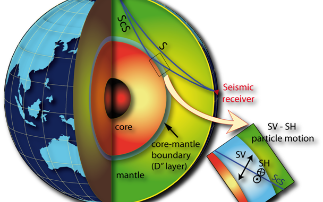
The impact earthquakes have on the planet’s surface is well documented. However, much less is known about what happens deep in the planet’s interior. An international group of researchers have been using the Extreme Conditions beamline at Diamond Light Source to study the mineral ferropericlase, thought to be the second most abundant mineral in the Earth’s lower mantle, over 300 miles (670 km) below the surface of the planet. Understanding what happens to ferropericlase in the high ...
-
highlight
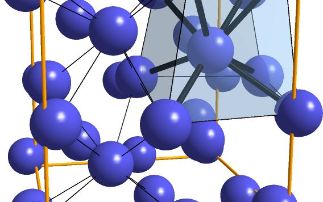
The first publication from Diamond Light Source utilised the synchrotron’s high intensity x-rays and a diamond-anvil cell on the Extreme Conditions beamline I15, to study the unique behaviour of sodium at high pressures. This research was carried out by a team from the Centre for Science at Extreme Conditions at the University of Edinburgh, working in collaboration with the I15 beamline team.1
 Macromolecular
 Soft Condensed
  Imaging and
 Biological
 Magnetic
 Structures and
 Crystallography
  Spectroscopy