-
news
Kicking off on Tuesday 30th June, Diamond had a busy week in London with a presence at two of the biggest science events in the city.
-
news
_%2520Copyright%2520the%2520Mary%2520Rose%2520Trust_%2520Copyright%2520the%2520Mary%2520Rose%2520Trust_%2520Copyright%2520the%2520Mary%2520Rose%2520Trust.jpg)
Diamond Light Source’s intense X-rays are helping researchers to refine their methods to better preserve the famous Tudor warship known as the Mary Rose. Raised from the seabed in October 1982, 437 years after she capsized and sank, the Mary Rose is the only 16th century warship on display anywhere in the world.
-
news
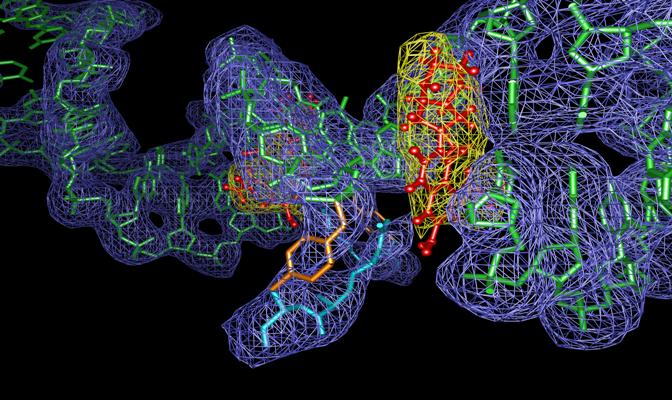
London: A special family of antimicrobials called quinolones is currently used to treat virulent bacteria responsible for some of the most dangerous diseases such as pneumonia and meningitis.
-
highlight

The impact earthquakes have on the planet’s surface is well documented. However, much less is known about what happens deep in the planet’s interior. An international group of researchers have been using the Extreme Conditions beamline at Diamond Light Source to study the mineral ferropericlase, thought to be the second most abundant mineral in the Earth’s lower mantle, over 300 miles (670 km) below the surface of the planet. Understanding what happens to ferropericlase in the high ...
-
news

Diamond is taking part in this year's Royal Society Summer Science Exhibition, showcasing the accelerator physics behind the facility and the outputs of an innovative science and art initiative.
-
news

From Tuesday 30th June to Thursday 2nd July, over 700 science writers and communicators will gather in London for the 2009 World Conference of Science Journalists (WCSJ).
-
news

What are the basic physical principles behind the Diamond machine? How is the electron beam produced? How is it steered, focussed and “wiggled” to produce synchrotron light?
-
news

At 5:30pm on Saturday 6th June, members of the local community took part in a special annual service commemorating the D-Day landings in Normandy on 6th June 1944.
-
news
On Saturday 23rd May 2009, over 200 members of the public flocked to Diamond to take a closer look at the facility, meet its staff and view the works of art produced by its artists in residence.
-
news
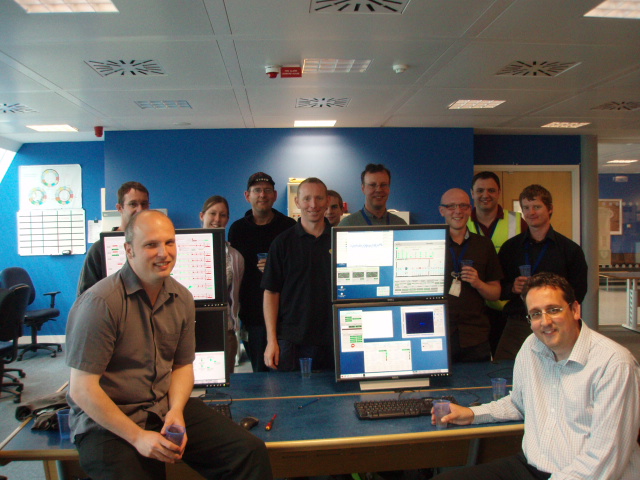
It was a novel event on Tuesday 12th May when two separate beamlines achieved first light on the same day. The screens in the control room lit up with fluorescent images as beamlines I07 (Surface and Interface diffraction) and I12 (JEEP) received synchrotron light for the first time.
-
news
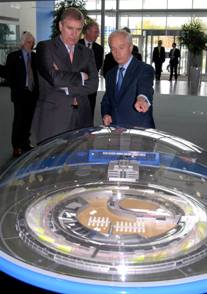
Harwell, UK – 16th April 2009: Today, His Royal Highness The Duke of York, Prince Andrew, met the winners of the National Science Competition, whose prize included a visit to Diamond Light Source, the UK’s national synchrotron science facility, which is based on the Harwell Science and Innovation Campus in South Oxfordshire.
-
highlight
%20diamond-ltas%20-%20R%20Lewis.png)
Researchers at Newcastle University’s Institute for Cell and Molecular Biosciences are regular users of Diamond’s MX beamlines. One of the complications of crystallography is that part of the information required to determine structures is lost in the diffraction experiment. This information can be inferred in special circumstances in a ‘SAD’ (single-wavelength anomalous dispersion) experiment. In common with other MX users, the Newcastle group have been utilising these SAD experiments to ...
-
highlight

Before we are born, each and every one of us is enveloped by membranes and fluid that ensure our safe development and protect us from the external environment at a time when we are at our most vulnerable. Foetal membranes are split into two layers and the protective sac, the amniotic membrane that surrounds the developing baby, is currently the focus
of studies being carried out by researchers from the University of Reading’s School of Pharmacy and the Institute for Women’s Health at ...
-
highlight
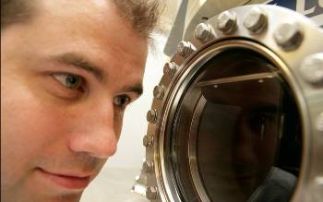
Extending our knowledge of how magnetic materials behave on an atomic scale has led to considerable technological advances, particularly in the area of information storage. Scientists have been using the Nanoscience beamline at Diamond to study the properties of magnetic domain walls, the boundary between areas of material with uniform magnetization. The group has modeled the way that these walls move when current is applied, a technique which has promising applications in writing data in ...
-
news

During a visit to Diamond Light Source earlier today (Wednesday 18th February), Tim Stevenson OBE, Lord Lieutenant of Oxfordshire, launched Diamond’s contribution to the Oxfordshire Science Festival by adding a stitch to the World’s largest diffraction pattern – an innovative textile project which brings science and art together to provide a platform for scientists to explain their research to the public in an engaging and imaginative way.
-
news
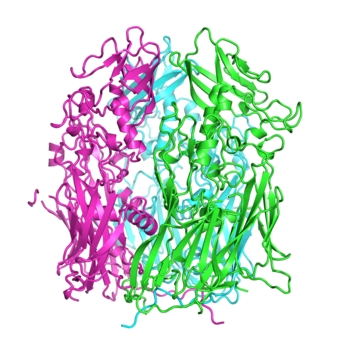
Leading Oxford science team solve structure of biological protein – an important step in developing new therapies to treat viruses
-
news
Extremely intense X-rays from Diamond - the UK’s national synchrotron - are helping to advance research into the understanding and treatment of eye diseases. Due to the detailed nature of the experiments, researchers from Cardiff University are making discoveries about the eye that should help to advance laser surgeries such as LASIK¹ and contribute to the eventual development of an artificial cornea.
-
news

Congratulations to Diamond Fellow, and former Life Sciences Director, Prof. Dame Louise Johnson (pictured left) for receiving the prestigious Novartis Medal and Prize; awarded by the Biochemical Society in recognition of her outstanding contributions to the development of biochemistry.
-
highlight
Scientists have been using both Diamond Light Source and the ISIS neutron source to get a better understanding of an important group of materials that can help target the delivery of drugs to the right place in the body. The materials, called Pluronics™, form water-based gels which can be customized to control their structure and how they flow, important considerations in controlling how and when the drugs become active.
-
news
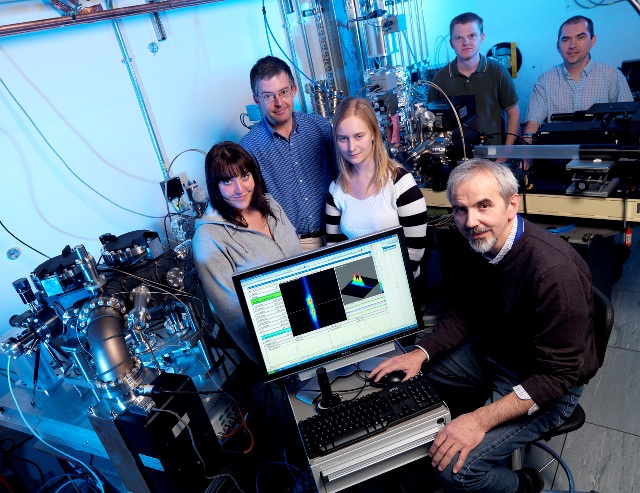
A team of scientists from the University of Reading became the first researchers to use the UK’s national synchrotron facility’s latest experimental station (B23).