-
news

The first users on the I22 Non-Crystalline Diffraction beamline, Professor Tim Wess and his team at the University of Cardiff, have been able to analyse the state of the collagen within parchment and its degenerative change to gelatine.
-
highlight
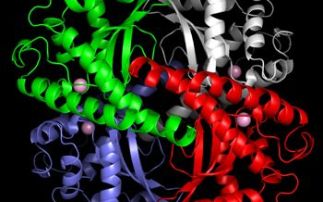
Superoxide Dismutase (SOD) is a key enzyme that is responsible for removing harmful oxygen radicals from cells by catalysing their breakdown into hydrogen peroxide and water. The synchrotron radiation at Diamond was used to determine the molecular structure of a SOD which contains the metal manganese from the parasitic worm C. elegans. The structure will help us understand how the enzyme works and how it chooses manganese over other metals. The picture shows the four protein chains in ...
-
news

Diamond has appointed a trio of artists to have a presence on site and work with members of the science team over the next 12 months.
-
news

This week marks the dawn of a new era of scientific endeavour as Diamond Light Source, the UK’s brand new synchrotron facility, opens its doors for business and welcomes its very first scientific users. Top academic teams from Durham, Oxford, Leicester and London have been selected to be the first users of one of the brightest sources of light in the world that will enable them to find out more than ever before about the secret structure of the world around us.
-
news

Three short months after celebrating the first generation of synchrotron light, Diamond Light Source announced today that it has reached the final milestone in the construction of a facility that is destined to change the landscape of UK science.
-
news
Diamond Light Source Ltd is now eligible for funding from Facility Development Project Grant Scheme, managed by STFC. This scheme was developed to encourage academic researchers and others to put forward innovative and creative ideas for development of facility instrumentation, detectors, analytical capabilities and sample environments among others.
-
news
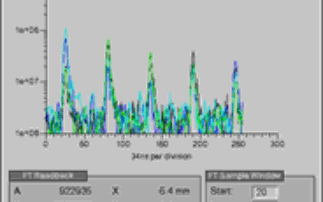
On the night of September 4th 2006 Diamond succeeding in circulating the first electrons in the storage ring at 3 GeV.
-
news
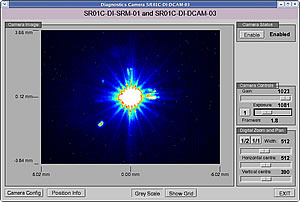
At 2.00am on Tuesday 30th May 2006 (Spring Bank Holiday Monday night shift!), Diamond's accelerator team achieved stored beam in the 561.6 metre Storage Ring, which in turn allowed the first observation of synchrotron light.
-
news
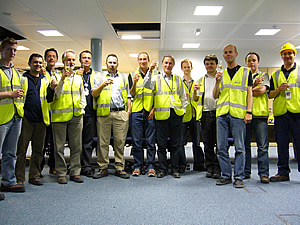
Diamond's accelerator team had a fantastic reason to celebrate last night, Thursday 4th May 2006.
-
news
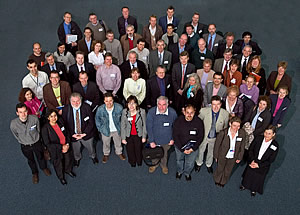
60 delegates from the Medical Research Council (MRC) gathered at Diamond for a Medical Sciences Workshop on 26th April 2006 (pictured left). The audience included MRC funded scientists, senior representatives from MRC regional centres and the HQ.
-
news
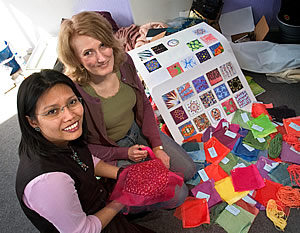
On Saturday 22nd April, leading textile artist and renowned Oxfordshire ‘super-stitcher’, Anne Griffiths will lead a mammoth dyeing session with eight Women’s Institute (WI) Leaders for ‘Designs for Life’ and scientists from Diamond, in Oxford. (Left hand image: Rohannah Hussain, Diamond Beamline Scientist -left- and Anne Griffiths WI -right- with panel designs and material samples)
-
news
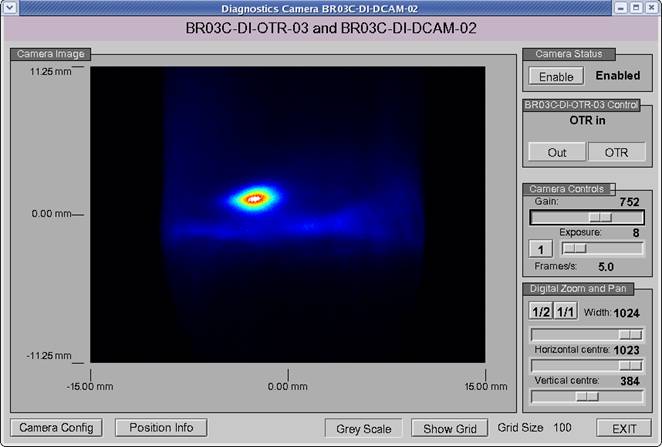
On the night of 3/4 April 2006 the first electrons were extracted from the second of Diamond's three particle accelerators - the booster synchrotron - towards the main storage ring, taking Diamond one step closer to completion.
-
news

Scientific links between Diamond Light Source Ltd, the UK's next generation synchrotron facility, the Japan Synchrotron Radiation Research Institute (JASRI), and the RIKEN Harima Institute will be strengthened today when these three partners sign a Memorandum of Understanding (MoU) on collaborative research.