 Macromolecular
 Soft Condensed
  Imaging and
 Biological
 Magnetic
 Structures and
 Crystallography
  Spectroscopy
 Allocation Period (AP) details
The current Allocation Period is AP38 which will run until 31st March 2026. AP39 starts from 1st April 2026 to 30th September 2026.
The proposal call for AP40 (1st October 2026 - 31st March 2027) is currently open. The deadline for submission is at 17:00hrs UTC:GMT on 1st April 2026.
We accept requests for rapid access at any point in time. See here for details.
Run details
Details of Run 1 of 2026 and Run 2 in 2026:
| Run 1 2026 | Start Date | End Date |
| MX Sample Shipping | From 5th January | To arrive on/by 6th March |
| MX User Beamtime | From 15th January | Ends at 9am on 13th March |
| Run 2 2026 | Start Date | End Date |
| MX Sample Shipping | From 15th April | Ends at 22nd May |
| MX User Beamtime | From 5th April | To arrive on/by 19th May |
Shutdown Details
- There are planned upgrades from RHEL7 to RHEL8 for the majority of the MX beamline servers during this shutdown period.
User outreach
Training
- Our next Onsite MX User Training session is scheduled for 11th & 12th February 2026. This session will be particularly designed for people who are new to both macromolecular crystallography and to using Diamond. Applications for this are open untill 12th January. For more details please check the events page.
-
The Macromolecular Crystallography (MX) Group at Diamond Light Source invites all interested users to our first MX User Drop-In Zoom Meeting on 27th January 2026.
This meeting will provide updates on beamlines and software, followed by an open Q&A session. Each meeting will begin with one or two short presentations on recent developments, with ample time for discussion. For additional information check the events page.
Meet and Greet
Our staff will be attending the following meetings and would be pleased to connect with you. Feel free to stop by for a conversation or to discuss any questions you may have.
- Diamond MX user meeting and CCP4 Study Weekend 7-9 January - Christian Orr, Kamel El Omari, Ramona Duman, Amy Thompson, Samuel Foster, Mike Hough, James Sandy, Isabel Barker, Jasmin Aschenbrenner, Blake Balcomb, Rebecca Parr, Dave Hall.
Processing snippets
Reprocessing in ISPyB
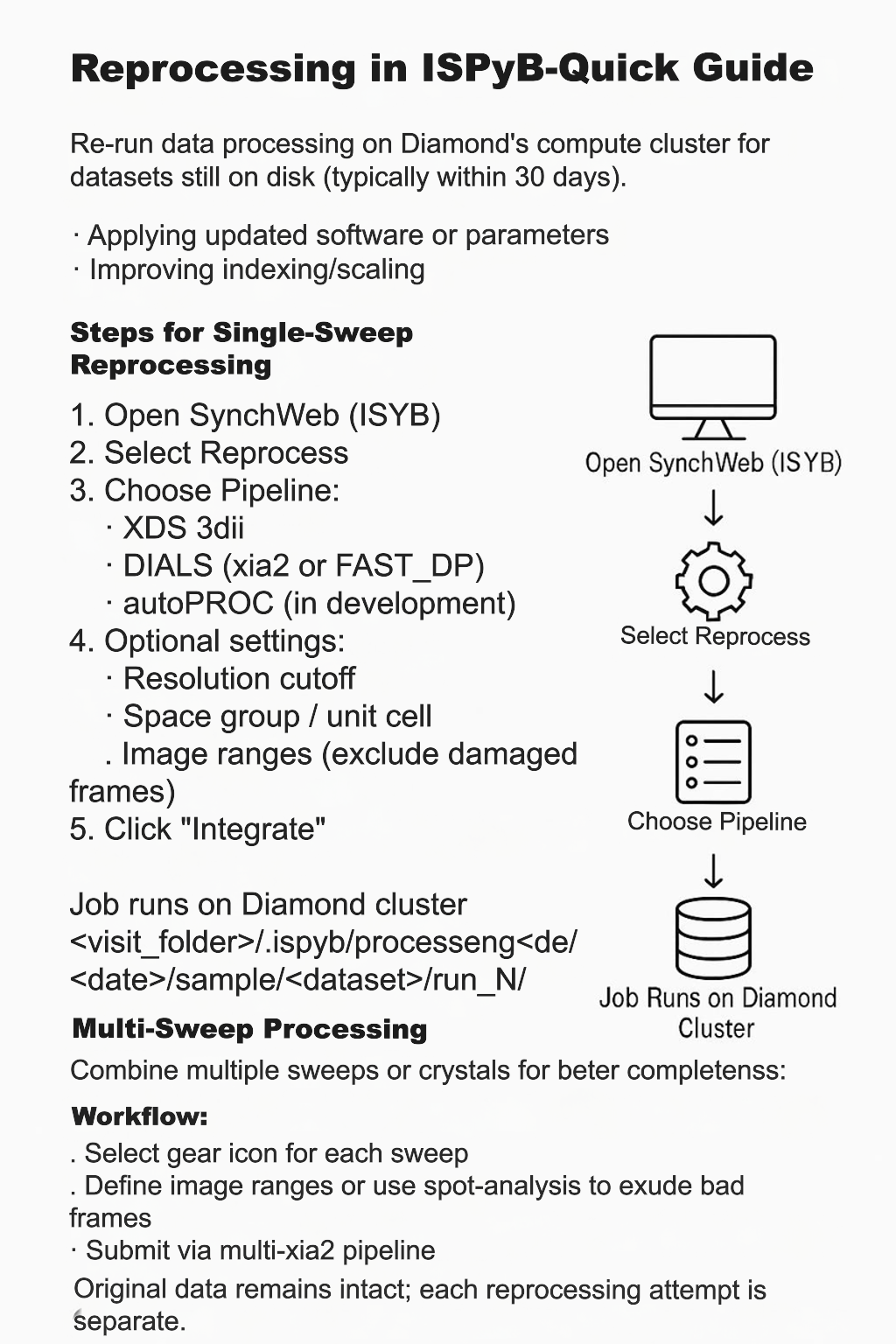
ISPyB allows users to re-run data processing on Diamond’s compute cluster for datasets still on disk (usually within 30 days). Through the SynchWeb interface, you can select a dataset, choose a pipeline (e.g., XDS, DIALS via xia2/FAST_DP, autoPROC), and optionally adjust parameters like resolution cutoff, space group, or image ranges. Jobs run remotely, and results—including logs and MTZ files—are stored in the .ispyb/processed directory under your visit folder. Multiple attempts are tracked in separate run folders. Multi-sweep or multi-crystal processing is supported via the multi-xia2 pipeline, with combined results accessible in ISPyB.
Multi-sweep processing in ISPyB refers to combining multiple data collections (sweeps) from the same crystal or related crystals into a single integrated dataset. This is useful when:
- You collected several sweeps at different orientations or wavelengths.
- You want to improve completeness or redundancy by merging data.
How it works:
- In SynchWeb, select the gear icon for each sweep you want to include.
- Specify image ranges or use the spot-analysis interface to pick frames (helpful for excluding radiation-damaged regions).
- Submit the job using the multi-xia2 pipeline, which handles indexing, integration, and scaling across all selected sweeps.
- Results appear in the reprocessing tab and are saved in the .ispyb/processed folder under your visit directory.
This approach is ideal for multi-crystal experiments or when a single sweep doesn’t give full coverage.More workflow details can be found in this page.
Selected Publications
Check out the new book chapter about serial data processing.
Processing serial synchrotron crystallography diffraction data with DIALS. James Beilsten-Edmands, James M. Parkhurst, Graeme Winter, Gwyndaf Evans. Methods in Enzymology, 709, 207-244,2024.
Take a look at the paper that investigates the structural basis of the SAM cycle and its short-circuiting, utilizing automated data collection at both cryo-cooled and room temperature conditions carried out at Diamond.
Short-Circuiting the SAM-Cycle in Escherichia coli. Zhong Li, Xiaojin Wen, Seseg B. Bolotova, and Florian P. Seebeck. Journal of the American Chemical Society 2025 147 (51), 47690-47700
Science in focus
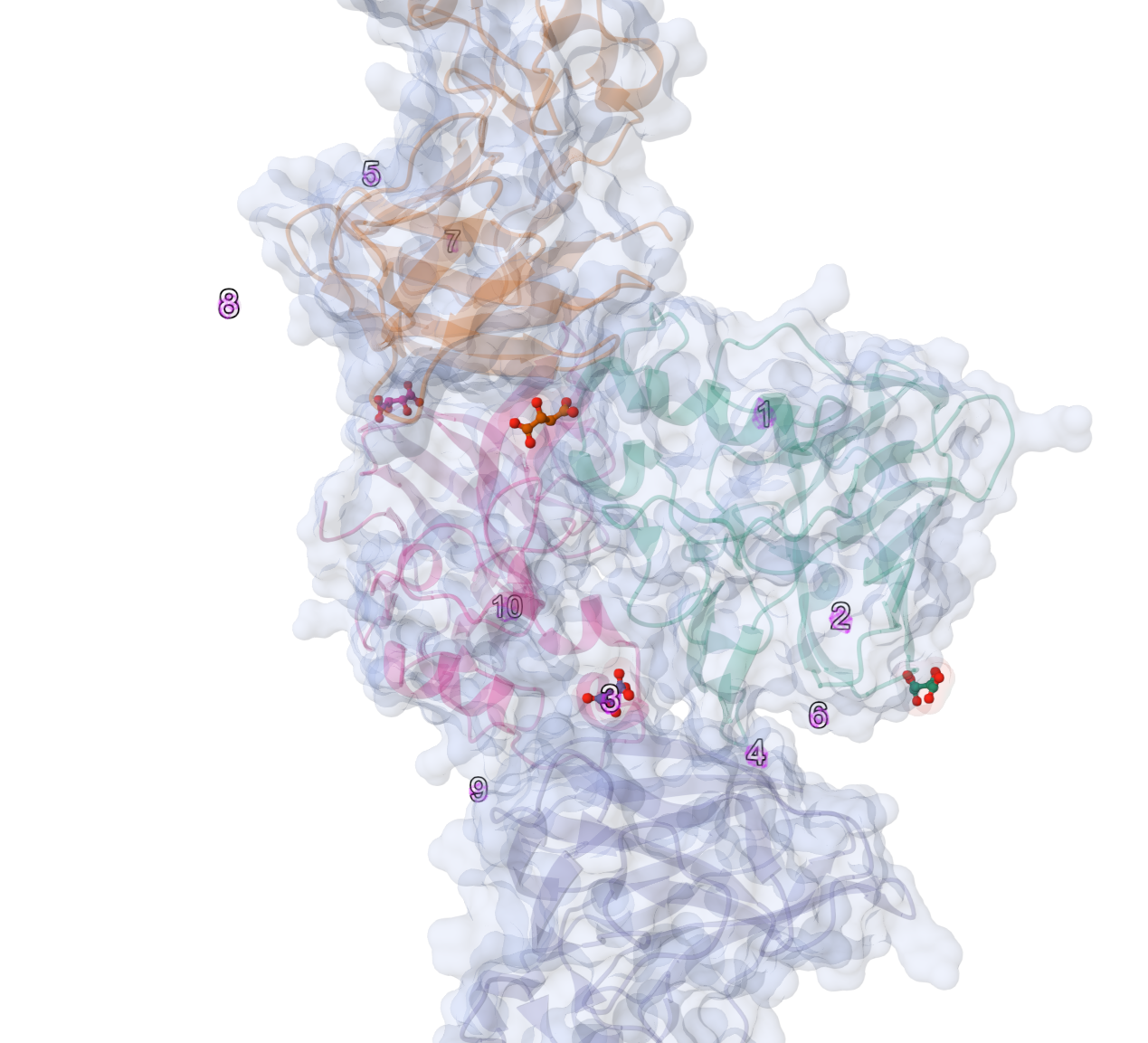
Diamond’s downstream processing now includes automated ligand fitting via phenix.ligand_pipeline, triggered after Dimple when a ligand SMILES is provided. Dimple also detects anomalous scatterers using SHELX/ANODE, with a new Interactive Viewer in Synchweb highlighting strongest peaks for improved visualization and streamlined structure determination.
In Memory of Karl Levik

- Karl Levik in front of Stortinget (Left) and Karl’s database demon logo! (Right)
It is with great sadness that we share the passing of our colleague Karl Levik, a Senior Research Database Engineer who served Diamond for nearly two decades. Karl was one of the original architects of the data infrastructure that underpins structural biology at our facility.
If you have ever used ISPyB, SyncWeb, or accessed results from any of our autoprocessing and post-processing pipelines to manage your samples or view your results, you have relied on the systems Karl meticulously built and maintained. He was the "invisible backbone" of our data management, ensuring that the flow of information across all MX beamlines and eBIC remained robust and reliable. We will miss his quiet expertise, his dedication, and the kindness he showed to everyone who sought his help.
Users who wish to contribute to an upcoming issue by sharing their scientific story or describing how Diamond has supported their research are invited to contact us via E-mail with your suggestions.

Diamond Light Source is the UK's national synchrotron science facility, located at the Harwell Science and Innovation Campus in Oxfordshire.
Diamond Light Source Ltd
Diamond House
Harwell Science & Innovation Campus
Didcot
Oxfordshire
OX11 0DE
Copyright © Diamond Light Source. Diamond Light Source® and the Diamond logo are registered trademarks of Diamond Light Source Ltd
Registered in England and Wales at Diamond House, Harwell Science and Innovation Campus, Didcot, Oxfordshire, OX11 0DE, United Kingdom. Company number: 4375679. VAT number: 287 461 957. Economic Operators Registration and Identification (EORI) number: GB287461957003.