-
highlight
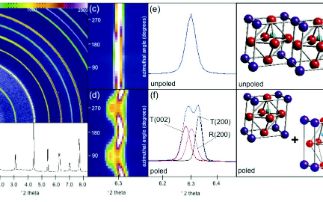
Piezoelectric materials are mainstream components for both consumer and industrial applications in a market worth an estimated $10.7 billion annually. The vast majority of this realm is served by the ceramic lead zirconate titanate (PZT), which contains up to 60% by weight of lead; there is considerable international effort at present to find viable lead free alternatives to PZT. High-energy synchrotron radiation available on the Extreme Conditions Beamline, I15 at Diamond Light Source has ...
-
highlight
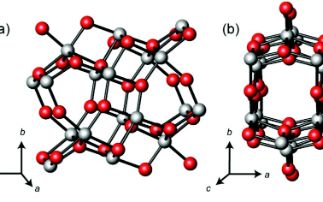
We have made use of the I15 beamline at Diamond Light Source to investigate the high pressure behaviour of Ti2.85O4N, a novel oxynitride synthesized by the unusual route of atmospheric pressure chemical vapour deposition, at pressures up to 68 GPa. At ambient pressure this phase adopts the pseudo-brookite Cmcm structure, and anisotropic compression was observed up 18 GPa, at which pressure a first order phase transition was observed to new orthorhombic (Pmc21) structure. Further compression ...
-
highlight
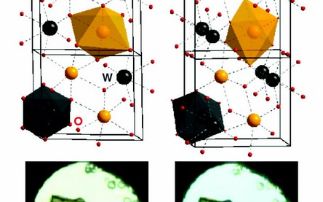
Tungstates of 3d-transition metals form an important family of inorganic materials with applications in various fields. CuWO4 is one of them, being well known as a semiconductor with technological applications in scintillator detectors, laser hosts, photoanodes, optical fibers, etc. In the last few years it has also attracted attention as a multiferroic material with an intriguing magnetic phase diagram. CuWO4 has been studied at ambient pressure to characterize its optical, magnetic, and ...
-
highlight
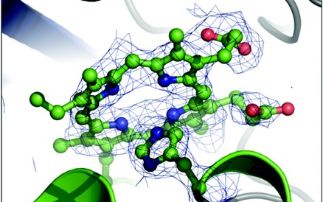
Iron is necessary for many cellular reactions and is therefore an essential nutrient for all living organisms. However, insolubility and toxicity of iron make its acquisition and processing a great challenge for living organisms. Thus to overcome such difficulties, bacteria have developed iron homeostasis mechanisms that involve control of three key processes: iron uptake, iron utilisation and storage of excess iron. Among these processes, uptake of iron plays a particularly crucial role for ...
-
highlight
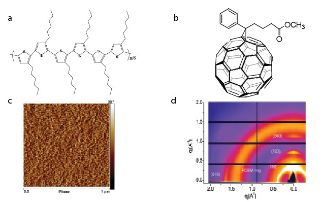
Growing concerns about fuel security and global warming have made the development and use of sustainable (low carbon) sources of energy an increasingly attractive proposition. Harvesting energy from sunlight at low-cost using photovoltaic devices is a rapidly growing research area, with organic based photovoltaics (OPVs) attracting particular interest as they have the potential advantages of low manufacturing-cost (as they are fabricated using solution based techniques) and ...
-
highlight

Spherulites are roughly spherical structures, and their name derives from the Greek for ‘ball’ and ‘stone’. Spherulites occur in various forms in nature. Those that form from polymers self-assemble into arrays of fibres that radiate out from the centre of the structure, and they are typically observed with diameters on the micrometre-scale. The arrangement of the fibres in the spherulite gives rise to birefringence, which may be observed when the spherulite is placed between crossed ...
-
highlight
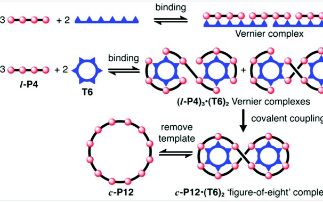
Templates are widely used to arrange molecular components so that they can be covalently linked to generate complex molecules that are not readily accessible by classical synthetic methods. Nature uses sophisticated templates such as the ribosome, whereas chemists use simple ions or small molecules. But as we tackle the synthesis of larger targets, we require larger templates — which themselves become synthetically challenging. Recently, we have shown that Vernier complexes can solve this ...
-
highlight
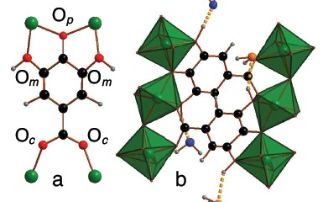
Inorganic-organic frameworks, particularly metal-organic frameworks (MOFs), have attracted considerable attention over the last decade because they exhibit a wide range of interesting physical properties.1 These include the ability to store or separate gases and perform catalytic reactions in nanoporous MOFs; while fascinating magnetic and electronic properties are found in denser frameworks. The transition metal gallate frameworks, M(C7HxO5)·2H2O (M = metal and x = 3 or 4) have ...
-
highlight
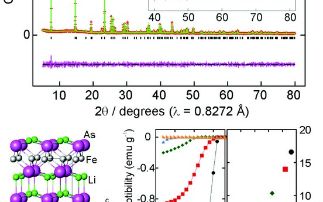
A range of techniques have been used to show that the behaviour of the superconductivity in LiFeAs is quite different from that in the other iron arsenide superconductors, and the system shows some similarities with the FeSe system.
-
highlight
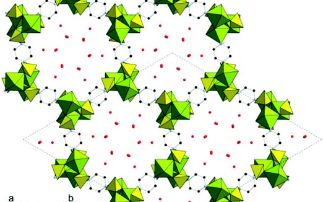
Crystalline porous solids, such as aluminosilicate zeolites have achieved widespread use in commercial processes of adsorption and catalysis. However, they are limited for many fine chemical conversions of complex organic molecules by the size of their pores, which typically do not exceed 1 nm. Mesoporous silicas are known with pore sizes of 3 nm upwards, but these lack long range order, so that crystallography cannot be used to measure, understand and improve their catalytic performance. ...
-
highlight

The alteration shown by silver leaf applied to polychrome carved wood and altarpieces to imitate metal objects (arms, garments, tools and decorative mouldings) is a very generalised phenomenon. The processes involved are not well understood, limiting the development of adequate conservation strategies. The object of the study was to determine and clarify the alteration mechanisms. For this, several silver foils from polychrome carved wood, mouldings as well as flat surfaces of altarpieces ...
-
highlight
Combinatorial high-throughput screening at Diamond may prove useful in discovering novel bulk hydrogen storage materials, according to new research published this month in the Royal Society of Chemistry’s Faraday Discussions journal.
A team of researchers from the ‘HyStorM’ project, a collaboration between Oxford University, Johnson Matthey, Ilika Technologies and the ISIS facility, funded by the Technology Strategy Board, used innovative high-resolution Powder X-Ray Diffraction (XRD) ...
-
news

Professor Gerhard (Gerd) Materlik, Chief Executive of Diamond Light Source, has been elected a Fellow of the Royal Society (FRS).
-
news
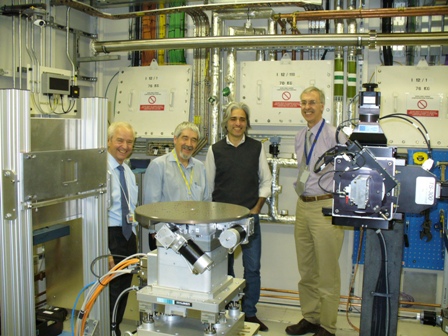
Prof David Delpy, Chief Executive of the Engineering and Physical Sciences Research Council (EPSRC), has praised Diamond's facilities and given support for Phase III investment.
-
news
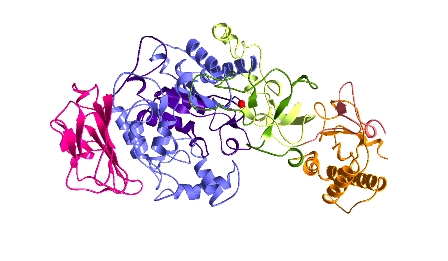
Scientists using Diamond Light Source have made a breakthrough in the battle against tooth decay, with research published in the leading Journal of Molecular Biology (JMB) on 29 April 2011.
-
news

Scientists from the Technical University of Catalonia in Barcelona have teamed up with Diamond Light Source to use a brilliant infrared microbeam to understand at the microscopic scale molecular processes affecting the decay or preservation of polychrome carved wood adorning churches and altarpieces depicting saints.
-
news
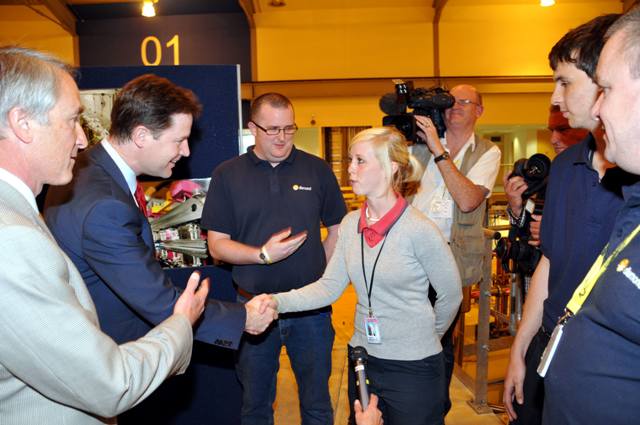
During a visit to Oxfordshire on Tuesday 19th April, Nick Clegg MP, Deputy Prime Minister, toured Diamond, the UK’s national synchrotron science facility.
-
news

A-level students from across the country were able to see science on a grand scale during visits to Diamond on 16th-18th March. They joined nearly 6,000 other students from 23 countries across the world taking part in annual Particle Physics Masterclasses this month.
-
news
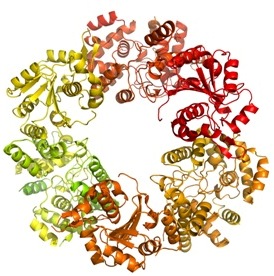
In 1962 the Nobel Prize in Chemistry was jointly awarded to Max Perutz and John Kendrew for determining the structures of two proteins, haemoglobin and myoglobin using a technique called X-ray diffraction.
-
highlight
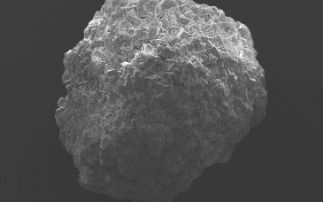
Scientists from Diamond Light Source, the Universities of Reading, Glasgow and the Natural History Museum in London have used the Diamond synchrotron to help determine whether worms can play a part in soil remediation. Their latest findings were published online in the journal Geochimica et Cosmochimica Acta.