-
highlight
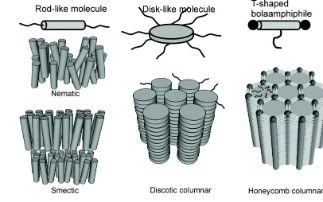
Liquid crystals have transformed our daily lives, with the LCD industry currently being worth £300 bn per year worldwide. The nematic phase, the most common LC phase used in displays and also the simplest, is formed by rod-like aromatic molecules bearing a flexible chain at one or both ends. Such molecules also form layered, or smectic, phases (Fig. 1, left). Thirty years ago a third type of LC, the columnar phase, was discovered in disc-like molecules, with columns of stacked discs placed ...
-
highlight
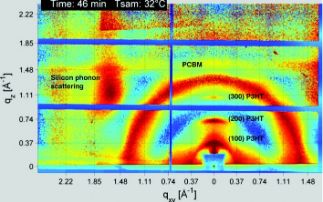
Organic photovoltaic (PV) materials have long-term promise for large area devices on flexible substrates produced by low-cost processes such as inkjet printing. Control of order and morphology at the nanometre scale during processing steps such as thermal annealing is crucial for optimized device efficiency. In this study, the structural changes during in-situ annealing are characterised by time-resolved grazing incidence X-ray diffraction.
-
highlight
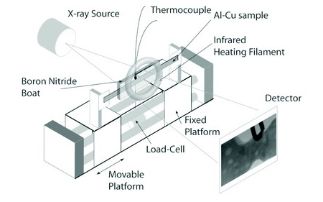
Our society takes for granted the high performance aluminium alloys used in aircraft, trains, fast ferries and motor vehicles. This high performance exists thanks to extensive research and development in industry and academia. One part of that research involves studying alloys as they solidify. During solidification, an alloy is a semi-solid “mush”, with properties that will significantly affect the quality of the final solid material. One property of great importance is the formation of ...
-
highlight
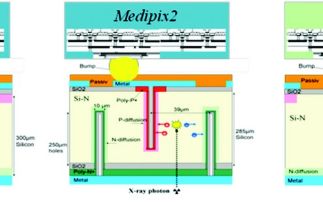
Synchrotron applications such as coherent X-ray diffraction and X-ray photon-correlation spectroscopy require detectors with a very small pixel size. Furthermore, the detector should have a high frame rate, large dynamic range, high detection efficiency and be also radiation hard. The Medipix range of readout chips (Medipix2 and Medipix3), with a pixel pitch of 55 µm, emerged as good candidates to develop a large area detector for the aforementioned applications. However, reducing the pixel ...
-
highlight
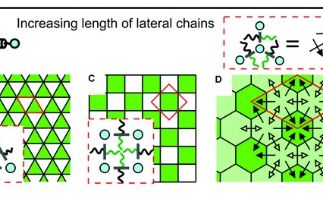
Solid-state materials, particularly those performing useful functions (e.g. zeolites), often form frameworks or cellular structures on the nanoscale1. These frameworks are usually rigid. Liquid crystals (LC), on the other hand, have a capacity to change shape and respond to external stimuli, such as pH or temperature, and offer the prospect of forming responsive cellular structures. T-shaped block molecules bearing three types of mutually incompatible groups (triphilic) were found to ...
-
highlight
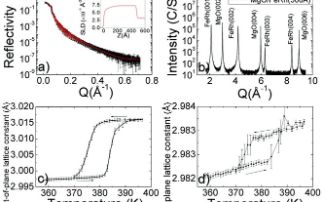
Magnetic recording lies at the heart of many modern electronic devices. The density at which information can be stored is directy related to the size of the magnetic particles within the storage devices. In order to increase the recording density one must reduce the size of the magnetic particles. Unfortunately, there is a problem: the superparamagnetic limit. Below this size, the magnetization can change direction randomly, driven by thermal fluctuations. Heat assisted magnetic recording1 ...
-
highlight
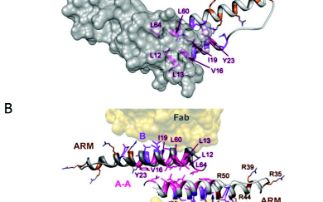
Despite decades of study, the mechanisms that HIV employs at certain steps of its replication cycle remain relatively nebulous. One such step involves the viral regulatory protein, Rev, whose principal function is to affect the nuclear export of a majority of the viral mRNA transcripts that are produced during infection. Rev achieves the specific transport of the viral RNAs by oligomerizing onto the Rev response element, a highly-structured RNA motif within an env intron. Without such RNA ...
-
highlight
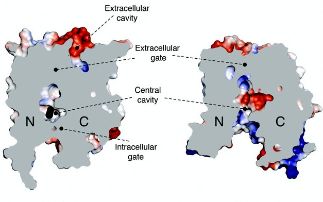
The proton dependent oligopeptide transporters (POTs) are a large family of integral membrane proteins that use the inwardly directed proton electrochemical gradient to transport small peptides, amino acids and nitrate across cellular membranes in both pro- and eukaryotic cells. Evolutionarily the POT family sits within the much larger Major Facilitator Superfamily (MFS), members of which contain a common structural motif of 12 transmembrane-spanning alpha-helical segments. The human genome ...
-
highlight
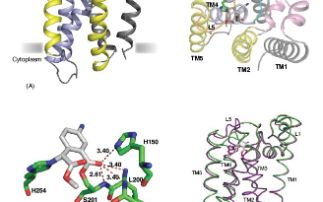
Rhomboids belong to the family of intramembrane proteases that use a catalytic dyad of serine and histidine for proteolysis of substrate transmembrane proteins. Conserved in both prokaryotes and eukaryotes, they regulate diverse cellular processes such as intercellular signalling, parasitic invasion of host cells, and mitochondrial morphology. Their importance in biology provides a strong incentive to understand the mechanism of these unusual enzymes for identification of specific ...
-
highlight
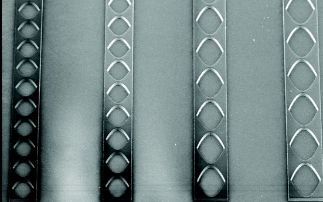
Diamond is one of the most interesting materials for many applications in engineering, electronics, jewellery, and synchrotron radiation instrumentation. Chemical vapour deposition techniques allow diamond growth on a range of substrates, and in a range of crystalline quality. Nano-crystalline diamond has been proposed for use in biosensors and nanolithography as it can be deposited with sub-µm resolution. X-ray optics made of diamond are almost transparent, very strong, and are subject to ...