Fundamental gains for a spintronic future
Nov 9, 2015
Electronic structure and spin-valley-layer coupling in the strong spin-orbit ...Read On I05 in the Annual Review
Nov 9, 2015
An international team of scientists have recently published results in Science Advances that bring us a step closer to the reality of ultra-efficient chip technology. The team used angle-resolved photoemission spectroscopy (ARPES) to investigate energy states at the surface of a semiconductor – bismuth telluride iodide, or BiTeI - prized for its exceptional electronic properties and earmarked as a potential microchip material.
By performing ARPES experiments on the surface of BiTeI at Diamond’s ARPES beamline (I05), the research team was able to study how the electrons move in this semiconductor, and how this is related to their spin. Studying this behaviour can identify how spin polarisations can be controlled, which in turn opens up the huge potential for new quantum technologies to be developed.

Lewis Bawden, PhD student at the University of St Andrews and lead author of the study, explained the fundamental premise of the research: “We aimed to shed new light on the Rashba effect - this is known to split electronic states according to the spin of the electrons and has promising applications in spintronics.” The concept might sound complicated, but is straightforward - whilst generic materials interact with a magnetic field by splitting into two distinct energy states of electron spin through the energy gained or incurred through alignment, the Rashba effect offers a way to ‘cheat’ the system into mimicking such a dichotomy without ever invoking a magnetic field.
What’s the catch?
Experimentalists must harness an elusive quantum mechanical interaction known as spin-orbit coupling. “This is a coupling of the electron spin to the motion of electrons in the solid” explains Dr Phil King, Royal Society University Research Fellow at the University of St Andrews, and the team’s principal investigator. Relativity dictates that in the rest frame of individual electrons, the presence of an electric field can be felt as a magnetic field, leading to that sought-after energy state splitting. Crucially, however, this causes very small changes in most materials, where it is also often limited to their surfaces.
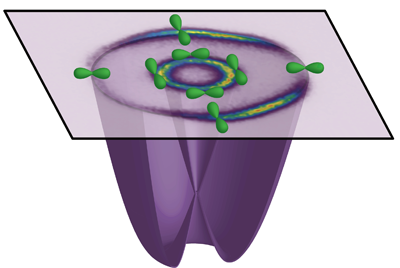 ARPES measurements of the Fermi surface of BiTeI, accompanied by a schematic representation of the electronic structure and corresponding orbital textures resolved for inner and outer spin-split branches of this model Rashba system (Bawden et al, 2015)
Bawden L. et al. Hierarchical spin-orbital polarization of a giant Rashba system. Science Advances 1, 8, (2015). DOI: 10.1126/sciadv.1500495.
Notes
ARPES measurements were performed at the CASSIOPEE beamline of SOLEIL synchrotron (France) and I05 beamline of Diamond Light Source (UK).
Image credit
 This image is used under the creative commons Attribution 2.0 Generic licence. Credit: Yuri Samoilov. Title: Circuit. Cropped from original.

Diamond Light Source is the UK's national synchrotron science facility, located at the Harwell Science and Innovation Campus in Oxfordshire.
Diamond Light Source Ltd
Diamond House
Harwell Science & Innovation Campus
Didcot
Oxfordshire
OX11 0DE
Copyright © Diamond Light Source. Diamond Light Source® and the Diamond logo are registered trademarks of Diamond Light Source Ltd
Registered in England and Wales at Diamond House, Harwell Science and Innovation Campus, Didcot, Oxfordshire, OX11 0DE, United Kingdom. Company number: 4375679. VAT number: 287 461 957. Economic Operators Registration and Identification (EORI) number: GB287461957003.