-
highlight
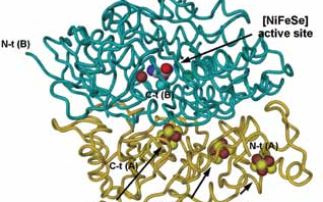
The three-dimensional structure of [NiFeSe] hydrogenase from D. vulgaris Hildenborough in its oxidised, “as isolated” state has been determined from a 3-wavelength MAD experiment at the Fe K-edge on Diamond Beamline I04. Crystals were obtained in space group P21 with cell parameters a = 60.6, b = 91.2, c = 66.7 Å, b = 101.7º and one hydrogenase molecule in the asymmetric unit. This work has recently been published [1]. Previously, only the structure of [NiFeSe] hydrogenase from Dm. baculatum ...
-
highlight
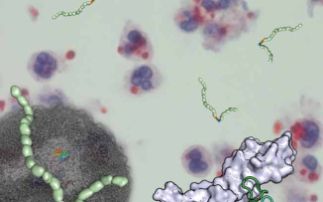
The structure of a protein complex between a bacterial and a human protein solved using data collected at Diamond Light Source (UK) and the ESRF (FRANCE) has revealed the way in which bacteria that cause bacterial meningitis mimic human cells to evade the body’s innate immune system. The study, published in Nature, could lead to the development of new vaccines that give better protection against meningitis B, the strain which accounts for the vast majority of cases of the disease in the UK.
-
news

Prof. Ian Robinson, who holds a joint appointment with University College London (UCL) and Diamond Light Source, has been awarded funding by the Biotechnology and Biological Sciences Research Council (BBSRC) for a 5-year BBSRC ‘Diamond Fellowship'.
-
highlight
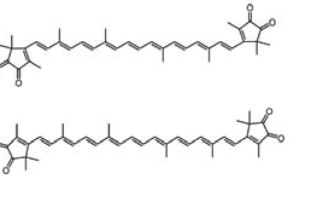
Violerythrin, a blue colored carotenoid, has been investigated by X-ray crystallography and by steady-state and ultrafast time-resolved absorption spectroscopy.
-
highlight
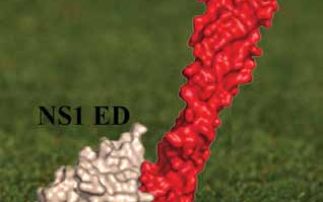
Seasonal epidemics and worldwide pandemics caused by influenza A viruses are of continuous public health concern. During infection, the viral nonstructural (NS1) protein stimulates phosphoinositide 3-kinase (PI3K) signaling, an essential cell survival pathway commonly mutated in human cancers. A structure of the NS1 effector domain in complex with the p85β inter-SH2 (coiled-coil) domain suggests that NS1 uses the coiled-coil as a structural tether to sterically prevent normal inhibitory ...
-
highlight
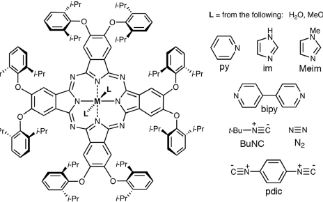
Crystal engineering of nanoporous structures has not yet exploited the heme motif so widely found in proteins. X-ray diffraction (XRD) analysis on Beamline I19 found that metal complexes of a phthalocyanine, a close analog of heme, forms molecular crystals that contain large interconnected voids (8 nm3), defined by a cubic assembly of six phthalocyanines. Rapid ligand exchange at the metal centres is achieved within these phthalocyanine nanoporous crystals (PNCs) by ...
-
highlight
Porous materials have wide ranging applications in areas such as hydrogen storage, catalysis and drug delivery. In rigid porous materials such as zeolites, the ability of the material to adsorb depends on the fixed size and shape of the pores. Until the mid 1990s most synthetic porous materials were either zeolites and their analogs or activated carbons. The discovery of metal-organic frameworks (MOFs) opened the possibility of more flexible frameworks, where the geometry of the pores can ...
-

The Structures of Life
-
highlight
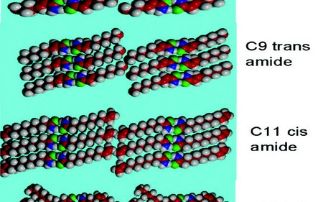
Molecular layers held together by non-covalent interactions on solid surfaces have gained increasing importance in recent times owing to their diverse commercial and academic applications and the ability to control behaviour by changing the molecular architecture of the adsorbing compounds. High-flux experiments on the powder diffraction beamline I11 at Diamond have enabled very accurate structural characterisation of a particular class of organic compounds, alkyl amides, adsorbed on the ...
-
highlight
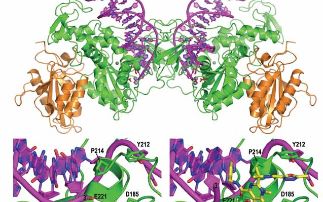
To establish successful infection, a retrovirus must insert DNA replica of its genome into a host cell chromosome. This process is catalysed by integrase (IN), the viral enzyme that synapses ends of viral DNA forming a highly stable nucleoprotein complex, intasome. The structure of full-length IN, either separately or in complex with viral DNA, has been lacking. Furthermore, although clinically useful inhibitors of HIV IN have been developed, their mechanism of action remained speculative. ...