-
highlight
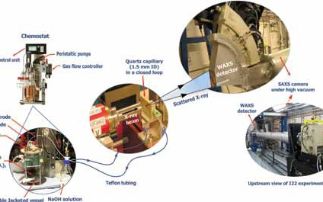
A combined time-resolved synchrotron-based Wide-Angle X-ray Scattering (WAXS) utilising a controlled chemical synthesis apparatus including electrochemical monitoring of the reaction was successfully developed to study the formation and transformation of the redox-reactive ‘green rust’ phases. Iron corrosion in some marine environments and waterlogged soils is known to involve the formation of dark olive-green compounds called green rusts (GR) which transform quickly into the usual brown ...
-
highlight
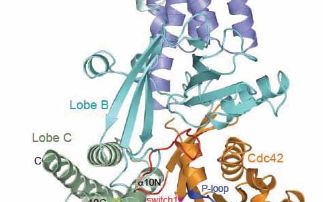
Rho proteins are small GTPases that function to regulate cell motility, polarity, adhesion, cytoskeletal organisation, proliferation and apoptosis. Two distinct families of Rho guanine nucleotide exchange factors (GEFs), the Dbl homology (DH) and DOCK proteins, activate Rho GTPases through the exchange of GDP for GTP. In humans, DOCK proteins are organised into four subfamilies, characterised by their differing specificities for Rac and Cdc42, regulatory domains and associated subunits. All ...
-
news
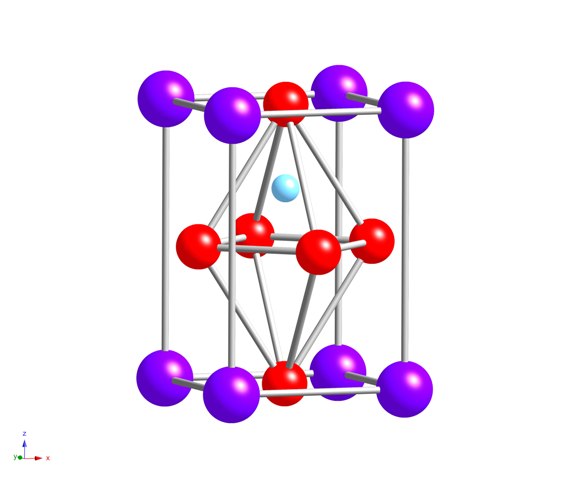
Scientists are using Diamond Light Source, the UK’s national synchrotron facility, to discover how we can detoxify our electronic gadgets. Results published in the journal Applied Physics Letters on 1st October reveal the potential for new artificial materials that could replace lead-based components in everyday products from inkjet printers to digital cameras.
-
highlight
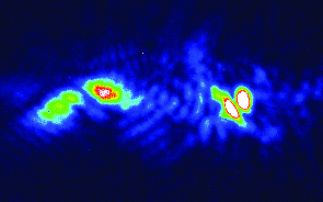
The experiment undertaken on I16 showed strong evidence of twinning, from the ‘speckled’ Bragg peaks of manganites crystallites. This was consistent with a new theory of the connection between ab-twinning, a classic disorder mode of these layered materials, and the phase of the domain that contributes to a given Bragg peak.
-
highlight

We show that small quantities of 1,3:2,4-di(4- chlorobenzylidene) sorbitol dispersed in poly(ε- caprolactone) provide a very effective self-assembling nanoscale framework which, with a flow field, yields extremely high levels of polymer crystal orientation. We have used the small-angle X-ray scattering beamline I22 at Diamond to follow in a time resolving manner the formation of the particles and the subsequent crystallisation of the polymer. During modest shear flow of the polymer melt, the ...
-
highlight

Why do some fossils preserve soft tissue in very fine detail while others most of the detail is lost? After death there is a race against time between soft tissue destruction and mineralisation of the carcass. In some cases soft tissue becomes mineralised in a state similar to the living animal; in others, only bone survives. One theory is that if the body is allowed to dehydrate, for example during a period of drought, and later rehydrated, for example during a flood, the soft tissue may be ...
-
highlight
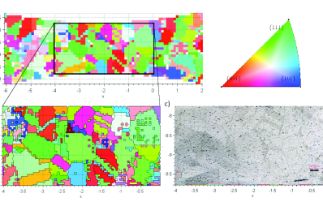
Better understanding of the distribution of elastic and plastic strains in deformed polycrystalline, multiphase materials is important for structural engineering. The deformation response depends upon the interaction of grains of different orientations, and the anisotropy associated with each phase. Strain partitioning and tensile-compressive hardening asymmetry arises due to mismatches in modulus and ductility between grains and phases in alloys such as Ti-6Al-4V, or Ni-base superalloys ...
-
highlight
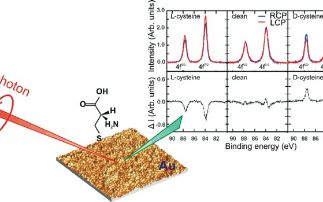
Chirality, the property of an object to exist as distinguishable mirror image forms (known as enantiomers), is ubiquitous. Intriguingly, the chemistry of life is intrinsically homochiral, as biological molecules such as sugars, amino acids and DNA exist almost exclusively as only one enantiomer. Identifying potential mechanisms for such asymmetry is therefore of tremendous interest, not least because those mechanisms may also allow more efficient asymmetric synthesis of pharmaceuticals. In a ...
-
highlight
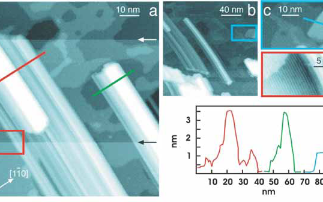
Electronic devices are getting smaller all the time, and the challenge is to make the individual components as small as possible without affecting how they function. This includes the need for nanometre scale wires to be placed on electrically insulating substrates. We used a technique called metal vapour deposition to grow palladium nanostructures on a dielectric support. We then used Scanning Tunnelling Microscopy (STM) to identify two distinct structures: roughly hexagonal islands and ...
-
highlight
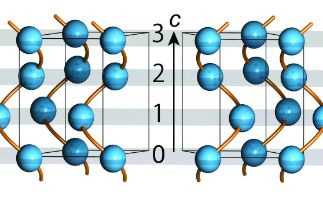
We have demonstrated the use of a new technique for determining absolute crystal chirality by resonant X-ray diffraction of circularly polarized X-rays from a crystal of tellurium. The new approach is based on studies of ‘forbidden’ reflections, which, as the name implies, are normally considered not to exist. With the high-intensity X-ray beam available on Diamond beamline I16 such signals gain considerable intensity and are exceptionally sensitive to the chirality (handedness) of the ...