• Diamond Home page
  • About
  • For Users
  • Public
  • Industry
  • Instruments
  • Careers
  • More Show more menu items
Search

About

  • About Diamond
  • About Synchrotrons
  • News and Features
  • Events
  • Contact Us
  • FAQ

For Users

  • Apply for beamtime
  • User guide
  • Diamond Users Commitee
  • FAQ
  • User Administration System
  • iSpyB

Industry

  • Techniques Available
  • Industry Research
  • Industry Case Studies
  • News
  • Meet the Industry Team

Science

  • Research
  • Computing
  • The Machine
  • Publications
  • Research Expertise
  • Membrane Protein Laboratory
  • Additional Facilities
  • Publications Database

Instruments

  • Biological Cryo-Imaging
  • Crystallography
  • Imaging and Microscopy
  • Macromolecular Crystallography
  • Magnetic Materials
  • Soft Condensed Matter
  • Spectroscopy
  • Structures and Surfaces

Diamond-II

  • Science
  • Machine
  • Beamlines
  • Software, Control and Computing
  • Infrastructure

Public

  • Public open days
  • School visits
  • Partner with Diamond
  • Explore Diamond

Procurement

  • Non-OJEU Tender Notices
  • OJEU PINs
  • OJEU Tender Notices
  • Registration Form

Careers

  • Vacancies
  • Info for applicants
  • Company Benefits
  • Apprenticeships
  • PhD Studentships
  • Work Placement

Main Content

A brighter light for science
Sub-navigation
  • About
  • Governance
  • Legal and Compliance
  • News and Literature
  • Events
  • Contact

In This Section

Sub Navigation
  • News and Science Highlights
  • Annual Review
  • Literature Reviews
  • Impact Case Studies
  • Press and media

Opportunities at Diamond

Learn more about career and student opportunities at Diamond:

Vacancies

Students

  1. Diamond Light Source
  2. News and Literature
  3. Annual Review
  4. Diamond Annual Review 2019
  5. Science Group Updates
  6. Crystallography Group
  7. Elastic porous crystals

Elastic porous crystals

Aug 2, 2019

Related publication: Henke S., Wharmby M. T., Kieslich G., Hante I., Schneemann A., Wu Y., Daisenberger D. & Cheetham A. K. Pore closure in zeolitic imidazolate frameworks under mechanical pressure. Chem. Sci. 9, 1654–1660 (2018). DOI: 10.1039/C7SC04952H
 
Publication keywords: High pressure; Metal-Organic Frameworks (MOFs); Phase transition 

Over the past few years, responsive materials - materials that change their structure when chemical, thermal, or mechanical stimuli are applied - have been studied extensively. A team of researchers used high-pressure X-ray diffraction on the Extreme Conditions beamline (I15) to study stimuli-responsive metal-organic frameworks (MOFs), a class of synthetic, crystalline, and porous materials constructed from organic and inorganic building units. Some MOFs are known to be flexible, and to dramatically change their crystal structure upon adsorption of guest molecules or changes in temperature. The team wanted to investigate whether the responsive behaviour of MOFs can also be triggered by mechanical compression.

They focused on ZIF-4 materials, which are representative of an important subclass of MOFs called zeolitic imidazolate frameworks (ZIFs). They had previously shown that the Zn-based derivative ZIF-4(Zn) undergoes a remarkable phase transition from an open-pore form to a closed-pore form when cooled to cryogenic temperatures, and now wanted to investigate whether the same change could also be triggered by compressing the material. If so, the materials would have potential for shock absorbers, nanodampers, and cooling applications.
The data they obtained at Diamond Light Source helped to generate a full picture of the unusual phase behaviour of these framework materials, including the determination of macroscopic parameters such as their compressibility, and the critical pressures needed for pore closure.
 
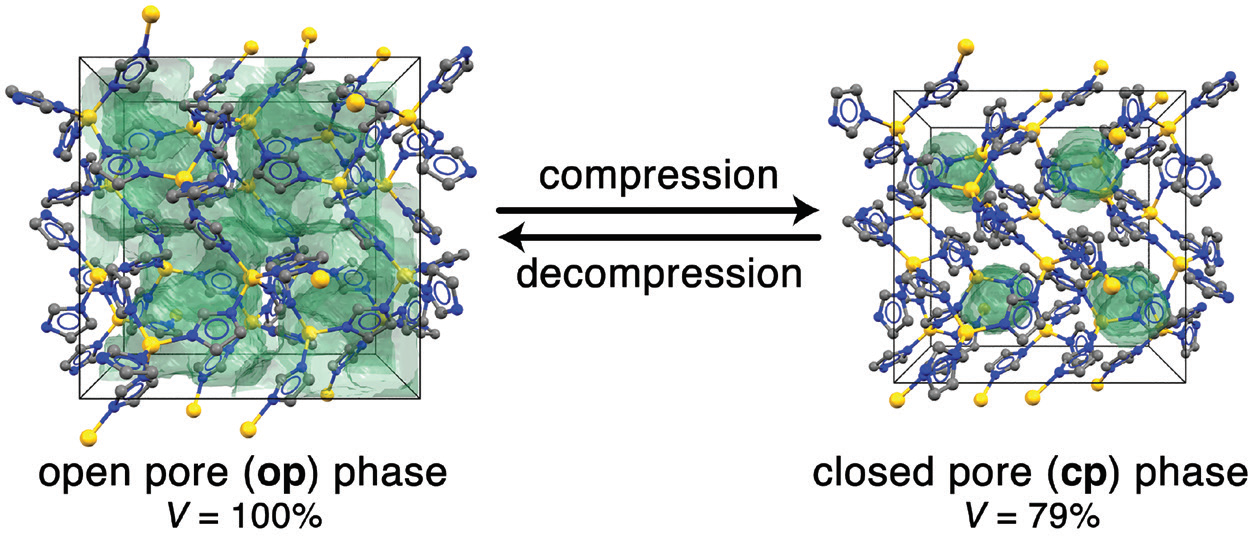
Figure 1: Representation of the op and cp phases of ZIF-4(M) materials.

Metal-organic frameworks (MOFs) are a class of crystalline porous materials constructed from molecular organic and inorganic building units. Some MOFs feature remarkable responsiveness towards external stimuli, enabling them to undergo reversible phase transitions as a function of guest molecule adsorption or changes in temperature1,2. Importantly, the crystalline order and internal connectivity (also known as topology) of the frameworks is retained in these processes, while volumetric changes of more than 20% occur. Such transitions typically involve large changes in pore volume, pore size, and pore shape. Chemical bonds between the building units remain fully intact, while bond and torsional angles change. In contrast to guest- and temperature-dependent structural changes, phase transitions as a function of mechanical pressure are much less common for MOFs3,4,5. However, pressure-driven framework flexibility is appealing for the application of such framework materials as shock absorbers, nanodampers, or for cooling applications (i.e. mechanocalorics).

Herein, the high-pressure phase behaviour of two isostructural zeolitic imidazolate frameworks (ZIFs) named ZIF-4(M), featuring the chemical composition M(im)2 (with M2+ = Zn2+ or Co2+, im– = imidazolate), was studied. ZIF-4(M) crystallises in the orthorhombic space group Pbca and features the cag topology. During a previous beamtime at the High Resolution Powder Diffraction beamline (I11) at Diamond, the team discovered that ZIF-4(Zn) undergoes a remarkable phase transition from its conventional open-pore (op) phase to a closed-pore (cp) phase when cooled below 140 K (Fig. 1)2. The cp phase is about 30% denser than the porous op phase; space group symmetry and network topology, however, are unchanged. During the transition a concerted sequence of single-bond rotations results in an isotropic contraction of the framework by more than 20% in volume. 
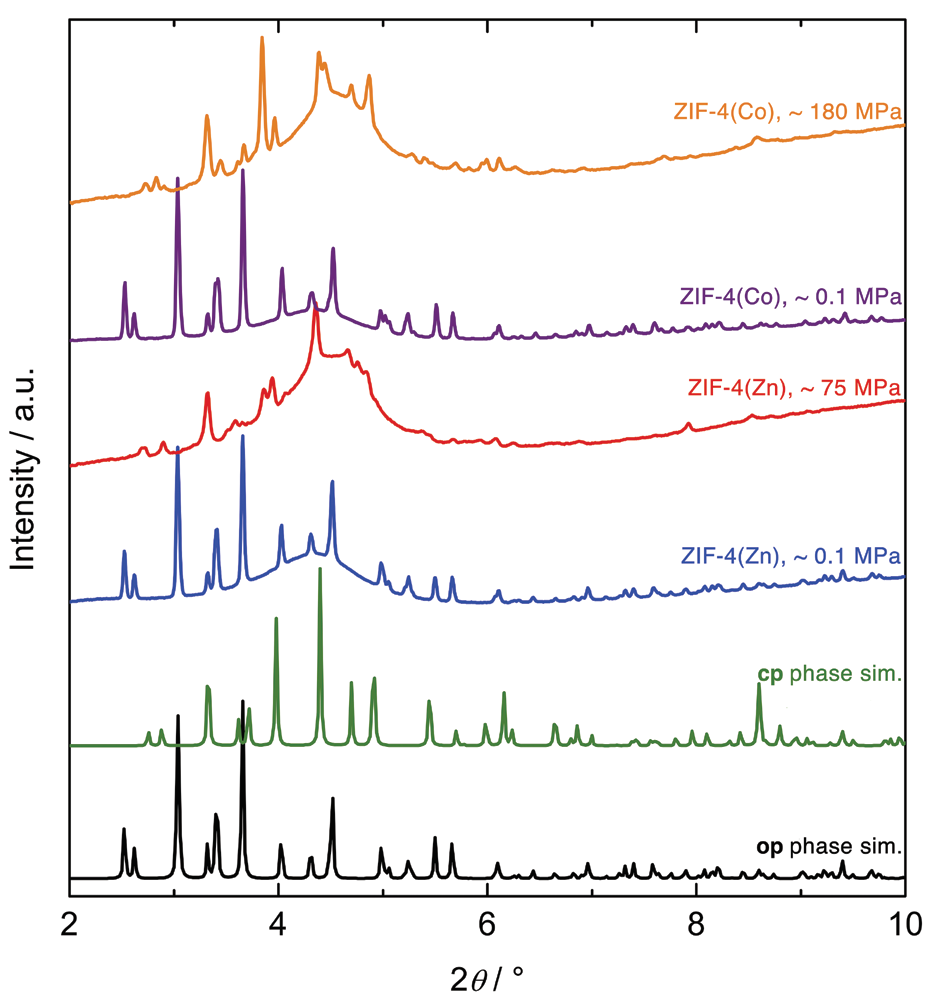
Figure 2: PXRD patterns of ZIF-4(M) materials at different hydrostatic pressures and room
<br/>temperature. The simulated patterns of the op and cp phases are shown for comparison.
Figure 2: PXRD patterns of ZIF-4(M) materials at different hydrostatic pressures and room temperature. The simulated patterns of the op and cp phases are shown for comparison.

In the current study, High-Pressure Powder X-ray Diffraction (HP-PXRD) experiments were performed at beamline I15 at Diamond to investigate if ZIF-4(Zn), and its isostructural derivative ZIF-4(Co), undergo similar op-cp transitions when exposed to hydrostatic mechanical pressures. Finely ground and guest-free powders of the ZIF-4(M) materials were loaded into membrane diamond anvil cells (mDAC), together with a pressure transmitting fluid (PTF), and an alkali halide, as internal pressure standard. mDAC preparation had to be performed inside a glovebox (Ar atmosphere) in order to prevent adsorption of moisture inside the guest-free porous ZIF-4(M) compounds. Fluorinert FC-70, a liquid composed of molecules that are too large to penetrate into the microporous frameworks of the ZIF-4(M) compounds, was used as PTF. Subsequently, HP-PXRD patterns were recorded as a function of hydrostatic pressure. Surprisingly, the op-cp phase transitions of the ZIF-4(M) compounds were observed already at comparatively low hydrostatic pressures between 75 and 180 MPa (Fig. 2). Structureless profile fitting suggested that the high-pressure cp phases of ZIF-4(Zn) and ZIF-4(Co) are similar, but different to the previously reported low temperature cp phase of ZIF-4(Zn). The HP-PXRD patterns could not be fitted satisfactory in the expected orthorhombic symmetry (space group Pbca). However, a symmetry reduction involving a small shear element, and a transition to the monoclinic subgroup P21/c, yielded a reasonable fit to both experimental datasets. A volumetric compression by ~21% was found for ZIF-4(Zn), and by ~19% for ZIF-4(Co).
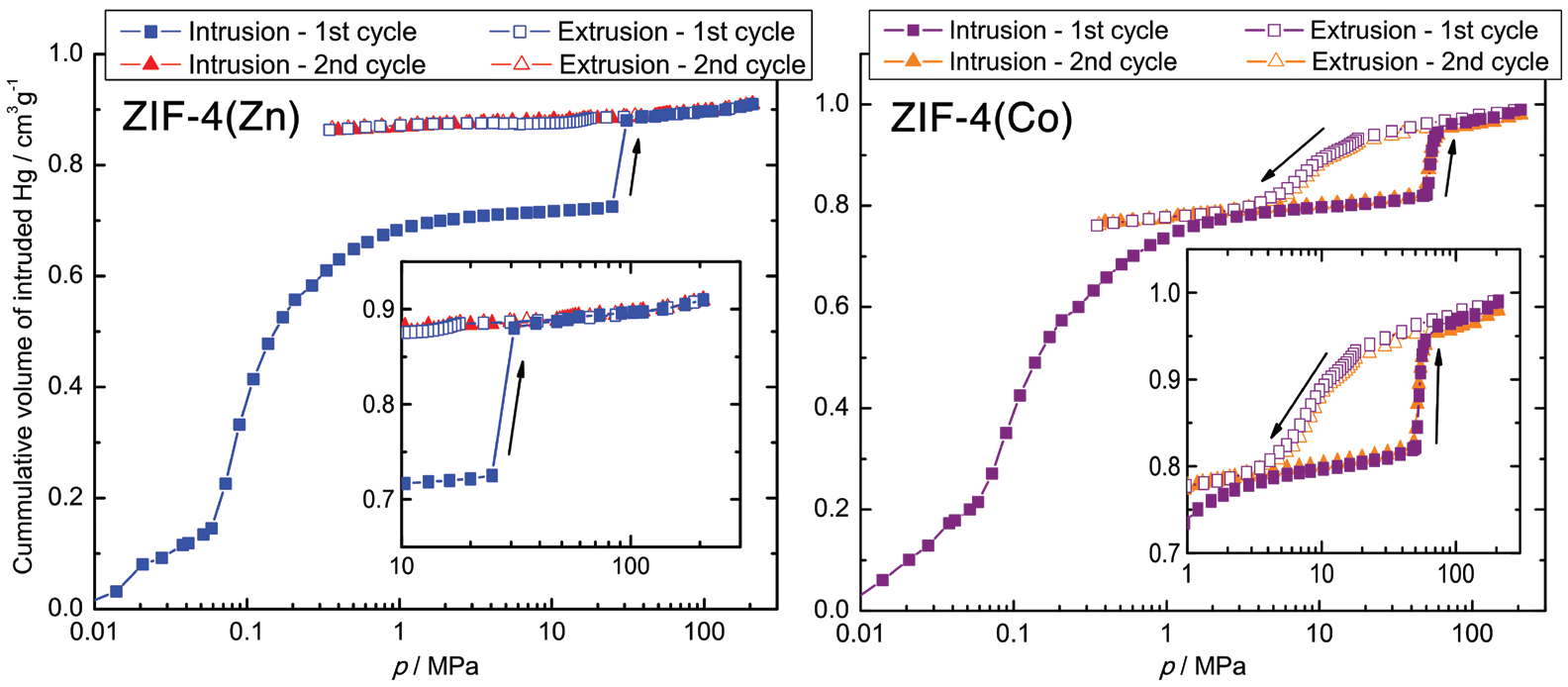
Additional mercury intrusion-extrusion experiments were performed to pinpoint the energetics and the reversibility of the unusual pressure-driven op-cp phase transformation of these materials (Fig. 3). It was found that ZIF- 4(Zn) undergoes the op-cp transition already at a surprisingly low mechanical pressure of only ~28 MPa. The op-cp transition is visible as a pronounced step in the mercury intrusion curve. The volume change corresponding to the step in the intrusion curve (ΔVintru = 0.16 cm3g–1) is very close to the value expected for the op-cp phase transition based on the crystallographic parameters extracted from the HP-PXRD data (ΔVcryst = 0.169 cm3g–1). Noticeably, the following extrusion curve, and a second cycle of mercury intrusion-extrusion, do not show any further steps, indicating that the op-cp transition is irreversible for ZIF-4(Zn). 
 
Figure 3: Mercury intrusion-extrusion curves recorded for ZIF-4(M) materials at room temperature. The insets reveal a closer look on the data in the region of the op-cp transition, which is irreversible
<br/>for ZIF-4(Zn), and reversible for ZIF-4(Co).
Figure 3: Mercury intrusion-extrusion curves recorded for ZIF-4(M) materials at room temperature. The insets reveal a closer look on the data in the region of the op-cp transition, which is irreversible for ZIF-4(Zn), and reversible for ZIF-4(Co).

 ZIF-4(Co) shows a different behaviour. The step associated to the op-cp phase transition is present at a much higher pressure of ~50 MPa, and the reverse cp-op transition is visible as a shallow but distinct step at pressures below 20 MPa. A second intrusion-extrusion cycle underlines the full reversibility of the phase transition process for ZIF-4(Co). The apparent differences of ZIF-4(Zn) and ZIF-4(Co) can be attributed to the specific valence electron configurations and electronegativities (ENs) of their respective metal ions (Zn2+, 3d10, EN = 1.65; Co2+, 3d7, EN = 1.88), which suggest a stronger and more directional ligand to metal bonding, as well as stiffer coordination tetrahedra for the Co-based derivative.

The discovery of pressure-driven op-cp phase transitions in ZIF-4(M) materials proposes novel applications of these microporous ZIFs as shock absorbers (i.e. irreversible transition of ZIF-4(Zn)), and nanodampers, or in mechanocalorics (i.e. reversible transition of ZIF-4(Co)). HP-PXRD and mercury intrusion experiments reveal that the detailed phase behaviour (critical pressure, volume change, reversibility) can be tuned by the selection of the appropriate metal ion. Furthermore, the obtained results suggest there may exist similar, or even more dramatic, phase transitions in other ZIF compounds. 

 References:

  1. Schneemann A. et al. Flexible metal-organic frameworks. Chem. Soc. Rev. 43, 6062–6096 (2014). DOI: 10.1039/c4cs00101j
  2. Mellot-Draznieks C. et al. Extreme Flexibility in a Zeolitic Imidazolate Framework: Porous to Dense Phase Transition in Desolvated ZIF-4. Angew. Chemie Int. Ed. 54, 6447–6451 (2015). DOI: 10.1002/anie.201410167
  3. Yot P. G. et al. Mechanical energy storage performance of an aluminum fumarate metal-organic framework. Chem. Sci. 7, 446–450 (2016). DOI: 10.1039/c5sc02794b
  4. Serre C. et al. Large breathing of the MOF MIL-47(VIV) under mechanical pressure: a joint experimental–modelling exploration. Chem. Sci. 3, 1100 (2011). DOI: 10.1039/c2sc00745b
  5. Llewellyn P. L. et al. Using Pressure to Provoke the Structural Transition of Metal-Organic Frameworks. Angew. Chemie Int. Ed. 49, 7526–7529 (2010). DOI: 10.1002/anie.201003048
Funding acknowledgement:
We gratefully acknowledge support from the Alexander von Humboldt Foundation (Fellowship for S. Henke), and the Priority Program 1928 COORNETs of the German Research Foundation (Start-Up Grant to S. Henke).
 
Corresponding author:
Prof Dr Sebastian Henke, Technische Universität Dortmund, [email protected]
  • Contact Us
  • About Diamond Light Source
  • Procurement
  • Supply Chain Transparency
  • Cookie Policy
  • Website Terms of Use
  • Privacy Notice

Diamond Light Source

Diamond Light Source is the UK's national synchrotron science facility, located at the Harwell Science and Innovation Campus in Oxfordshire.

Follow us on Facebook Follow us on Linkedin Follow us on Instagram Follow us on Bluesky

Diamond Light Source Ltd
Diamond House
Harwell Science & Innovation Campus
Didcot
Oxfordshire
OX11 0DE

See on Google Maps

Copyright © Diamond Light Source. Diamond Light Source® and the Diamond logo are registered trademarks of Diamond Light Source Ltd

Registered in England and Wales at Diamond House, Harwell Science and Innovation Campus, Didcot, Oxfordshire, OX11 0DE, United Kingdom. Company number: 4375679. VAT number: 287 461 957. Economic Operators Registration and Identification (EORI) number: GB287461957003.

feedback