Sofia Diaz-Moreno, Science Group Leader
Microfocus Spectroscopy beamline (I18) the Core X-ray Absorption Spectroscopy (XAS) beamline (B18) and the two independently operating branches of the Versatile X-ray Absorption Spectroscopy beamline, I20-scanning and I20-EDE. These four beamlines are complementary in many aspects, such as the energy range they cover, the size of the focussed beam spot delivered to the sample, and the time resolution they are able to reach.
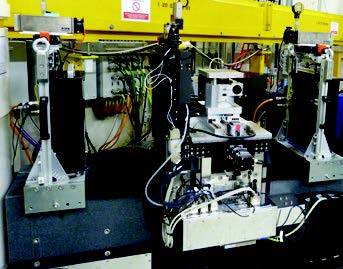
- Figure 1: Turbo-XAS end-station mounted on the I20-EDE branch.
Nevertheless, each beamline has its unique characteristics and they are optimised for performing different types of experimental studies. Over the last year more than 1,350 peer-reviewed experimental shifts were delivered using the Spectroscopy Group beamlines, covering many different scientific disciplines, from chemistry and catalysis to environmental and life sciences, materials science, hard condensed matter and cultural heritage. As well as supporting a very vibrant user programme, many technical developments have also been implemented on the beamlines during the last year. Some of the developments have improved data quality and collection times, while others have added new capabilities to the beamlines.
I18 Update
The Microfocus Spectroscopy beamline (I18) uses a 2x2 μm beam to examine heterogeneous material on the micrometre scale using a variety of techniques, such as X-ray Fluorescence (XRF), X-ray Absorption Near Edge Structure (XANES) spectroscopy and X-ray Diffraction (XRD). During the last year considerable effort has gone into optimising the new mapping perspective used to collect XRF maps, as well as its integration into the Diamond General Data Acquisition program (GDA). This new software, originally installed in November 2016 along with a new motor control platform, has dramatically improved the efficiency of XRF map collections. This has allowed the routine collection of full fluorescence XANES map stacks; about a hundred maps at different incident energies are acquired over the same region of a sample to give hundreds of XANES scans when the energy dimension of the dataset is probed. The software has been fine tuned to give a much smoother user experience over the last year.
In addition, a new silicon drift Vortex-ME4 detector has been installed to operate together with the already existing detector. The two silicon detectors are now routinely used for data collection in a set-up shown in Figure 2. The use of these detectors has replaced the need to use a liquid nitrogen cooled germanium detector, simplifying significantly the beamline operation, as well as improving the count rate performance for the energy range covered by the beamline.
B18 Update
The Core XAS beamline (B18) uses an X-ray beam covering a broad energy range to collect X-ray Absorption Spectroscopy (XAS) data on all elements heavier than phosphorus. The capability of the monochromator for continuous scanning together with a flexible experimental space with the availability of a large range of sample environment equipment, make this beamline ideal to perform experiments in situ and under operando conditions.
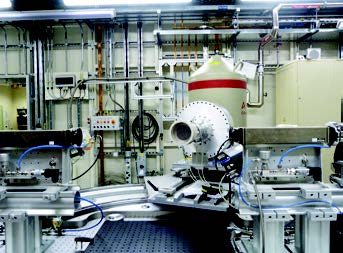
The fluorescence capabilities of B18 have been expanded with the development of an X-ray spectrometer with medium energy resolution working in Von Hamos geometry. This spectrometer has been designed to overcome the limitations of the traditional solid state detectors when the fluorescence detection of the element of interest is affected by the presence of overlapping emission lines and intense backgrounds. The spectrometer has demonstrated very good performance not only for the study of complex samples, but also for very dilute systems. The implementation of streamlined alignment procedures and an increase of the collected solid angle are on-going developments. We expect to be able to make this spectrometer available to the user community in late spring 2018.
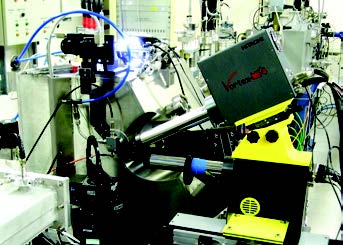
- Figure 2: Two silicon detectors configured for use on I18 to increase count rate performance.
Upgrades to the beamline in 2017 also included the redesign of the low energy section of the experimental table. With this new development, the setup time for low energy experiments that are not compatible with high vacuum conditions is significantly reduced, increasing the efficiency and the reliability of the beamline.
The implementation of a simplified framework has improved the software interface for experiments with a large number of samples. The measurements can be programmed in one go using a spreadsheet-like interface, minimising the chances of errors during the experiment preparation. This functionality has already been used during the Block Allocation Group access mode reducing the time needed for the experiment.
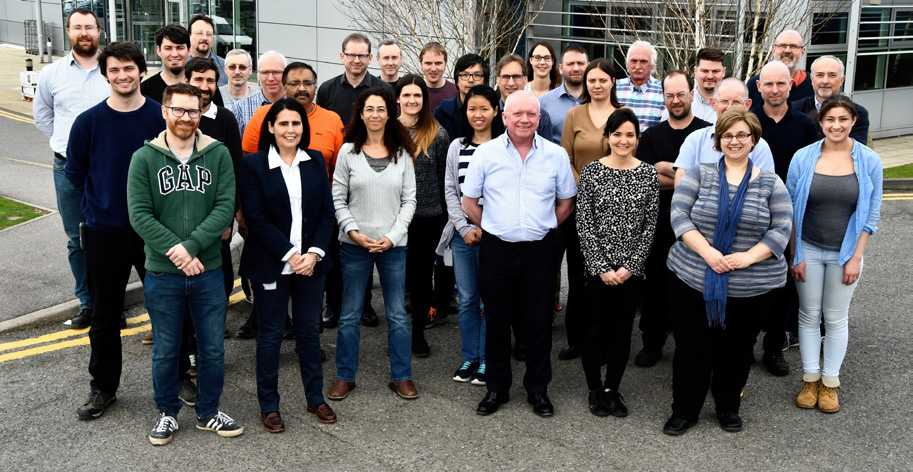
- Figure 3: The scientists, engineers, technicians, PDRAs and PhD students that make up the Spectroscopy Group.
I20 Update
The scanning branch of I20 (I20-scanning) provides high intensity X-rays for the study of very low concentration samples by XAS. It also provides the capabilities to perform X-ray Emission Spectroscopy (XES) using a Rowland circle spectrometer, enabling the performance of high-resolution studies of the electronic structure of samples.
- Figure 4: I20-Scanning fluorescence detector mounted on the new rotational stage that enhances flexibility for sample environment integration.
This year the main developments on this branch have been focussed on improving its ability to perform XAS on challenging samples. A new experimental table has been installed to allow the integration of a large rotational stage for the 64 element monolithic germanium solid state detector. With this stage the detector can be located at different angles with respect to the incident X-ray beam which allows the use of sample environments that leave very limited space for the collection of the fluorescence emission. To further improve the beamline performance, new read-out electronics has been developed and integrated with the germanium detector. This new system is the Xspress-4 digital pulse processor that has been developed in-house by the Diamond Detector Group. Xspress-4 is able to deliver a factor of three increase in detector system count rate whilst maintaining the data quality that could be achieved using the previous read-out system. This new read-out system consequently allows the beamline to study samples where the element of interest is surrounded by many other heavy elements that otherwise would saturate the detector signal at high count rates.
The development project for a new monochromator for the scanning branch of I20 is still ongoing with the aim of delivering a device that is to enable better use of the high photon flux delivered by the wiggler source, and extend the energy range of the beamline up to 34 keV.
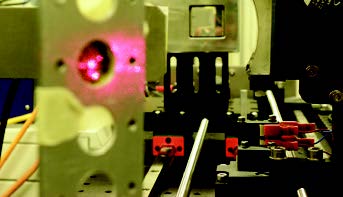
- Figure 5: The Von Hamos spectrometer installed at B18.
The I20-EDE branch is designed to perform XAS experiments in dispersive configuration, and has been optimised for in situ and operando time-resolved studies over time scales ranging from seconds down to milliseconds or even microseconds. The optimisation of this branch has continued during the last year and significant effort has been invested in the development of the software necessary to visualise and analyse the large amount of data that can be collected. In addition, the development and integration into the beamline of a sequential data acquisition mode, turbo-XAS, is very well advanced. This mode of data collection is well suited to the investigation of systems in transmission mode when small angle scattering from the samples is significant, or in fluorescence mode when the concentration of the element of interest is low. Two successful user experiments have been performed during the last year that makes use of this new development.
In parallel to supporting the beamlines and the operational science programme, the Spectroscopy Group was also busy last year organising and hosting the International Workshop on Improving Data Quality on XAFS Spectroscopy, Q2XAFS2017. At this event, more than 50 participants met to review international standards and protocols, and to revise recommendations for best practice when performing XAFS experiments.

Diamond Light Source is the UK's national synchrotron science facility, located at the Harwell Science and Innovation Campus in Oxfordshire.
Diamond Light Source Ltd
Diamond House
Harwell Science & Innovation Campus
Didcot
Oxfordshire
OX11 0DE
Copyright © Diamond Light Source. Diamond Light Source® and the Diamond logo are registered trademarks of Diamond Light Source Ltd
Registered in England and Wales at Diamond House, Harwell Science and Innovation Campus, Didcot, Oxfordshire, OX11 0DE, United Kingdom. Company number: 4375679. VAT number: 287 461 957. Economic Operators Registration and Identification (EORI) number: GB287461957003.