Filming magnetic motion in 3D on the I10 beamline
Jun 22, 2026
Jun 22, 2026
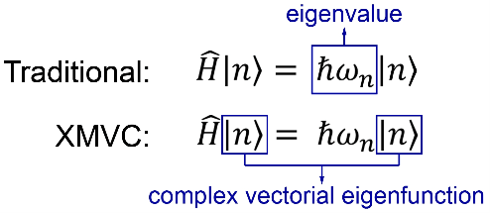
A groundbreaking study led by Shilei Zhang, Thorsten Hesjedal and Gerrit van der Laan (ShanghaiTech University, University of Oxford and Diamond Light Source), published in Nature Nanotechnology, demonstrates a new way to directly measure the full motion of magnetic excitations. Using Diamond’s BLADE (I10) beamline, the team reconstructed the complete three-dimensional dynamics of spin waves, revealing their underlying “wavefunctions” (the complete mathematical description of each spin’s motion) for the first time.
Many physical systems are governed by waves. While their frequencies are routinely measured, their full motion - how they propagate, rotate, and interact - has remained largely hidden. In magnetic materials, these waves are known as magnons: collective oscillations of electron spins that underpin technologies ranging from data storage to next-generation spin-based computing.
Now, a new method called X-ray Magnetic Vector Chronoscopy (XMVC) makes this motion directly visible. By exploiting the pulsed nature of synchrotron radiation, XMVC effectively “films” magnetic dynamics, capturing snapshots of spin motion across an entire oscillation cycle with picosecond time resolution.
The experiments were performed on the I10 BLADE beamline, a beamline dedicated to studying magnetic structure and dynamics using polarised soft X-rays. Its combination of element selectivity, full polarisation control, and advanced scattering instrumentation enables detailed probing of magnetic materials at the nanoscale.
Using the RASOR diffractometer, the team tuned the X-ray energy to specific elements, allowing them to isolate and track the dynamics of individual magnetic layers within a device. At the same time, the intrinsic pulsed time structure of the synchrotron enabled stroboscopic measurements with picosecond precision. Together, these capabilities allowed the researchers to reconstruct the full three-dimensional trajectories of spins - rather than measuring a single projected signal, as in conventional experiments.
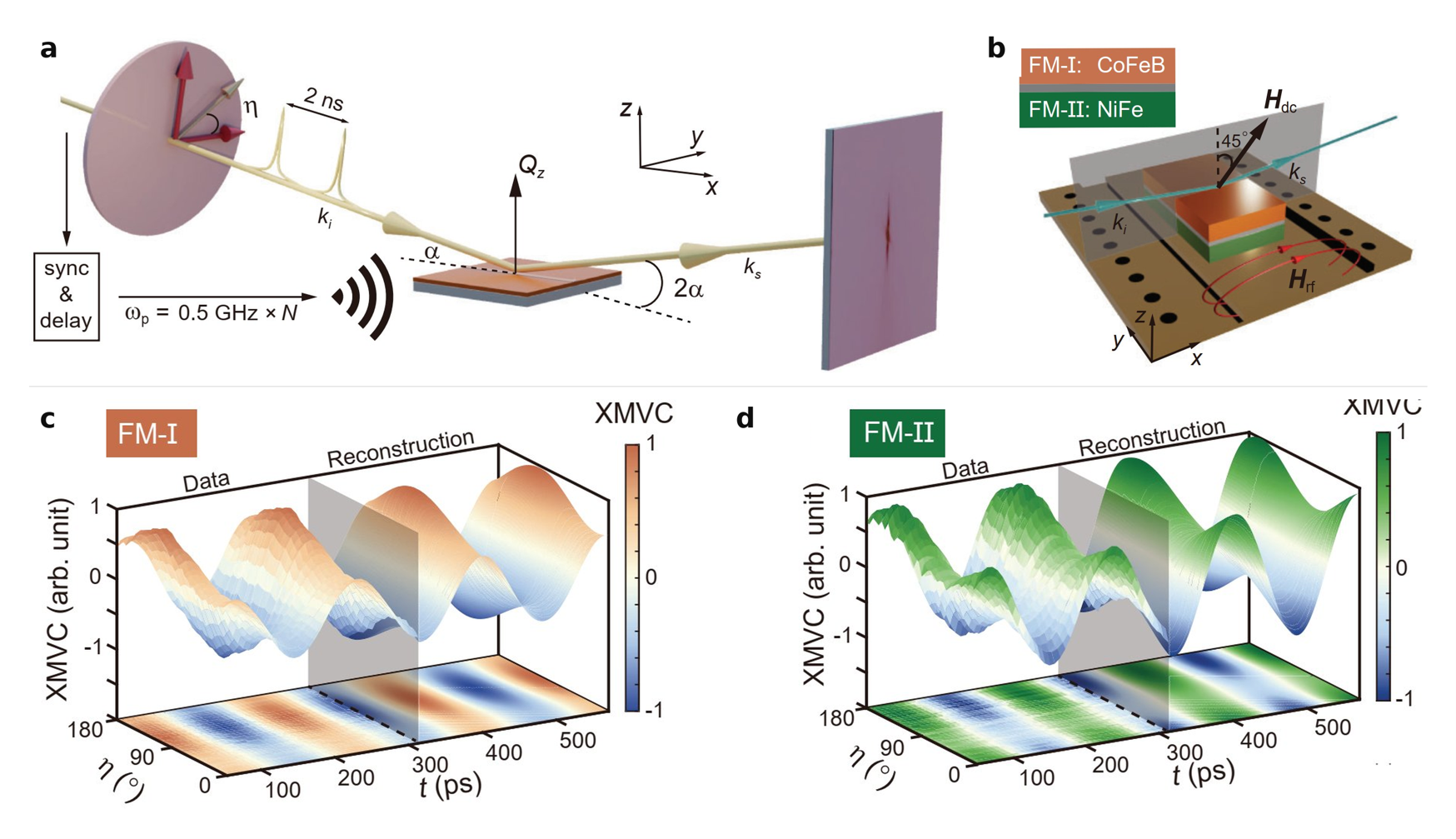
Applying XMVC to a coupled magnetic multilayer system, the team mapped the complete motion of spins in each layer. This revealed not only the amplitude of the oscillations, but also their phase relationships and handedness which are key properties governing how magnetic excitations propagate and interact. The technique goes beyond imaging. From the reconstructed motion, the researchers directly determined how the layers are coupled, including both energy exchange and dissipation. This provides a full dynamical description of the system, something that has previously relied on indirect modelling. The approach can be viewed as a form of magnon state tomography, reconstructing the full magnetic state from experimental measurements - analogous to methods used in quantum science.
The ability to directly visualise spin dynamics has important implications for emerging technologies. Fields such as spintronics and quantum information processing depend critically on controlling how magnetic excitations propagate, couple, and dissipate. XMVC provides, for the first time, a direct experimental window into these processes at the microscopic level, opening new opportunities to design and engineer magnetic systems with unprecedented precision. More broadly, this work highlights a shift in synchrotron science: moving beyond measuring signals to reconstructing the full behaviour of physical systems in space and time.
Professor Shilei Zhang said: "What matters is not just the frequency, but the full motion. With XMVC, we can now directly see how spins dance in space and time.”
The ability to directly visualise spin dynamics has important implications for emerging technologies. Fields such as spintronics and quantum information processing depend critically on controlling how magnetic excitations propagate, couple, and dissipate. XMVC provides, for the first time, a direct experimental window into these processes at the microscopic level, opening new opportunities to design and engineer magnetic systems with unprecedented precision.
For more information on the subject matter, please contact:
Professor Shilei Zhang (ShanghaiTech University): [email protected]
Professor Gerrit van der Laan (Diamond Light Source): [email protected]
Professor Thorsten Hesjedal (Oxford Physics): [email protected]
Haonan Jin, Yuqiang Wang, Xinyi He, Jingyi Chen, Ethan L. Arnold, Gerrit van der Laan, Thorsten Hesjedal, Guoqiang Yu, and Shilei Zhang. Reconstruction of magnon eigenfunctions by X-ray magnetic vector chronoscopy. Nat. Nanotechnol. (2026). https://doi.org/10.1038/s41565-026-02185-2

Diamond Light Source is the UK's national synchrotron science facility, located at the Harwell Science and Innovation Campus in Oxfordshire.
Diamond Light Source Ltd
Diamond House
Harwell Science & Innovation Campus
Didcot
Oxfordshire
OX11 0DE
Copyright © Diamond Light Source. Diamond Light Source® and the Diamond logo are registered trademarks of Diamond Light Source Ltd
Registered in England and Wales at Diamond House, Harwell Science and Innovation Campus, Didcot, Oxfordshire, OX11 0DE, United Kingdom. Company number: 4375679. VAT number: 287 461 957. Economic Operators Registration and Identification (EORI) number: GB287461957003.