Diamond's 16,000th publication from the I11 beamline reveals frozen clues to hidden moon oceans
Jul 27, 2026
Jul 27, 2026
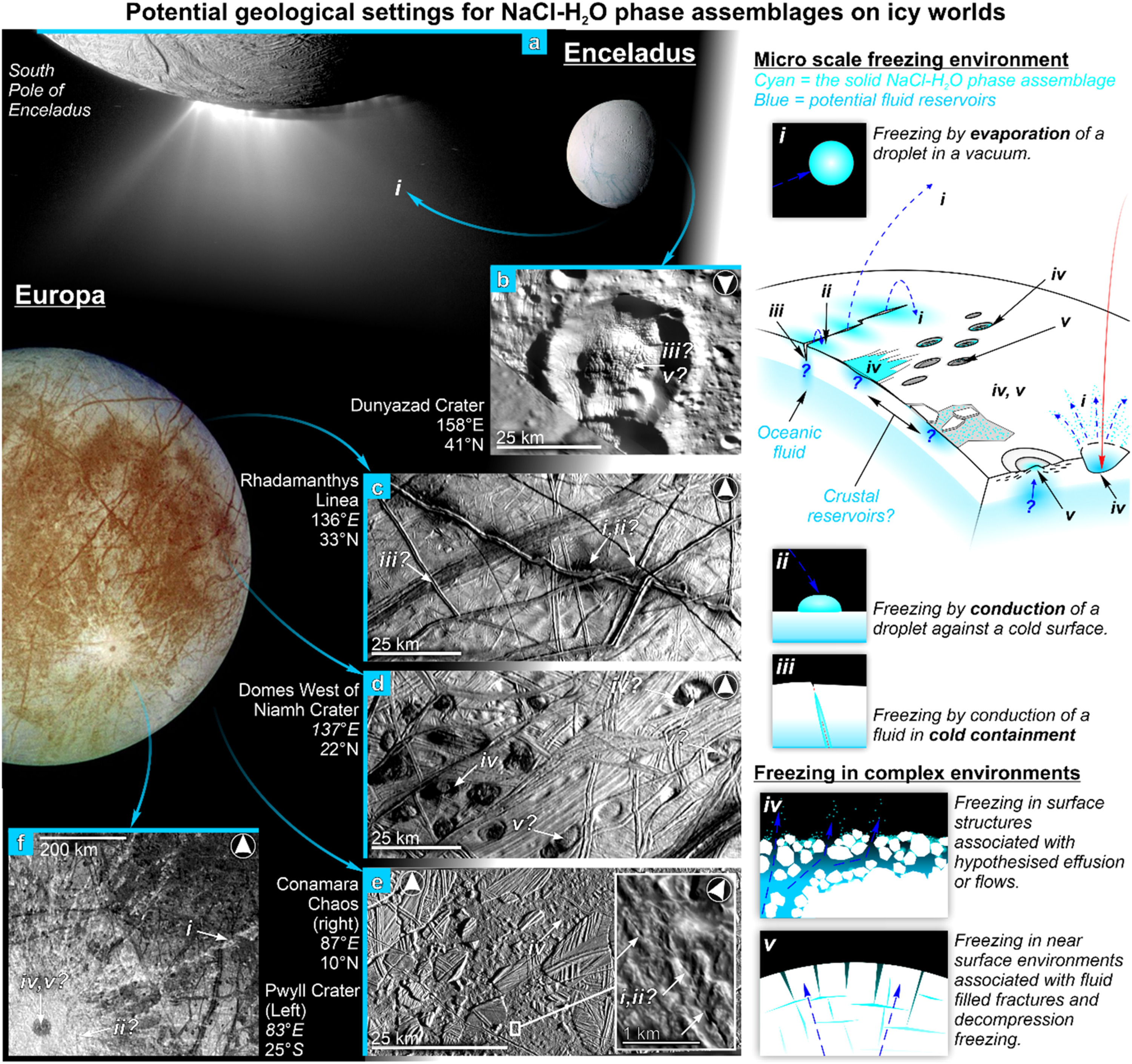
Beneath the icy crusts of moons such as Europa and Enceladus lie vast subsurface oceans that are among the most promising places in the Solar System to search for signs of life. Understanding how these oceans freeze, along with the fate of any ocean fluids that reach the cold icy surface, is essential for interpreting data from current and future planetary missions. New research published in Earth and Planetary Science Letters has shown that the answer may be preserved within the ice itself.
A team of UK-based researchers has discovered that sodium chloride hydrates, the salt-rich minerals that form when saline water freezes - can act as a geological archive of the conditions under which ocean fluids solidify. By recreating the freezing of sodium chloride brines under controlled laboratory conditions, the researchers demonstrated that different cooling rates and salt concentrations produce distinct combinations of crystalline and amorphous hydrates. Rather than simply recording the presence of salt, these mineral assemblages preserve information about the freezing history of the fluid, offering a new way to reconstruct geological processes on icy worlds.
Dr Rachael Hamp from the Open University, and lead author of the study, said: "It's amazing that everyday materials we're so familiar with can transform in unexpected ways, creating entirely new minerals when exposed to these very cold temperatures.”
The study also revealed that each hydrate assemblage produces a unique near-infrared spectral signature. This means that future spacecraft equipped with infrared spectrometers could potentially identify these minerals remotely, allowing scientists to determine how rapidly ocean-derived fluids froze, estimate the salinity of ancient oceans, and gain insights into the geological evolution of these extraterrestrial environments. The findings could help maximise the scientific return from missions such as ESA's JUICE mission and NASA's Europa Clipper, both of which are currently on route to Jupiter, to investigate the icy moons of the outer Solar System.
"If upcoming space missions identify sodium chloride minerals on the surface of these icy moons, we'll gain a much deeper understanding of what's happening beneath their icy surfaces," Dr Hamp said.
Diamond Light Source played a key role in the research through experiments carried out on the I11 High Resolution Powder Diffraction beamline. Using the intense, highly collimated X-rays produced by the synchrotron, the team was able to precisely identify the crystal structures of the sodium chloride hydrates formed during the experiments, including metastable phases that are difficult to distinguish using conventional laboratory techniques. These high-resolution structural measurements were essential for linking individual hydrate assemblages to specific freezing conditions and for validating the spectral fingerprints that future spacecraft may detect.
Dr Stephen Thompson, I11 Principal Beamline Scientist and a co-author of the study said, “These measurements were only made possible by combining the power of the synchrotron with the high-resolution capabilities of the beamline’s fast position sensitive detector, which allowed us to collect structural data on multiple frozen salt solutions across a representative range of compositions and very cold temperatures using the beamline’s cryogenic infrastructure.”
By combining synchrotron X-ray diffraction with laboratory spectroscopy and planetary science, the study provides a powerful new framework for interpreting the frozen surfaces of ocean worlds. As new missions begin to explore Europa, Ganymede and other icy moons in unprecedented detail, this research will help scientists decode the geological history recorded within their icy crusts, improving our understanding of how subsurface oceans evolve and assessing their potential to support life beyond Earth.
Rachael E. Hamp, Mark G. Fox-Powell, Peter Fawdon, Christoph G. Salzmann, Jessica P. Hogan, Milz L. Beaumont, Liam Perera, Stephen P. Thompson. Sodium chloride hydrates provide an archive of ocean fluid freezing rates at icy worlds. Earth and Planetary Science Letters, Volume 690, 2026,120196.

Diamond Light Source is the UK's national synchrotron science facility, located at the Harwell Science and Innovation Campus in Oxfordshire.
Diamond Light Source Ltd
Diamond House
Harwell Science & Innovation Campus
Didcot
Oxfordshire
OX11 0DE
Copyright © Diamond Light Source. Diamond Light Source® and the Diamond logo are registered trademarks of Diamond Light Source Ltd
Registered in England and Wales at Diamond House, Harwell Science and Innovation Campus, Didcot, Oxfordshire, OX11 0DE, United Kingdom. Company number: 4375679. VAT number: 287 461 957. Economic Operators Registration and Identification (EORI) number: GB287461957003.