Advanced X-ray spectroscopy uncovers what controls zinc reactivity
Jun 5, 2026
Jun 5, 2026
A research team from the University of Reading, the University of East London, the University of Chicago and Diamond Light Source have used zinc-specific advanced X-ray spectroscopy available at the I20-Scanning beamline to investigate what factors impact reactivity ‘at’ zinc.
Their study, published in Communications Chemistry, focuses on a group of compounds known as diorganozincs (ZnR2). These compounds are central to many important chemical reactions, including catalysis and the synthesis of complex molecules. However, diorganozincs behave very differently depending on what the ‘R’ group is, for example, i.e. ethyl, phenyl or fluorinated groups.
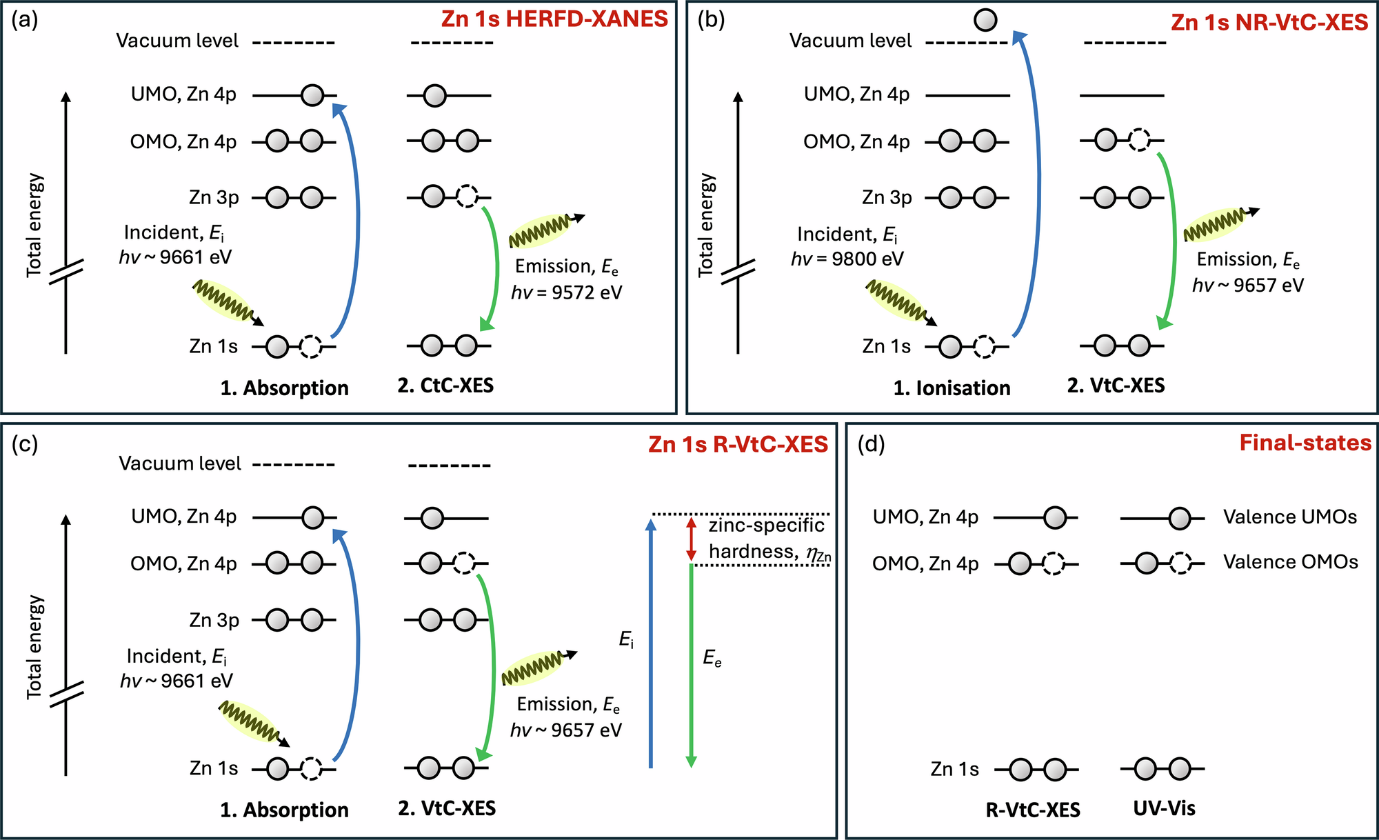
Due to the “spectroscopically quiet” nature of zinc, it is challenging for researchers to observe the structure of zinc atoms directly and how they behave in solution. This makes it hard to predict whether a ZnR2 compound will act as an electron donor (Lewis base) or an electron acceptor (Lewis acid) in a reaction.
Until now, most advances in ZnR2 chemistry have been driven by trial and error rather than prediction, which is why the team developed and applied three new zinc-specific spectroscopy techniques in their study. This helped them to determine the real molecular structures of diorganozinc compounds in weakly interacting solvents, measure zinc’s electronic properties directly and create new numerical indicators (descriptors) that accurately describe the Lewis acidity or basicity of the compound.
The team found that in weakly coordinating solvents, electronic structure is dominant in controlling how ZnR2 behaves. They also discovered that changing the R group significantly alters zinc’s electronic properties and directly controls whether it behaves like a Lewis base or a Lewis acid.
By combining the three zinc-specific spectroscopy methods with computational analysis, the team were able to quantify these effects, rather than just describing them qualitatively.
Their approach also has the potential to be extended beyond ZnR2 compounds. The authors of the paper emphasise that these techniques could act as a general toolkit for studying zinc in liquids, including other zinc reagents, zinc-containing battery electrolytes and zinc in biological systems.
Shusaku Hayama, Principal Beamline Scientist on the I20-Scanning beamline said: “The researchers have used advanced X-ray emission spectroscopy techniques to probe both the occupied and unoccupied electronic states. The emission measurements are particularly challenging because of inherently weak signals, but they were able to use this novel approach to reveal the electronic properties and predict reactivities.”
Read the full paper here: Determining structure and Zn-specific Lewis acid-base descriptors for diorganozincs in non-coordinating solvents using X-ray spectroscopy

Diamond Light Source is the UK's national synchrotron science facility, located at the Harwell Science and Innovation Campus in Oxfordshire.
Diamond Light Source Ltd
Diamond House
Harwell Science & Innovation Campus
Didcot
Oxfordshire
OX11 0DE
Copyright © Diamond Light Source. Diamond Light Source® and the Diamond logo are registered trademarks of Diamond Light Source Ltd
Registered in England and Wales at Diamond House, Harwell Science and Innovation Campus, Didcot, Oxfordshire, OX11 0DE, United Kingdom. Company number: 4375679. VAT number: 287 461 957. Economic Operators Registration and Identification (EORI) number: GB287461957003.