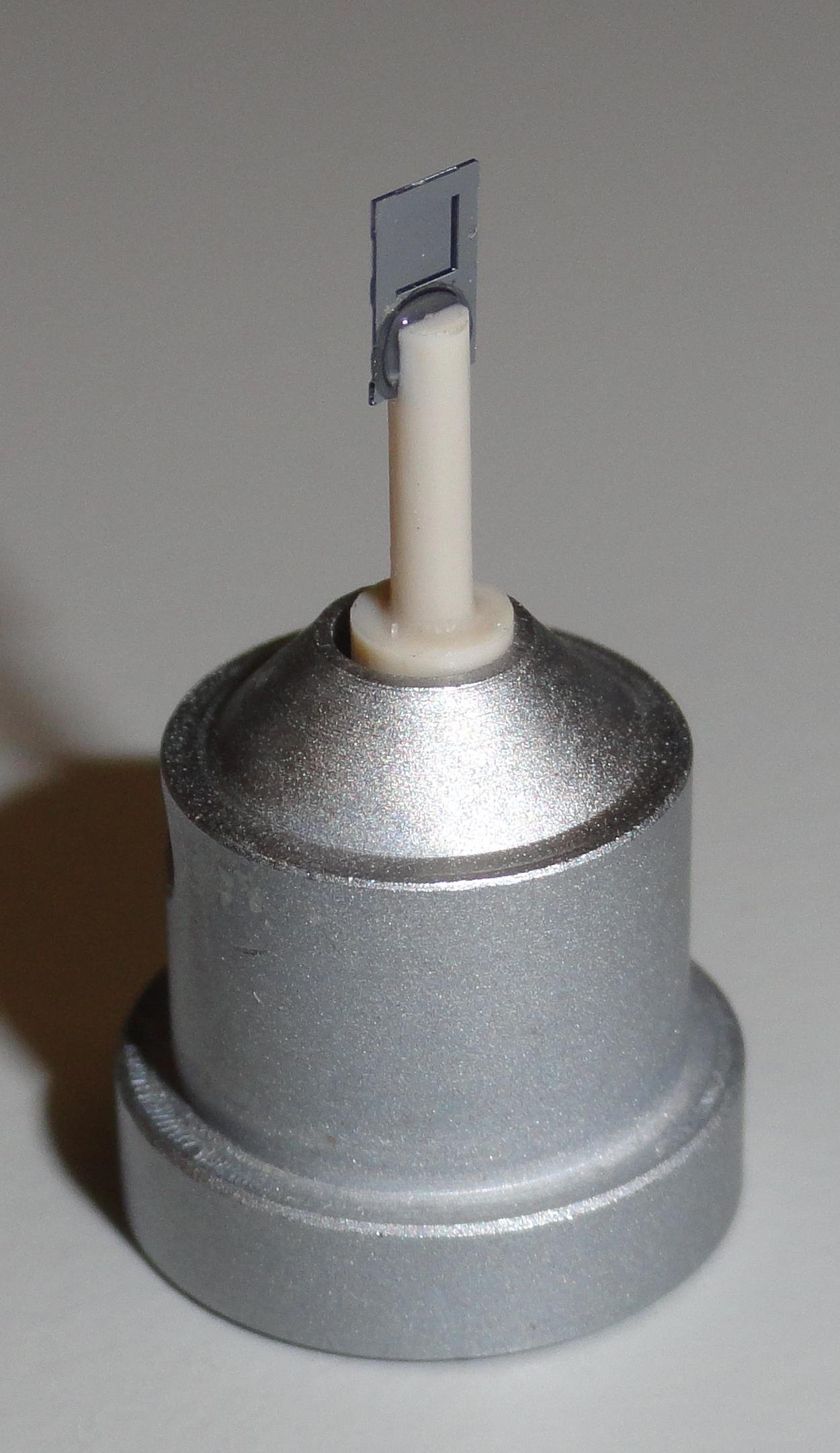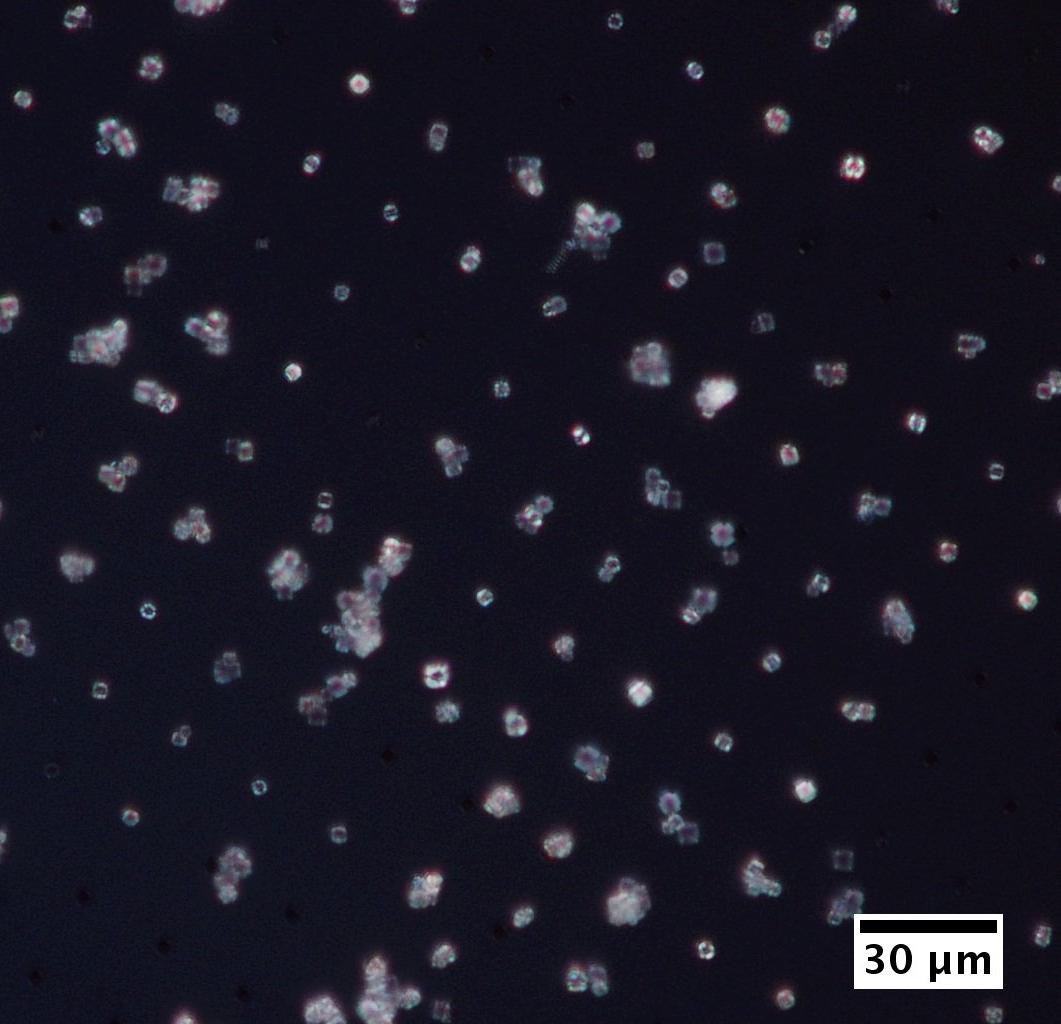
- Polyhedrin: 'About 20 000 microcrystals fit on the two square millimetres silicon chip which is fixed on a magnetic mount, courtesy of DESY'
- © Diamond Light Source 2015
The chip can be used at microfocus beamlines of synchrotron light sources such as Diamond, as well as with X-ray free electron lasers such as the LCLS in Stanford and the forthcoming European XFEL in Hamburg. In contrast to the methods typically used so far, such as liquid jets, in which microcrystals are surrounded by a liquid or a gel and then analysed using X-rays, the new sample holder positions the crystals in small holes in a membrane made from a single silicon crystal, just ten micrometres thick, which can then be scanned by an X-ray beam. This technique ensures that the crystals can be accurately located.
“Our new sample holder allows us to characterise tiny microcrystals with a unique level of efficiency,” explains Alke Meents, the scientist at DESY who is in charge of the work. Philip Roedig, a scientist at DESY and the principal author of the study, continues: “You can think of the chip as being like a sieve. The silicon membrane consists of a matrix of many tiny holes which are slightly smaller than the crystals themselves. In order to prepare the specimen, a drop of the mother solution containing the microcrystals is placed on top of the chip, and then the solution is drawn off from below. The crystals are left sticking in the holes, like in a sieve, and can be scanned by the X-ray beam, crystal by crystal.”
The researchers published their development in the journal
Scientific Reports, and additional experiments are due to take place at the X-ray laser LCLS later this year. You can read the paper
here.