Smart new in situ tool keeps X-rays on track at national science facility
Oct 21, 2013
Oct 21, 2013

A collaboration between Diamond Light Source, the UK’s national synchrotron science facility, and the University of Manchester’s School of Electrical and Electronic Engineering has successfully built a new beam imaging instrument, the Lancelot X-ray Beam Position Monitor (XBPM).
The new device, which incorporates the advanced silicon chip Medipix3 technology, will help scientists using Diamond to monitor the alignment of the micrometer-sized X-ray beams as they travel, first through the instrumentation that refines them and then on to the precious samples being studied with the intense synchrotron light produced by the facility’s 562m storage ring. The stability of the synchrotron radiation beams produced at Diamond is crucial to the success of experiments using smaller and smaller X-ray beams to analyse material or biochemical samples.
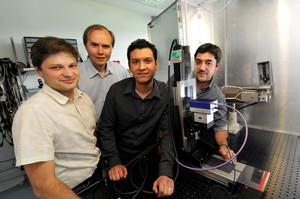 Synchrotrons offer scientists a range of cutting-edge experimental techniques and, as the field matures, the potential for exploiting the powerful qualities of synchrotron radiation increases, making them the tool of choice for thousands of scientists in the UK and elsewhere around the world. Julien Marchal, Senior Detector Scientist at Diamond, explains, “The need for improved X-ray beam position control during experiments led us to set up the Lancelot XBPM project with the University of Manchester. The Manchester team had already demonstrated considerable success in the area of in situ beam imaging utilising a pinhole camera system based on commercial CCDs or CMOS sensors, which are similar to the imaging systems used by conventional commercial digital cameras. The idea behind our project was to replace the standard X-ray sensor used in this pinhole camera with the new X-ray photon counting pixel detector developed by the Medipix3 collaboration, which is led by CERN and to which Diamond is contributing together with several other synchrotrons and research organisations. The expertise of Roelof van Silfhout and his colleagues at UoM, coupled with our in-house detector team and access to the Medipix3 detector and Diamond’s B16 Test Beamline, has proved extremely fruitful. We now have a fully operational, portable, system that can be used in any experiments where accurate beam position control is required. ”
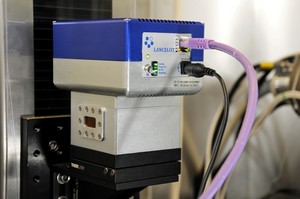 In essence the device is a pinhole X-ray camera that makes images of the beam by recording the scattered radiation from thin, weakly scattering foils. A unique feature of the instrument is that it acts as a microscope, providing enlarged images with very detailed information of the impinging X-ray beam even for the micrometre-sized beams that are routinely available at Diamond.
Diamond Light Source is the UK's national synchrotron science facility, located at the Harwell Science and Innovation Campus in Oxfordshire.
Diamond Light Source Ltd
Diamond House
Harwell Science & Innovation Campus
Didcot
Oxfordshire
OX11 0DE
Copyright © Diamond Light Source. Diamond Light Source® and the Diamond logo are registered trademarks of Diamond Light Source Ltd
Registered in England and Wales at Diamond House, Harwell Science and Innovation Campus, Didcot, Oxfordshire, OX11 0DE, United Kingdom. Company number: 4375679. VAT number: 287 461 957. Economic Operators Registration and Identification (EORI) number: GB287461957003.