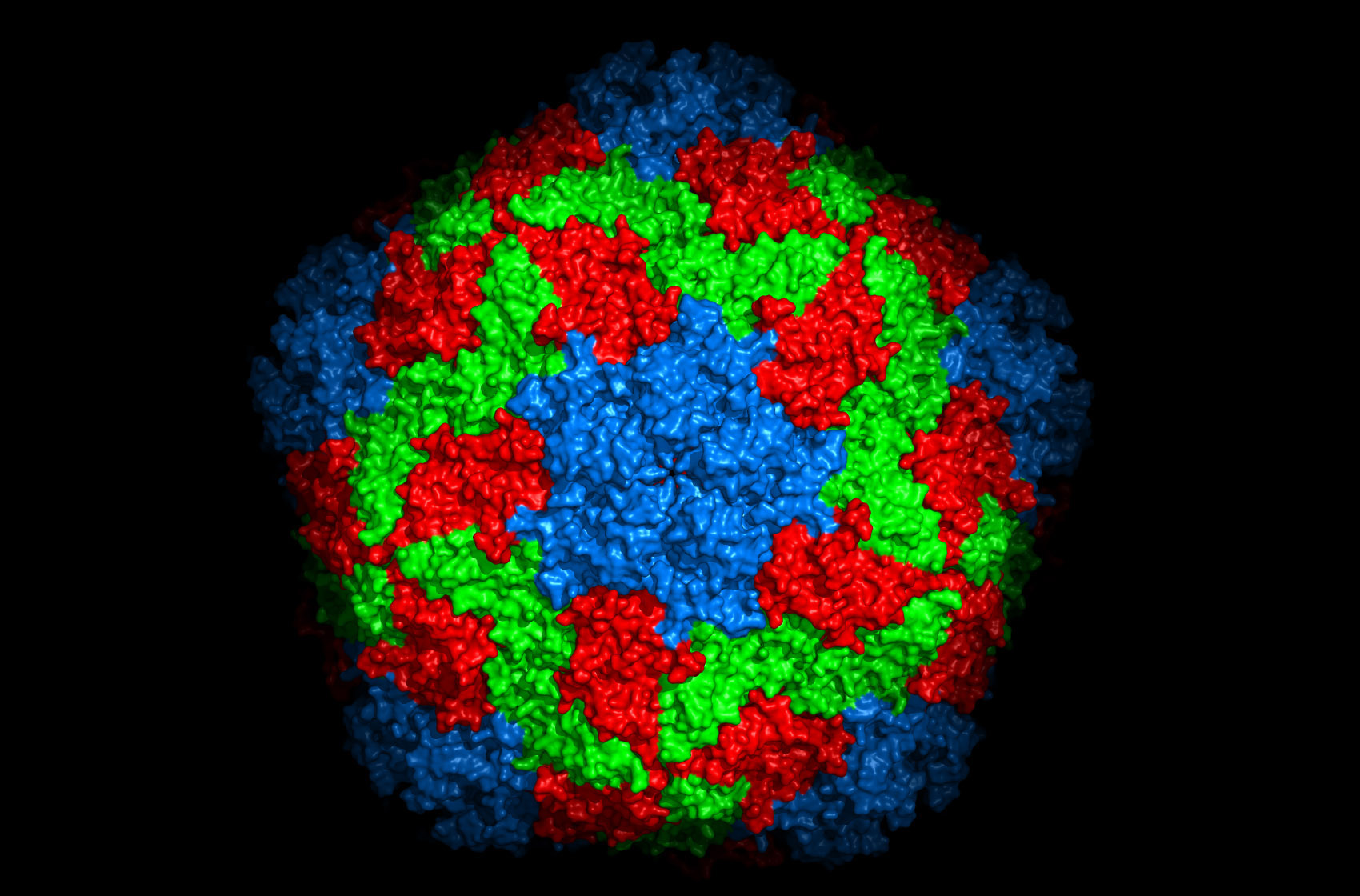
- Hep A Virus
- © Diamond Light Source 2014
Scientists have used advanced X-ray techniques at the UK’s synchrotron science facility, Diamond Light Source, to unravel the secrets of Hepatitis A: a virus that appears to be rather unique. Hep A has proved difficult to study in the past, but for the first time scientists have been able to determine the atomic structure of the virus. Their findings suggest that Hep A may be the evolutionary missing link between picornaviruses, which infect humans and animals, and some insect viruses.
Despite an effective vaccine, Hep A continues to infect 1.4 million people each year. It causes infection of the liver, and symptoms can include diarrhoea, vomiting, yellow skin, fever, and abdominal pain. Hep A is particularly hardy; unlike other viruses in the picornavirus family, which includes polio and the common cold, Hep A is able to withstand remarkably high temperatures and remain stable in hostile environments, making it difficult to control infection. It also has a unique enveloped form, whereby it shrouds itself in the host membrane, making it harder for the body’s immune system to detect.
But in an unprecedented step forward, a team of scientists from Beijing and Oxford have been able to determine the exact structure of Hepatitis A, down to the individual atoms. This new finding is a considerable advance for research into Hep A, and more broadly for our understanding of the virus world.
Having scrutinised the atomic structure of the virus, the team from the University of Oxford have concluded that Hep A possesses characteristics of both ancient insect viruses and modern human viruses such as polio. The methods by which it infects host cells, the very limited range of cells in which it thrives and the sheer stability of Hepatitis A all point towards it having somehow become stuck along the evolutionary trail. Where other picornaviruses developed into the structures we know today, Hepatitis A has remained forever frozen between the old and the new.
This discovery is ground-breaking for what it reveals about the history and evolution of viruses. Viruses are some of the oldest and most pervasive elements of the natural world. There are more viruses on Earth than all bacteria, plant and animal life combined, and they can evolve much faster than any living thing. Because they are so diverse and develop so quickly, it can be difficult to work out how they are related and how they evolved. Scientists know enough to group similar viruses into different families, but the question of their history and how these families came to exist in their current form has been very difficult to unravel.