


-
highlight
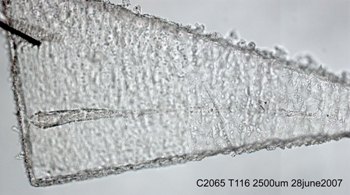
Liquid crystals are a state of matter that possesses some properties of liquids and some of solids. Their use in display screens is familiar, where the optical properties of the substance change in response to applied electric field. However, liquid crystals can form a wide range of very complex phases, and scientists have been using Diamond to study perhaps the most complex liquid crystal structure so far observed. This work has been published in the Journal of Materials Chemistry.
-
highlight
All living things propagate through the process of cell division. Histone proteins play a vital role in this complex process, but the exact molecular mechanisms that make it possible are not well understood. Histones act as spools for DNA, allowing it to wind around them to make compact packages that fit neatly into cells. Scientists from the European Molecular Biology Laboratory in Heidelberg, Germany, have been studying how histones interact with a chaperone protein to answer the ...
-
news
The new Diamond Light Source synchrotron was the star of the show at the prestigious Royal Academy of Engineering Soirée in Didcot last night (26 June). More than 150 distinguished guests including His Royal Highness the Duke of Kent, the Academy’s Royal Fellow, attended the dinner at the Rutherford Appleton Laboratory.
-
highlight
Shigella flexneri is a bacterium which causes dysentery, resulting in a million deaths worldwide every year. To infect humans, it uses a complex molecular machine which attaches itself to a host cell and uses a needle to pierce the cell membrane and deliver proteins that hijack cellular processes to facilitate infection. Scientists from the University of Oxford have been using Diamond to study how the machine identifies a host cell and triggers the transfer of proteins. This work is ...
-
highlight
DNA is constantly under attack. Within the human body there is an army of proteins which can detect when DNA has been damaged and attempt to repair it. One such protein is Helicase XPD.
-
news
Diamond has announced that USA-based global biotechnology company Vertex Pharmaceuticals Incorporated is the first industrial user at the UK's world class new research facility, Diamond Light Source.
-
highlight
During normal healthy cell division, the cell goes through a series of checkpoints to prevent abnormal or damaged cells from proceeding with division. But if one of these checkpoints is defective, chromosomal instability can result, leading to the growth of malignant cells. Scientists from the University of Manchester have been using Diamond to study a protein called Mps1, which regulates the number of chromosomes during the cell cycle, making it a potential target for new cancer treatments.
-
highlight
Multiferroics are materials in which ferroelectric and magnetic orders are closely related, opening the possibility for tuning the first one with the other and vice versa. This class of material has attracted recent interest for their potential applications in memory devices and other electronic components. In addition there is a drive from a more fundamental perspective - to understand the fundamental physics that give rise to these exotic properties. By combining x-ray diffraction studies ...
-
news
Diamond Light Source the UK's new synchrotron, this month announces the appointments of Professor David Stuart and Professor Trevor Rayment as Directors of Life Sciences and Physical Sciences respectively.
-
highlight
Professor Trevor Rayment and Dr Alison Davenport from the University of Birmingham have used the Microfocus Spectroscopy beamline I18 to carry out X-ray studies of corrosion that may help corrosion scientists understand the phenomenon of pit corrosion.