
• Diamond Home page
  • About
  • For Users
  • Public
  • Industry
  • Instruments
  • Careers
  • More Show more menu items
Search

About

  • About Diamond
  • About Synchrotrons
  • News and Features
  • Events
  • Contact Us
  • FAQ

For Users

  • Apply for beamtime
  • User guide
  • Diamond Users Commitee
  • FAQ
  • User Administration System
  • iSpyB

Industry

  • Techniques Available
  • Industry Research
  • Industry Case Studies
  • News
  • Meet the Industry Team

Science

  • Research
  • Computing
  • The Machine
  • Publications
  • Research Expertise
  • Membrane Protein Laboratory
  • Additional Facilities
  • Publications Database

Instruments

  • Biological Cryo-Imaging
  • Crystallography
  • Imaging and Microscopy
  • Macromolecular Crystallography
  • Magnetic Materials
  • Soft Condensed Matter
  • Spectroscopy
  • Structures and Surfaces

Diamond-II

  • Science
  • Machine
  • Beamlines
  • Software, Control and Computing
  • Infrastructure

Public

  • Public open days
  • School visits
  • Partner with Diamond
  • Explore Diamond

Procurement

  • Non-OJEU Tender Notices
  • OJEU PINs
  • OJEU Tender Notices
  • Registration Form

Careers

  • Vacancies
  • Info for applicants
  • Company Benefits
  • Apprenticeships
  • PhD Studentships
  • Work Placement

Main Content

A brighter light for science
Sub-navigation
  • About
  • Governance
  • Legal and Compliance
  • News and Literature
  • Events
  • Contact

In This Section

Sub Navigation
  • News and Science Highlights
  • Annual Review
  • Literature Reviews
  • Impact Case Studies
  • Press and media

Opportunities at Diamond

Learn more about career and student opportunities at Diamond:

Vacancies

Students

  1. Diamond Light Source
  2. News and Literature
  3. Annual Review
  4. Diamond Annual Review 2019
  5. Science Group Updates
  6. Structures and Surfaces Group

Structures and Surfaces Group

  • annual review
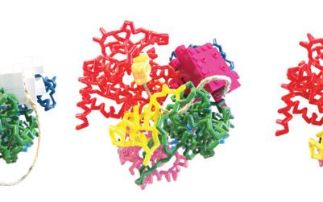
    Sweet Success: Crystal structure of the full-length GLP-1 receptor bound to a peptide agonist

    Sweet Success: Crystal structure of the full-length GLP-1 receptor bound to a peptide agonist Jun 1, 2018

    To design such small molecules, a detailed map of the interactions between GLP-1 and its receptor was needed.

  • annual review
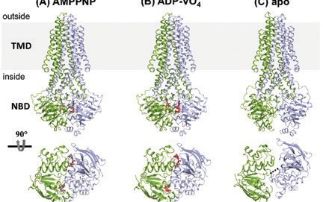
    Structural insights into the mechanism of bacterial ABC transporters

    Structural insights into the mechanism of bacterial ABC transporters Jun 1, 2018

    Bacteria utilise ATP-binding cassette (ABC) transporters to import nutrients and detoxify themselves. These transporters have been shown to exist in wide open conformations that permit the access of many substrates in the binding pocket.

  • annual review
    Structure of the surface layer surrounding Caulobacter crescentus bacteria

    Structure of the surface layer surrounding Caulobacter crescentus bacteria Jun 1, 2018

    Many types of single-celled microorganisms such as bacteria are covered with a protective outer layer of proteins known as the S-layer.

  • annual review
    How does an inspector call: structures of UGGT, the eukaryotic glycoprotein quality control checkpoint.

    How does an inspector call: structures of UGGT, the eukaryotic glycoprotein quality control checkpoint. Jun 1, 2018

    In all cells derived from animals, plants, fungi and protozoa a single protein called UGGT acts as a quality control checkpoint that inspects secreted glycoproteins.

  • annual review
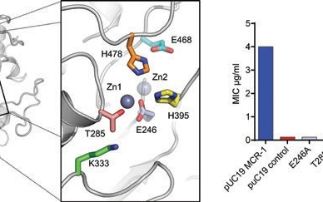
    Insights into the mechanism of colistin resistance from crystal structures of MCR-1

    Insights into the mechanism of colistin resistance from crystal structures of MCR-1 Jun 1, 2018

    Gram-negative bacteria that are extensively resistant to multiple antibiotics are an ever-increasing global threat. Colistin is an antibiotic used as the last line of defence against highly resistant Gram-negative bacteria. However, in recent years bacteria have emerged with resistance to this crucial antibiotic.

  • annual review
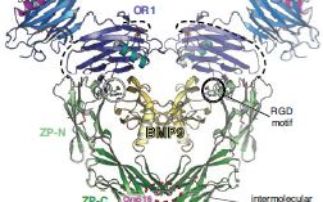
    How human endoglin captures its ligand BMP9

    How human endoglin captures its ligand BMP9 Jun 1, 2018

    Endoglin (ENG)/CD105 is a mammalian glycoprotein that is found in the membranes of cells that line blood vessels. It is essential for healthy heart development and blood vessel growth, but conversely it is also involved in preeclampsia and can help tumours establish their blood supply.

Chris Nicklin, Science Group Leader

The Structures and Surfaces Group consists of four beamlines: I05 (Angle Resolved Photoelectron Spectroscopy – ARPES), I07 (Surface and Interface X-ray Diffraction), B07 (Versatile Soft X-ray Scattering – VERSOX), and I09 (Atomic and Electronic Structure of Surfaces and Interfaces). There has been a great deal of activity this year; continuing to develop the beamlines, working closely with the user groups, and looking to the future opportunities enabled by the Diamond-II upgrade. The group held a successful workshop in September 2018, with a focus on Diamond-II and the new science that could be enabled including potential new techniques or beamlines. Outcomes from the workshop were incorporated into the science case for the upgrade, highlighting in particular the important role that surfaces and interfaces play in broader research areas such as battery technology, photovoltaic structures, and catalytic/electrochemical systems under operando conditions. Expanding the techniques to these communities is a key objective for the group. Read more
  • annual review
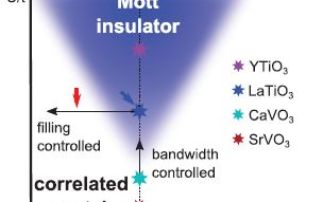
    Teaching 'failed metals' new tricks

    Teaching 'failed metals' new tricks Jul 30, 2019

    A new class of electronic devices, often referred to by the term Mottronics, is based on charge correlations between the electrons. Transition metal oxides exhibit fascinating phenomena such as the Mott metal-to-insulator transitions, electronic phase transitions that are of potential interest for future device applications. However, further progress in material development is required to make high quality thin films of prototypical Mott materials available, and to establish methods to ...

  • annual review
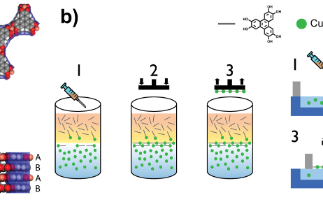
    X-rays help to unravel the structure and orientation of semiconductive porous ultrathin films

    X-rays help to unravel the structure and orientation of semiconductive porous ultrathin films Jul 30, 2019

    Electrically conductive Metal-Organic Frameworks (MOFs) are promising materials for electronic devices, owing to their unique capability to adsorb guest molecules. Processing them as ultrathin films is one of the key requirements for the development of electronic devices, and might offer new perspectives in fields of key environmental value such as photovoltaics, photocatalysis or sensing.

  • annual review
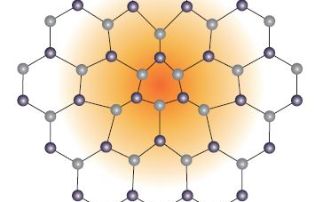
    A quantum bead rolling on a lattice cushion

    A quantum bead rolling on a lattice cushion Jul 30, 2019

    If you imagine a solid bead rolling on a soft cushion, it leaves distortions in the cushion in its wake. Transfer this analogy to the quantummechanical realm, and the condensed matter physics version of the rolling bead is a polaron. Holstein polarons are small composite particles composed of an electron dragging a cloud of lattice distortions. Although they were predicted to play a key role in high-temperature superconductivity and solar cells, the spectroscopic signature of Holstein ...

  • Contact Us
  • About Diamond Light Source
  • Procurement
  • Supply Chain Transparency
  • Cookie Policy
  • Website Terms of Use
  • Privacy Notice

Diamond Light Source

Diamond Light Source is the UK's national synchrotron science facility, located at the Harwell Science and Innovation Campus in Oxfordshire.

Follow us on Facebook Follow us on Linkedin Follow us on Instagram Follow us on Bluesky

Diamond Light Source Ltd
Diamond House
Harwell Science & Innovation Campus
Didcot
Oxfordshire
OX11 0DE

See on Google Maps

Copyright © Diamond Light Source. Diamond Light Source® and the Diamond logo are registered trademarks of Diamond Light Source Ltd

Registered in England and Wales at Diamond House, Harwell Science and Innovation Campus, Didcot, Oxfordshire, OX11 0DE, United Kingdom. Company number: 4375679. VAT number: 287 461 957. Economic Operators Registration and Identification (EORI) number: GB287461957003.

feedback